The Colombo Family: Blood Feuds and FBI Rats
The Colombo family fought three separate internal wars over six decades, produced more FBI informants than any other New York family, and demonstrated what happens when succession disputes in a criminal organization can never be fully resolved.
The Colombo Family: Blood Feuds and FBI Rats
Of the five New York crime families, the Colombo family has spent the most time in the past fifty years at war with itself — and the internal conflicts are not incidental to the Colombo story.^1^ Three distinct internal power struggles produced multiple murders, several FBI informants, and periods in which the family was functionally ungovernable. Understanding why a criminal organization repeatedly fractures along internal fault lines, and what that fracturing costs, is the central lesson the Colombo family’s history has to teach.
Part of The Five Families — ← Back to series hub
The Profaci Family’s Culture of Extraction Set the Pattern for Everything After
The Colombo family traces its origins to the Profaci family, led by Joe Profaci from the early 1930s through his death in 1962. Profaci was one of the founding members of the Commission in 1931 and ran his organization in Brooklyn with the combination of religious piety — he was a major donor to Brooklyn Catholic churches — and predatory extraction that characterized his management style. He taxed his own members heavily, demanded tribute on every criminal transaction, and used violence against members who questioned the arrangement.
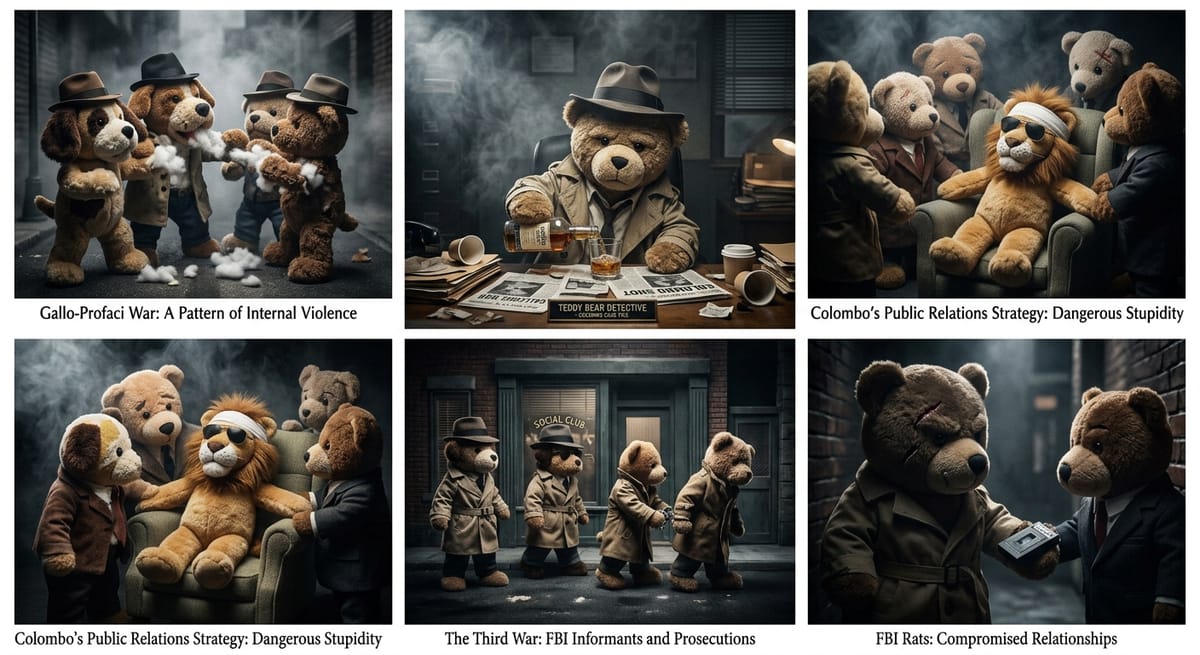
The Gallo brothers — Larry, Albert “Crazy Joe,” and Kid Blast — challenged Profaci’s authority in 1961, initiating a series of kidnappings of senior family members and a prolonged guerrilla conflict known as the Gallo-Profaci War that continued through Profaci’s death in 1962 and into the tenure of his successor Joseph Magliocco. The war produced at least twelve murders and established a pattern of internal violence that would repeat with variations across the next four decades.
Magliocco, Profaci’s successor, was himself removed from power in late 1963 after a Commission investigation found that he and Joseph Bonanno had conspired to murder Carlo Gambino and Tommy Lucchese. Magliocco avoided execution by cooperating with the Commission’s inquiry, was fined, and died of natural causes in December 1963. The Commission then installed Joseph Colombo — a capo, not the obvious internal candidate — as boss.
Why Joe Colombo’s Civil Rights Strategy Was the Most Dangerous Thing He Could Have Done
Joseph Colombo’s tenure produced the most surreal public relations episode in the history of American organized crime. In 1970, Colombo founded the Italian-American Civil Rights League, a grassroots organization that claimed the FBI’s investigation of organized crime was bigoted targeting of Italian-Americans. The League held rallies, picketed FBI offices, and organized a Unity Day festival in Columbus Circle in Manhattan on June 28, 1970, drawing an estimated 50,000 people. Carlo Gambino refused to participate and privately regarded the entire enterprise as dangerous stupidity.^1^
At the second Unity Day rally, on June 28, 1971, Colombo was shot three times in the head by Jerome Johnson, a Black activist who approached him with press credentials. Johnson was immediately shot and killed by an unidentified gunman in the crowd. Colombo survived in a vegetative state for seven years before dying in 1978. Johnson’s connection to the Gallo faction — Crazy Joe Gallo had cultivated relationships in Black criminal networks during his prison years — was widely assumed but never definitively proven. Gallo himself was murdered on April 7, 1972, shot at Umberto’s Clam House in Little Italy on the night of his birthday, in what appeared to be a Colombo family retaliation.
The episode illustrates the organizational cost of Colombo’s public-facing strategy. His Unity Day events made the FBI’s investigation politically complicated for a brief period, but they also made Colombo personally visible at a time when organized crime leadership depended on invisibility, invited scrutiny of his own criminal activities, and generated internal family opposition significant enough that his own underboss may have facilitated his murder.
The Third War Gave the FBI Everything It Needed to Prosecute Both Sides
The Colombo family’s most damaging internal conflict occurred between 1991 and 1993. Carmine “the Snake” Persico, who had become boss in 1973 and maintained control of the family throughout his imprisonment beginning in 1985, designated his son Alphonse as acting boss while he served a 100-year sentence. The family’s street operations were actually managed by acting boss Victor Orena, installed in that role in 1988. Orena concluded that Persico was using the family’s resources to support his imprisoned leadership at the family’s expense and moved to take control permanently.
The resulting conflict — three murders on June 20, 1991 alone — lasted approximately eighteen months and produced over a dozen deaths. The FBI, monitoring the family’s communications and benefiting from multiple informants within both factions, gathered enough evidence to prosecute essentially the entire leadership of both sides. By the time the government was finished, Orena had been convicted of murder and racketeering in 1992, sentenced to three life terms. The Persico faction’s senior figures were prosecuted in the mid-1990s. Carmine Persico remained imprisoned and was designated by his loyalists as the official boss until his death in prison in 2019 at age eighty-seven.^1^
How the Colombo Family Produced More FBI Informants Than Any Other New York Organization
The Colombo family produced more significant FBI informants than any other New York family. The internal conflicts created conditions in which members and associates facing prosecution had strong incentives to cooperate, both because they were already in danger from within the family and because cooperation offered protection from prosecution.
The most significant was Gregory Scarpa Sr., known as “the Grim Reaper,” who was a Colombo family capo and simultaneously an FBI informant from the 1960s through the 1990s. Scarpa’s relationship with FBI agent R. Lindley DeVecchio — in which Scarpa provided information about family operations while DeVecchio allegedly provided Scarpa with information about rivals and targets — resulted in DeVecchio’s indictment in 2006 on charges that he had facilitated murders. The case collapsed in 2007 when a key witness was impeached, but the episode documented one of the most compromised FBI-informant relationships in organized crime history.^2^ Scarpa participated personally in at least seven murders while simultaneously serving as a source for some of the government’s most significant Colombo family prosecutions.
The Colombo family’s recurring internal conflicts are not a sign of uniquely dysfunctional leadership, though the individual bosses made choices that worsened their situations. They reflect structural features of criminal organizations: disputes over tribute and allocation that can’t be resolved through legitimate contract enforcement, succession conflicts that have no neutral arbitration mechanism, and the always-present possibility that internal enemies will cooperate with the government. The Genovese family avoided similar conflicts through leadership continuity and extreme discretion. The Gambino family’s internal conflict under Gotti came from a similar source but was resolved by the FBI before the family could resolve it internally. The Colombo family’s conflicts were longer, bloodier, and more damaging because the underlying disputes about leadership legitimacy were genuine and unresolved.
By the 2010s, the Colombo family was assessed by the FBI as significantly reduced in membership and revenue, with remaining operations concentrated in gambling and loan sharking in Brooklyn. The wars had cost more than they could have been worth.
─────────
Sources:
- Raab, Selwyn. Five Families: The Rise, Decline, and Resurgence of America’s Most Powerful Mafia Empires. St. Martin’s Press, 2005.
- Capeci, Jerry. The Complete Idiot’s Guide to the Mafia. Alpha Books, 2002.
- Olmstead, Marya. The Good Guys: How We Turned the FBI ‘Round — and Finally Broke the Mob. Simon & Schuster, 1994.
- DeVecchio, R. Lindley, and Charles Brandt. We’re Going to Win This Thing: The Shocking Frame-Up of a Mafia Crime Buster. Berkley, 2011.