The Lucchese Family: The Quiet Power
The Lucchese family ran the Lufthansa heist and controlled the JFK cargo operation and the garment district for decades — outlasting rivals by staying out of the papers and making the FBI earn every conviction.
The Lucchese Family: The Quiet Power
The Lucchese family never had a John Gotti. It never had an Albert Anastasia who ordered murders impulsively, a Vito Genovese who convened national crime summits and got caught, or a Joe Colombo who organized a civil rights protest march in his own family’s name and got shot at it. The Luccheses spent most of their history being the organized crime family that federal law enforcement found hardest to penetrate and the press found least interesting to cover — and that combination of low public profile and high operational security made the family one of the most enduring criminal organizations in twentieth-century America.^1^
Part of The Five Families — ← Back to series hub
What Made the Lucchese Family Different from Its More Famous Competitors
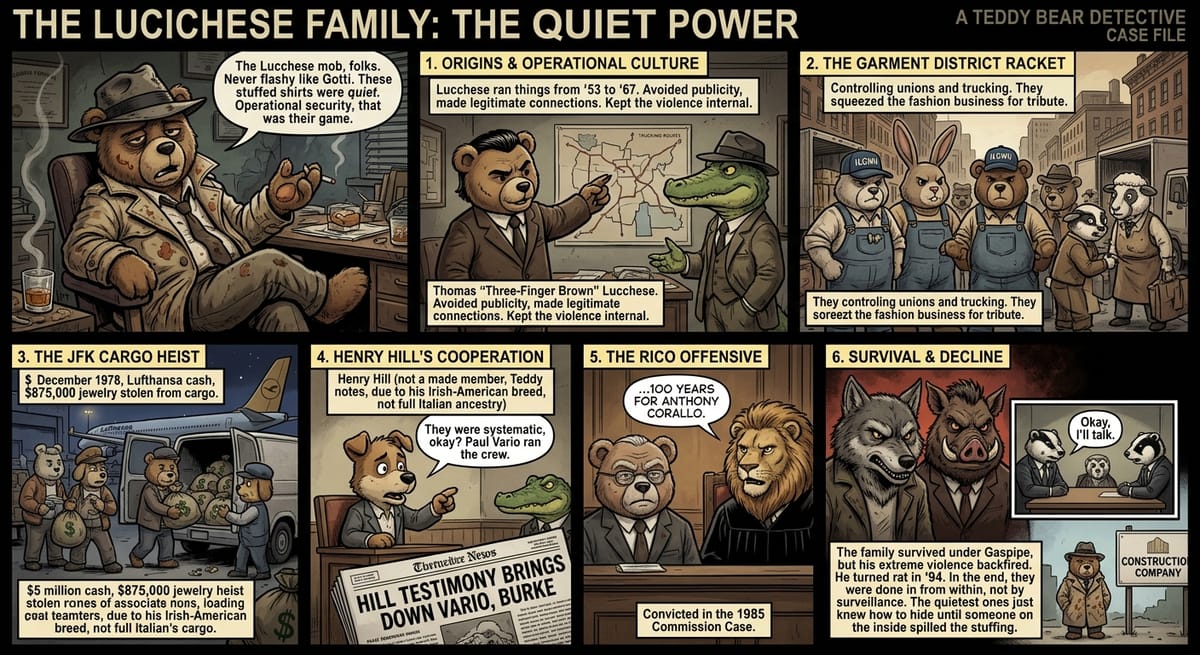
The Lucchese family traces its origins to the Reina family, which operated in the East Harlem and Bronx neighborhoods of Manhattan under Gaetano Reina through the 1920s. Reina was murdered in February 1930, a casualty of the Castellammarese War, and the family passed through several leadership transitions before coming under the control of Thomas “Three-Finger Brown” Lucchese, a Bronx-born capo who had risen through the organization over two decades.
Lucchese ran the family from 1953 to his death in 1967, establishing the operational culture that defined it for the following decades. His approach — cultivate legitimate business fronts, maintain political connections, keep violence minimal and internal, avoid publicity — produced a family that generated significant revenue from garment district racketeering, construction, and airport cargo theft while attracting far less law enforcement attention than its more visible competitors.^1^
By the 1980s, FBI estimates put the Lucchese family at roughly 115 made members and several hundred associates, making it mid-sized among the five families but with a reach that extended from Queens and the Bronx into New Jersey, Connecticut, and Pennsylvania.
Two Revenue Streams That Defined the Family Across Multiple Generations
Two operations defined the Lucchese family’s economic base. The first was the garment industry. New York City’s garment district had been organized crime territory since the 1930s, when labor racketeers discovered that controlling the International Ladies’ Garment Workers’ Union locals and the trucking companies that moved goods between manufacturers gave them leverage over the entire production chain. The Lucchese family controlled specific locals and specific trucking routes for decades, extracting tribute from manufacturers who needed goods moved and contractors who needed peace on the shop floor.
The second major revenue stream was John F. Kennedy International Airport and specifically the cargo facilities where imported goods arrived and were distributed. The Lucchese family, through control of specific Teamster locals and cargo handlers’ unions, managed systematic theft from the JFK cargo operation beginning in the 1960s. In December 1978, a crew of Lucchese associates pulled off what was then the largest cash robbery in American history: the Lufthansa heist at JFK, stealing $5 million in cash and $875,000 in jewelry from the Lufthansa cargo building. The crew was organized by Lucchese capo Paul Vario and included Henry Hill, whose later cooperation with the FBI provided the prosecution evidence that dismantled that wing of the family and whose memoir was the basis for the 1990 film GoodFellas.^2^
How Henry Hill’s Cooperation Mapped the Family for Federal Prosecutors
Henry Hill was not a made member of the Lucchese family — he was Irish-American, which made formal membership impossible under the family’s rules requiring full Italian ancestry. He was an associate working under Vario’s crew, involved in the Lufthansa heist along with Jimmy Burke and approximately fifteen other individuals. In the aftermath of the robbery, most of the participants were murdered by Jimmy Burke, apparently to eliminate witnesses and reduce the number of people who needed to be paid.
In 1980, Hill was arrested on drug trafficking charges in an unrelated investigation and turned government witness, entering the federal witness protection program. His testimony helped convict Paul Vario and Jimmy Burke and provided investigators with a detailed map of Lucchese family operations in the outer boroughs and at JFK. The Lufthansa case took years to fully prosecute because of the gaps left by Burke’s post-robbery murder campaign, but Hill’s cooperation was extensive and damaging.
The broader federal RICO offensive of the mid-1980s hit the Lucchese family hard, as it hit all five families. Boss Anthony Corallo was among the defendants in the 1985 Commission Case — the landmark prosecution that used RICO to charge the bosses of four of the five families with a single conspiracy — and was convicted in 1986, sentenced to 100 years. He died in federal prison in 2000.
Why the Family Survived RICO When Others Collapsed
The Lucchese family’s response to the RICO prosecutions followed a pattern that distinguished it from some competitors: the organization continued functioning under new leadership rather than fragmenting. Vittorio Amuso became boss in 1986 and was later convicted in 1992 on murder and racketeering charges, serving a life sentence. Anthony “Gaspipe” Casso, the underboss, was one of the most feared figures in New York organized crime — known for extreme personal violence and a willingness to order murders with less deliberation than other bosses considered prudent. Casso eventually became a government witness in 1994, a cooperation that produced extensive information about Lucchese family operations and implicated two NYPD detectives, Louis Eppolito and Stephen Caracappa, in murders committed on the family’s behalf. Eppolito and Caracappa were convicted in 2006.^3^
The family continued operating under acting leadership throughout the 1990s and 2000s, with periodic prosecutions reducing active membership but never eliminating the organization. By the 2010s, FBI assessments described the Lucchese family as significantly diminished but still functioning, with remaining revenue concentrated in construction, garbage hauling, and gambling operations in New Jersey.
The FBI’s penetration of the Lucchese family came largely through insider cooperation — Henry Hill, Anthony Casso — rather than through surveillance of known meeting places, because the family’s operational security made external surveillance difficult. When those insiders were turned, the damage was significant. But the organization’s low cultural profile meant that political pressure for prosecution was lower than it was for families like the Gambino family whose bosses appeared in tabloid photographs. The Genovese family and the Lucchese family shared the same operating principle: the less the public knows you exist, the less pressure there is to take you down. The Lucchese family lasted as long as it did not because it was the most powerful, but because it was the most careful.
─────────
Sources:
- Pileggi, Nicholas. Wiseguy: Life in a Mafia Family. Simon & Schuster, 1985.
- Raab, Selwyn. Five Families: The Rise, Decline, and Resurgence of America’s Most Powerful Mafia Empires. St. Martin’s Press, 2005.
- Capeci, Jerry. The Complete Idiot’s Guide to the Mafia. Alpha Books, 2002.
- Casso, Anthony, with Peter Moses. Gaspipe: Confessions of a Mafia Boss. HarperCollins, 2008.