Lucky Luciano: The Man Who Organized Crime
Lucky Luciano reorganized New York's criminal underworld in 1931, created the Commission, and built the structure the American Mafia followed for the next fifty years.
Lucky Luciano: The Man Who Organized Crime
Lucky Luciano didn’t build organized crime from nothing — he reorganized what already existed, killed the men who couldn’t be persuaded to adapt, and created a corporate structure for criminal enterprise that outlasted Prohibition, outlasted him personally, and established the basic architecture of the American Mafia for the next fifty years.^1^ The nickname came from the night they left him for dead on a Staten Island beach in October 1929, beaten, stabbed, and with his throat slashed. He survived. The alternative interpretation — that he had staged his own kidnapping and survived through calculation rather than luck — was more complicated and arguably more accurate.
Part of Prohibition-Era Organized Crime — ← Back to series hub
How He Built His Network Before Anyone Else Saw What It Could Become
Born Salvatore Lucania on November 24, 1897, in Lercara Friddi, Sicily, Luciano immigrated with his family to New York in 1906, settling on Manhattan’s Lower East Side. He was arrested for the first time at age eighteen, in 1916, for heroin distribution — the same year he met Meyer Lansky and Benjamin Siegel, two Jewish teenagers from the neighborhood with whom he formed a partnership that persisted for decades. The multiethnic composition of his inner circle — Italian, Jewish, and eventually Irish — was not accidental. Luciano recognized that the ethnic tribalism of traditional organized crime created inefficiencies and operated on the principle that competence mattered more than ancestry.
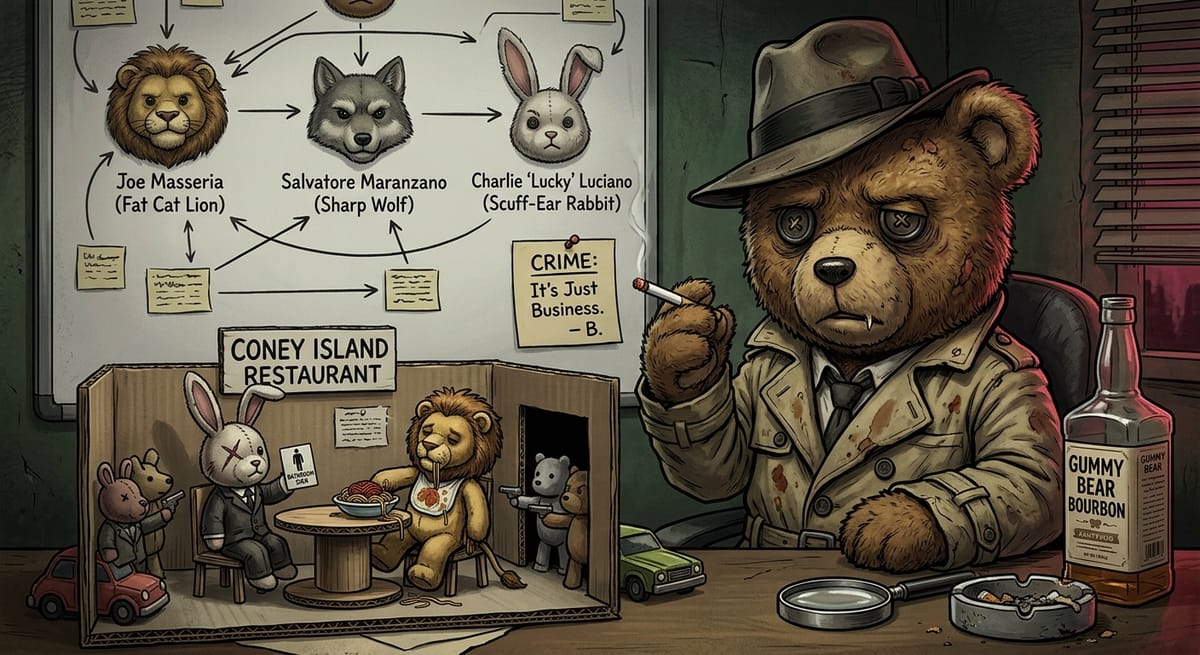
Through the 1920s, he worked within Joe “the Boss” Masseria’s organization, rising to senior lieutenant while simultaneously building relationships with members of a rival faction led by Salvatore Maranzano. The “Castellammarese War” of 1930 to 1931 — a conflict that killed dozens of men and paralyzed New York’s criminal operations for nearly two years — ended when Luciano arranged for Masseria to be shot to death in a Coney Island restaurant on April 15, 1931, with Luciano himself excusing himself to use the bathroom before the gunmen entered.
With Masseria dead, Maranzano declared himself “Boss of Bosses” and reorganized the families into the five-family structure that still nominally defines New York organized crime today. Then, on September 10, 1931, five months after Masseria’s murder, Maranzano was killed in his Park Avenue office by four men disguised as IRS agents. The story that followed — that Luciano ordered simultaneous murders of old-guard bosses across the country in what was called the “Night of the Sicilian Vespers” — appears to be largely myth, the body count dramatically exaggerated. What actually happened was simpler: Luciano eliminated both men above him and emerged as the most powerful figure in New York organized crime without holding any title that could be prosecuted.
The Commission Was His Most Important Structural Achievement
The Commission, established in 1931 at a meeting of major organized crime figures from across the country, was Luciano’s most significant legacy. Before it, disputes between organized crime families were resolved through war, which was expensive, lethal, and generated law enforcement attention that hurt everyone. The Commission created a forum for dispute resolution, set rules for conduct that all affiliated families were expected to follow, and provided a mechanism for collective decisions on issues affecting the whole enterprise.^1^
The founding members included Luciano representing the Genovese family, Vincent Mangano of the Gambino family, Joseph Profaci of the Colombo family, Joseph Bonanno, Chicago’s Frank Nitti representing the Capone organization, and representatives from Buffalo, Cleveland, and Detroit. The Commission was not a democracy. It was closer to a cartel agreement, with the understood sanction that defectors could be killed. But it worked, largely, for several decades.
The governing principle Luciano established was that the Commission would arbitrate but not rule — families remained autonomous within their territories, and the Commission’s authority extended to cross-family disputes and actions that affected everyone. The decision to kill Dutch Schultz before Schultz could murder prosecutor Thomas Dewey in 1935 was a Commission decision, made on exactly the grounds Luciano had established: some actions, regardless of their immediate utility, were too dangerous for the collective to permit.
Why His Conviction Led to a Wartime Deal That Got Him Deported
In 1936, Thomas Dewey — the same prosecutor Schultz had wanted killed — successfully prosecuted Luciano on sixty-two counts of compulsory prostitution, producing a sentence of thirty to fifty years. Luciano denied personal involvement in the prostitution operation and maintained the denial for the rest of his life. Whether he was directly responsible or whether Dewey oversold the connection is still debated.
He served nine years at Dannemora and Great Meadow prisons before his sentence was commuted in 1946 by Governor Thomas Dewey — the same man who had prosecuted him.^2^ The commutation came after Luciano allegedly cooperated with U.S. Naval Intelligence during World War II, providing assistance for the Sicily invasion and helping prevent labor unrest on the New York docks. The extent of his actual contribution remains disputed; the Navy’s own records are ambiguous. What is established is that the commutation was unusual, politically controversial, and came with the condition of deportation to Italy.
He arrived in Italy in February 1946 and spent the rest of his life attempting to maintain his American criminal connections from Naples and later from Rome. He was barred from returning to the United States and rejected by the Cuban government in 1947 after pressure from the U.S. State Department. He died of a heart attack at Naples International Airport on January 26, 1962, at age sixty-four, reportedly while meeting with a film producer who wanted to make a movie about his life.
The Management Structure He Built Outlasted Everything
Luciano’s lasting contribution to American organized crime wasn’t any specific racket — it was the management structure. The five-family system created stable territorial boundaries that reduced internal conflict. The Commission provided a mechanism for coordination without requiring centralization. The principle that criminal organizations should be run like businesses — with clear hierarchies, role definitions, and rules of conduct — became the template the American Mafia followed for the next half-century.
Federal prosecutors eventually dismantled much of what he built through RICO prosecutions in the 1980s, using the statute he never had to face to dismantle the Commission itself through the “Commission Case” concluded in 1986, when the bosses of four of the five families were convicted on a single conspiracy indictment. The Commission as a functioning institution effectively ended with those convictions. What Luciano had understood — that organized crime functioned best when its internal disputes were managed rather than fought out in the streets — turned out to be correct as a business principle. What he hadn’t anticipated was that the same organizational coherence that made the Commission effective also made it easier to prosecute as a single enterprise.
─────────
Sources:
- Lacey, Robert. Little Man: Meyer Lansky and the Gangster Life. Little, Brown, 1991.
- Raab, Selwyn. Five Families: The Rise, Decline, and Resurgence of America’s Most Powerful Mafia Empires. St. Martin’s Press, 2005.
- Gosch, Martin A., and Richard Hammer. The Last Testament of Lucky Luciano. Little, Brown, 1975.
- Dewey, Thomas E. Twenty Against the Underworld. Doubleday, 1974.