The Bonanno Family: Donnie Brasco and the Mob's Worst Nightmare
The Bonanno family had an FBI agent proposed for associate membership in 1981 and its sitting boss cooperate against his own family in 2004 — forty years of compounding damage that left it the weakest of the five families.
The Bonanno Family: Donnie Brasco and the Mob’s Worst Nightmare
The FBI agent who spent six years inside the Bonanno family went by the name Donnie Brasco. His real name was Joseph D. Pistone, a special agent from New Jersey who had grown up around Italian-American communities and spoke the vernacular fluently enough to pass as a jewel thief from out of town. Operation Donnie Brasco ran from 1976 to 1981, and by the time Pistone was pulled out, he had documented enough evidence to support more than 100 convictions and had mapped the Bonanno family’s organizational structure in granular detail.^1^ The Bonanno family never fully recovered.
Part of The Five Families — ← Back to series hub
How the Banana War Weakened the Family Before the FBI Arrived
The Bonanno family was founded by Joseph Bonanno, a Sicilian immigrant born in 1905 who arrived in the United States via Cuba after fleeing Sicily in 1924, when Mussolini’s crackdown on the Mafia forced many figures to emigrate. Bonanno became one of the youngest bosses in organized crime history when he assumed control of his family at approximately age twenty-six in 1931, following Lucky Luciano’s reorganization, and maintained that position through three decades of relative stability.
His downfall came from his own ambitions. In 1963, Bonanno allegedly conspired with Joe Magliocco to murder Carlo Gambino and Tommy Lucchese — the same conspiracy that ended Magliocco’s leadership of the Colombo family. The Commission, discovering the plot, summoned Bonanno to account for himself. On October 21, 1964, on Park Avenue in Manhattan, Bonanno was “kidnapped” by two men with guns — accounts differ on whether this was a genuine abduction by Commission enforcers or a staged disappearance by Bonanno to avoid the summons. He was absent for nineteen months and returned in 1966 to find his family in conflict and the Commission prepared to remove him formally.
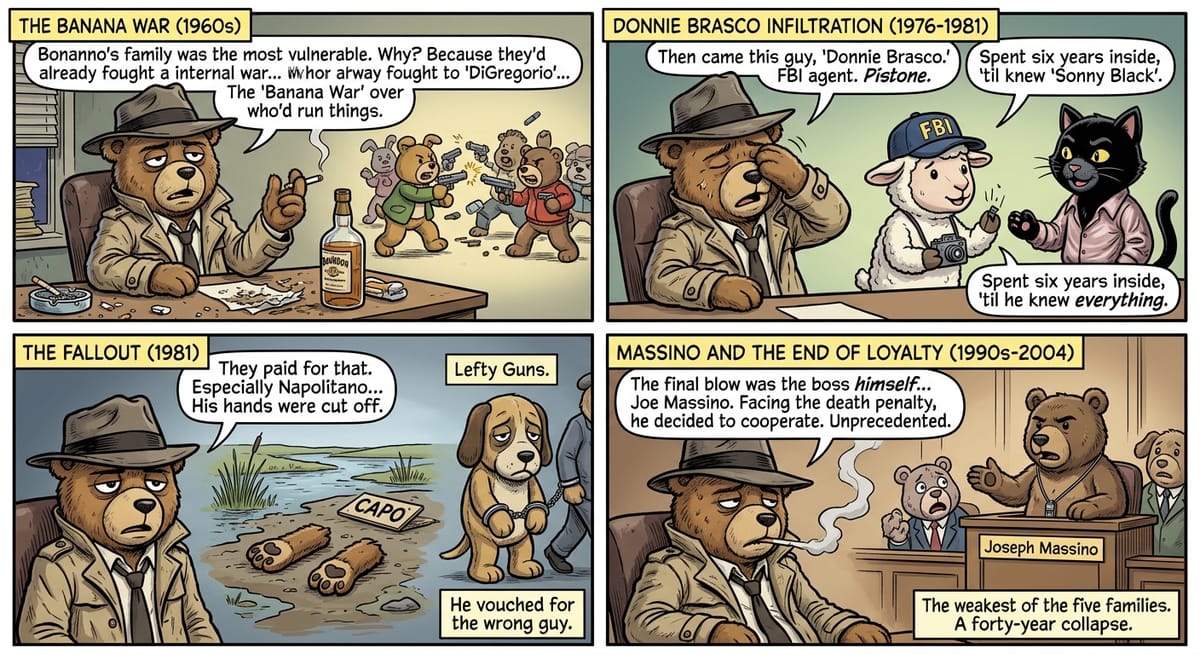
The succession battle known as the “Banana War” — after Bonanno’s nickname “Joe Bananas” — lasted from 1964 through 1969 and produced approximately a dozen killings between factions loyal to Bonanno and those aligned with Gaspar DiGregorio, his cousin, whom the Commission had installed as the alternative leader. Bonanno retired to Tucson, Arizona, in 1968, wrote a memoir published in 1983 in which he discussed the Mafia with an openness that horrified the families he’d been part of, and died in 2002 at age ninety-seven — the only original Commission member to die a free man of old age in the United States.
Why the Bonanno Family’s Weaknesses Made It the Most Penetrable Organization in New York
Joseph Pistone’s infiltration of the Bonanno family remains the most successful undercover operation in the history of American organized crime, and it was made possible by specific vulnerabilities in the Bonanno organization that didn’t exist to the same degree in other families.
The Bonannos, weakened by the Banana War and subsequent Commission sanctions that had reduced their status and membership, were less selective in vetting new associates than healthier organizations. Pistone made initial contact in 1976 through connections in the New York jewelry theft underworld, presenting himself as a fence with stolen goods to sell and money to invest. He cultivated Dominick “Sonny Black” Napolitano, a Bonanno capo, as his primary contact and through him gained access to the family’s operations in Florida, the West Coast, and New York over the next five years.^1^
By 1981, Pistone had been introduced to virtually every significant figure in the Bonanno family and had accompanied members on activities that constituted federal crimes. When he was extracted in July 1981, the Bonannos discovered that Donnie Brasco had been a federal agent. Napolitano, who had sponsored Pistone and was therefore responsible for the security breach, was murdered in August 1981. His hands were cut off — the traditional penalty for a capo who had vouched for a government informant. His remains were found in a Staten Island marsh in 1982. Capo Benjamin “Lefty Guns” Ruggiero, who had been Pistone’s primary day-to-day sponsor, was convicted in 1982 and sentenced to fifteen years.
The Commission Case and the Boss Who Eventually Cooperated Against His Own Family
The Commission Case — United States v. Salerno, tried in the Southern District of New York — indicted the bosses of four of the five New York families on a single RICO conspiracy, arguing that the Commission itself was a criminal enterprise. Bonanno family boss Philip “Rusty” Rastelli was among the defendants. The jury convicted on all counts in November 1986. Rastelli was sentenced to twelve years and died in prison of liver cancer in 1991.^2^
A series of bosses cycled through the position with various convictions following, until Joseph Massino became boss in 1991 and ran the family through careful operational security that produced a period of relative stability and growth in the 1990s. Massino’s tenure ended in 2003 when he was arrested on racketeering charges and faced the prospect of a death sentence for the murder of three capos. In 2004, he made a decision that no sitting boss of a New York family had previously made: he became a government cooperating witness. His testimony was extensive, mapping the family’s operations from 1991 onward in detail that no external investigation could have assembled. In exchange, the government agreed not to seek the death penalty and eventually dropped the murder charges.
The Bonanno family’s continued existence after Massino’s cooperation, with Vincent Basciano serving as acting boss while Massino cooperated against him, represented the most complete collapse of institutional loyalty in the history of the five families.
What Forty Years of Compounding Damage Looks Like From the Inside
Pistone’s operation and Massino’s cooperation, separated by twenty-five years, together demonstrated that the Bonanno family’s security culture was fundamentally compromised. Pistone had shown that the family’s vetting procedures could be defeated by a patient, skilled undercover operative. Massino showed that even the boss, facing sufficient personal legal jeopardy, might choose self-preservation over institutional loyalty.^1^
The Bonanno family that emerged from these twin betrayals was a significantly diminished organization, with reduced membership, reduced revenue, and reduced standing among the other families. FBI assessments in the 2010s described it as the weakest of the five families — a contrast with the Genovese family, which maintained operational discipline across every leadership transition, and the Lucchese family, which stayed quiet enough to avoid the same level of external pressure. The Commission sanctions imposed after the Banana War, the damage of the Donnie Brasco investigation, the Commission Case convictions, and Massino’s cooperation compounded across forty years into an organization that had been structurally weakened at every level.
Joseph Pistone, after being extracted from the operation in 1981, continued working for the FBI and later wrote about the operation in Donnie Brasco: My Undercover Life in the Mafia, published in 1988. He has lived under an assumed name, with a reported $500,000 bounty placed on his life by organized crime figures, since leaving the operation.
─────────
Sources:
- Pistone, Joseph D., with Richard Woodley. Donnie Brasco: My Undercover Life in the Mafia. New American Library, 1988.
- Raab, Selwyn. Five Families: The Rise, Decline, and Resurgence of America’s Most Powerful Mafia Empires. St. Martin’s Press, 2005.
- Bonanno, Joseph, with Sergio Lalli. A Man of Honor: The Autobiography of Joseph Bonanno. Simon & Schuster, 1983.
- Capeci, Jerry. The Complete Idiot’s Guide to the Mafia. Alpha Books, 2002.