The Genovese Family: The Most Powerful Mob in America
The Genovese family has been the most powerful of New York's five crime families across multiple bosses and eras — built on waterfront labor racketeering and a culture of strategic restraint that kept it operational long after its rivals declined.
The Genovese Family: The Most Powerful Mob in America
The Genovese family has been described, by FBI analysts and organized crime historians alike, as the most powerful and sophisticated of New York’s five crime families — and that description has held across multiple eras and multiple leadership transitions, which is evidence of something structural rather than merely biographical.^1^ Other families rose and fell with their bosses. The Genovese family was powerful under Frank Costello, powerful under Vito Genovese after him, powerful under Vincent “Chin” Gigante after him, and remained a functioning criminal enterprise into the early twenty-first century.
Part of The Five Families — ← Back to series hub
How the Family Was Built and Why Size Alone Doesn’t Explain Its Durability
The Genovese family traces its lineage to Lucky Luciano’s reorganization of New York organized crime in 1931. The family was first led by Luciano himself, then by Frank Costello during the years Luciano spent in prison and after his deportation to Italy in 1946.
The family has always been the largest of the five New York organizations in terms of membership. FBI estimates in the 1990s put active members and associates in the hundreds, with significant presence in New York, New Jersey, and Connecticut. Scale matters because larger organizations can maintain multiple revenue streams simultaneously, absorb the loss of individual leaders without organizational collapse, and apply pressure across more markets than smaller competitors. But scale alone doesn’t explain the Genovese family’s persistence — the Gambino family had more members at its peak and declined far faster.
Three Sources of Power That Compounded Over Decades
The Genovese family’s power derived from sources that built on each other over time. The first was early dominance in labor racketeering, specifically in the waterfront unions along the New York and New Jersey docks. Frank Costello, who ran the family as acting boss through much of the 1940s and 1950s, was less interested in bootlegging or gambling than in the kind of institutional corruption that embedded the family in legitimate economic structures — union pension funds, construction contracts, civil government. The International Longshoremen’s Association, which controlled hiring on the docks from the 1930s onward, was deeply infiltrated by Genovese family associates.^1^
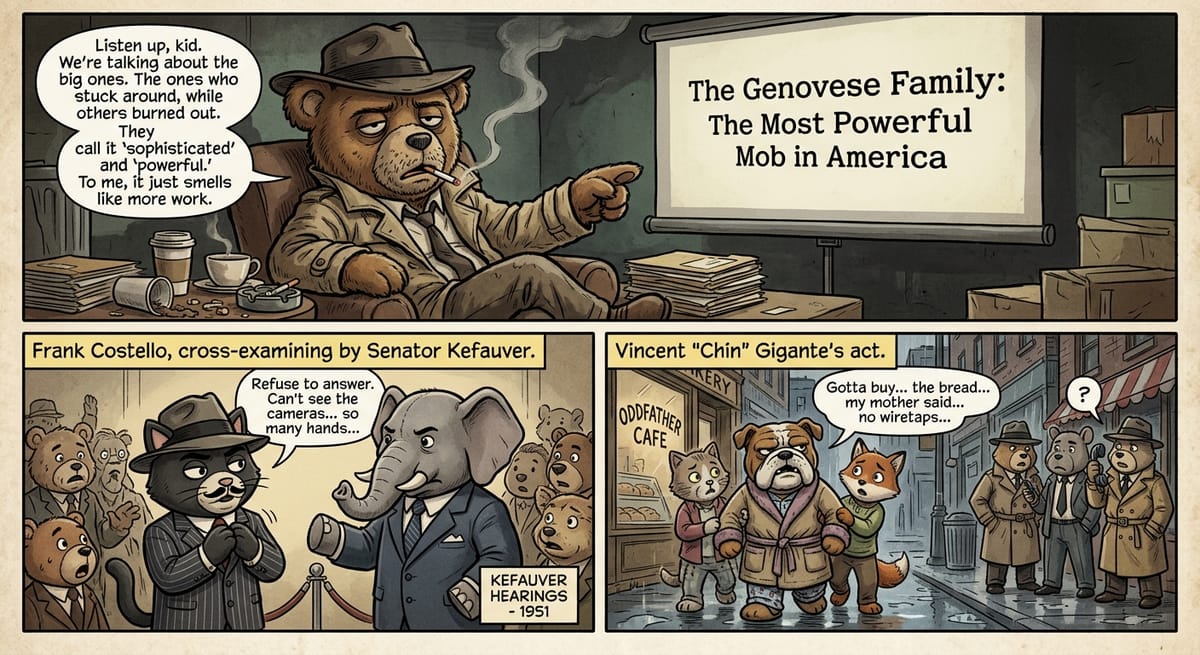
The second source was political access. Costello cultivated relationships with Tammany Hall, the Manhattan Democratic political machine, that gave the family influence over judicial appointments, district attorney races, and police promotion decisions. When Senator Estes Kefauver’s crime investigation committee held the first televised congressional hearings in 1951 — drawing an estimated 30 million viewers — Costello was the most prominent witness. The sight of his hands fidgeting on camera while he refused to look at the cameras directly became one of the defining images of organized crime’s penetration of American political life. He served eighteen months for contempt of Congress.
The third source was strategic restraint. The Genovese family, more than any other New York organization, consistently avoided the kind of public violence and media exposure that drew unwanted enforcement attention. When Vincent “Chin” Gigante became boss in 1981, he developed an elaborate counter-surveillance strategy: Gigante spent years wandering the streets of Greenwich Village in a bathrobe, muttering to himself, in an attempt to convince federal investigators and prosecutors that he was mentally incompetent to stand trial.^2^ The act worked for over a decade. Prosecutors called it “the Oddfather.” Gigante called it survival.
Vito Genovese’s Rise and the Meeting That Exposed the Whole Structure
Vito Genovese, the man whose name the family bears, was born in Naples in 1897 and emigrated to the United States in 1913. He was a member of the Luciano organization from the early 1920s, was implicated in multiple murders, fled to Italy in 1937 to avoid prosecution, ingratiated himself with Mussolini’s government, and returned to the United States in 1945 facing a murder charge that collapsed when the key witness died in custody.
The Apalachin Meeting of November 14, 1957, was Genovese’s high-water mark and his undoing. The meeting — held at the estate of Joseph Barbara in Apalachin, New York — was a national gathering of organized crime leadership called by Genovese after he had engineered the shooting of Frank Costello and the murder of Albert Anastasia, positioning himself as the dominant figure in New York organized crime. A state trooper named Edgar Croswell, working a routine surveillance of the Barbara property, alerted colleagues who set up roadblocks. More than fifty organized crime figures were stopped and identified. No criminal charges resulted from the gathering itself, but the national publicity destroyed the government’s ability to maintain its official position that a national organized crime syndicate didn’t exist. J. Edgar Hoover, who had resisted acknowledging organized crime for decades, was forced to create the Top Hoodlum Program within months.^2^
Genovese was convicted in 1959 on narcotics trafficking charges and sentenced to fifteen years. He died in the federal penitentiary at Springfield, Missouri on February 14, 1969, still nominally boss, at age seventy-one.
Why the Family Outlasted Every Boss Who Ran It
Vincent Gigante’s leadership from 1981 to his conviction in 1997 demonstrated that the family’s organizational depth extended beyond any single leader. During those sixteen years, with Gigante conducting business through whispered conversations in his mother’s Greenwich Village apartment and refusing to discuss anything of substance near known surveillance locations, the family continued generating significant revenue from construction, garbage hauling, and labor racketeering throughout the New York metropolitan area.
The FBI’s RICO case against Gigante, concluded in 1997 when he was convicted on racketeering and murder conspiracy charges and sentenced to twelve years, did not dismantle the organization. He continued managing family business from prison until 2003, when he finally admitted that his mental incompetence had been a fabrication. He died in prison in December 2005.
The Genovese family’s persistence through Luciano’s imprisonment, Costello’s retirement, Vito Genovese’s conviction, and Gigante’s death is the central fact about the organization. Individual bosses are replaceable. The institutional relationships — the union connections, the construction contracts, the embedded presence in legitimate economic structures — are not, which is why the family has outlasted every attempt to remove its leadership. The Commission that Luciano built was convicted in 1986; the Genovese family, the most careful of all five, remained the last one standing in any meaningful operational sense.
─────────
Sources:
- Raab, Selwyn. Five Families: The Rise, Decline, and Resurgence of America’s Most Powerful Mafia Empires. St. Martin’s Press, 2005.
- Critchley, David. The Origin of Organized Crime in America: The New York City Mafia, 1891–1931. Routledge, 2009.
- Fox, Stephen. Blood and Power: Organized Crime in Twentieth-Century America. William Morrow, 1989.
- Mustain, Gene, and Jerry Capeci. Mob Star: The Story of John Gotti. Franklin Watts, 1988.