The Chicago Outfit: After Capone
The Chicago Outfit outlasted Al Capone by sixty years — running Las Vegas skim operations and Teamsters pension fund schemes from Tony Accardo's era through the 1990s RICO prosecutions.
The Chicago Outfit: After Capone
The Chicago Outfit is American organized crime’s clearest proof that the man at the top matters less than the institution he leaves behind. Al Capone went to federal prison in 1932. The Chicago Outfit did not go with him. By the time Capone died in Florida in 1947, the organization had reorganized under new leadership, survived the end of Prohibition, and developed revenue streams that made the bootlegging years look like a startup phase.^1^ The Chicago Outfit operated as a functioning criminal enterprise from the 1930s through at least the 1990s, with tentacles in legitimate businesses, labor unions, and Las Vegas casino operations that extended far beyond Illinois. That it never gets as much sustained attention as the New York families is a failure of storytelling, not a reflection of its actual power.
Part of Regional Organized Crime — ← Back to series hub
Why the Post-Capone Outfit Outlasted Its Founder
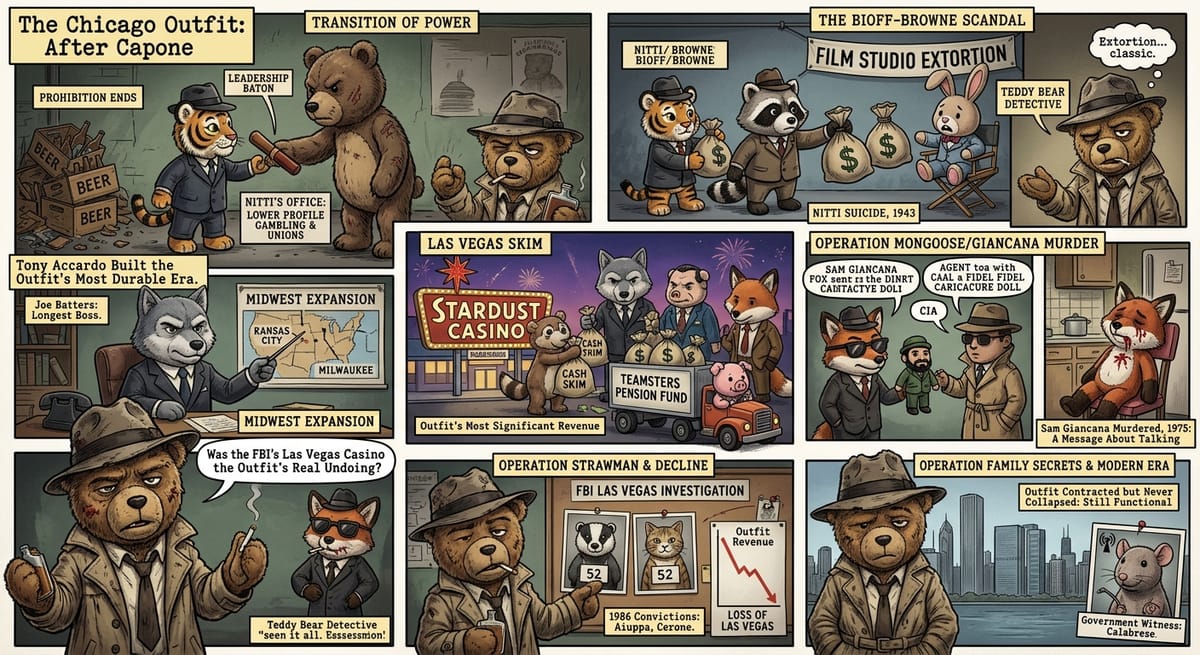
The men who took over the Outfit after Capone’s imprisonment represented a deliberate de-escalation of his publicity-seeking style. Frank Nitti, who served as Capone’s street enforcer and public face, became the effective leader in the early 1930s and cultivated a lower profile than his predecessor. He represented the Outfit at the 1931 Commission meeting and oversaw the transition from bootlegging into gambling, labor racketeering, and extortion with methodical efficiency.
Nitti died in 1943 — a suicide, on the day he was to be indicted on extortion charges related to a scheme to extort Hollywood film studios through corrupt union officials. The scheme, known as the Bioff-Browne scandal after union officials Willie Bioff and George Browne who implemented it, had generated approximately $1 million from the major studios between 1936 and 1941, using the threat of labor disruption to extract payments.^1^ It was exactly the kind of diversified, labor-based extortion that characterized the Outfit’s approach to crime in the post-Prohibition era.
Tony Accardo Built the Outfit’s Most Durable Era
Tony “Joe Batters” Accardo became the Outfit’s boss in 1943 and held power, in various capacities, for the next four decades — making him one of the longest-tenured organized crime leaders in American history alongside Tony Accardo in Chicago. Accardo had been a Capone driver and enforcer and brought to the job a combination of personal ruthlessness and institutional patience that the organization needed after the turbulence of the early 1930s.
Under Accardo, the Outfit expanded its gambling operations throughout the Midwest, extending influence into Kansas City, Milwaukee, and other regional cities through alliances with local criminal organizations. The Las Vegas connection was formalized in the 1950s and 1960s, when Outfit money flowed into casino construction through the Teamsters Central States Pension Fund, which was controlled by the mob through corrupt union officials including Teamsters president Jimmy Hoffa. The Stardust, the Fremont, and several other Las Vegas casinos received loans from the pension fund that allowed the Outfit and allied families to skim casino revenue — taking unreported cash before it was counted and entered in the books — for years.^1^
Sam Giancana, who served as the Outfit’s public face as boss during the late 1950s and early 1960s while Accardo retained real power behind him, became the most publicly recognizable Chicago organized crime figure since Capone. His social relationships with Frank Sinatra, his affair with Judith Campbell Exner (who was simultaneously involved with President John F. Kennedy), and his CIA cooperation in anti-Castro operations — Operation Mongoose, in which the CIA approached organized crime figures about assassinating Fidel Castro — made him one of the most-surveilled organized crime figures in the country. He was murdered in his Oak Park, Illinois kitchen on June 19, 1975, shot six times including once under the chin and five times around the mouth — a message about talking too much to the wrong people.
Was the FBI’s Las Vegas Casino Case the Outfit’s Real Undoing?
The FBI’s investigation of the Outfit’s Las Vegas casino operations — documented in detail by FBI agent William Roemer and eventually producing the prosecutions dramatized in Nick Pileggi’s book Casino — established that the Outfit was skimming approximately $2 million per month from the Stardust casino alone during the 1970s.^1^ The skim operation required coordination among several Midwest crime families and depended on the Teamsters pension fund’s continued willingness to provide financing that would have been unavailable through legitimate banking.
The Las Vegas skim prosecutions of the early 1980s — Operation Strawman — resulted in convictions of Outfit members and associates in 1986, including acting boss Joseph Aiuppa and capo Jackie Cerone, both sentenced to 28 years. Accardo himself, despite decades of investigation, was never convicted of a serious federal felony. He died in his bed in 1992, at age eighty-six, after a criminal career spanning six decades.^1^
The Outfit Contracted but Never Collapsed
The loss of Las Vegas — casinos were corporatized following the 1983 Nevada Gaming Control Board reforms and the FBI investigations, removing the mob’s ability to skim undetected — deprived the Outfit of its most significant revenue stream. The organization contracted significantly through the 1990s and 2000s, focusing on its remaining Illinois operations: gambling, loan sharking, labor racketeering in the construction and service industries, and street tax collection from independent criminal operators within its territory.
By the 2000s, FBI assessments described the Outfit as significantly diminished from its peak but still functional, with revenue concentrated in Chicago and suburban Cook County. A 2007 racketeering prosecution — “Operation Family Secrets” — convicted acting boss James Marcello and several other senior figures on charges that included murders dating to the 1970s. Nicholas Calabrese, a made member who became a government witness, testified to the inner workings of the organization in detail that confirmed the Outfit’s continued operation as a coherent criminal enterprise.^1^
The Chicago Outfit never regained the cultural prominence it held under Al Capone, and it never needed to. The decades of quiet operation between Accardo’s consolidation of power and the Las Vegas prosecutions demonstrated that an organized crime family can accumulate enormous wealth and institutional power without the kind of publicity that invites prosecution. Capone had proved the model worked. The Outfit proved it worked without Capone.
The Chicago Outfit belongs to the broader pattern of regional organizations — alongside Philadelphia, Detroit, and Kansas City — that operated as nodes in a national criminal network, each sustaining the system the New York families nominally governed. The Outfit’s six decades of continuous operation, through federal prosecution and the loss of Las Vegas, makes it the most durable of all of them.
─────────
Sources:
- Roemer, William F., Jr. Roemer: Man Against the Mob. Donald I. Fine, 1989.
- Pileggi, Nicholas. Casino: Love and Honor in Las Vegas. Simon & Schuster, 1995.
- Binder, John J. The Chicago Outfit. Arcadia Publishing, 2003.
- Eghigian, Mars, Jr. After Capone: The Life and World of Chicago Mob Boss Frank “the Enforcer” Nitti. Cumberland House, 2006.