The Kansas City Mob: The Midwest's Hidden Power
The Kansas City mob controlled the Tropicana counting room and skimmed casino revenue for Chicago Cleveland and Milwaukee — until FBI surveillance ended the mob's entire Las Vegas era in the 1980s.
The Kansas City Mob: The Midwest’s Hidden Power
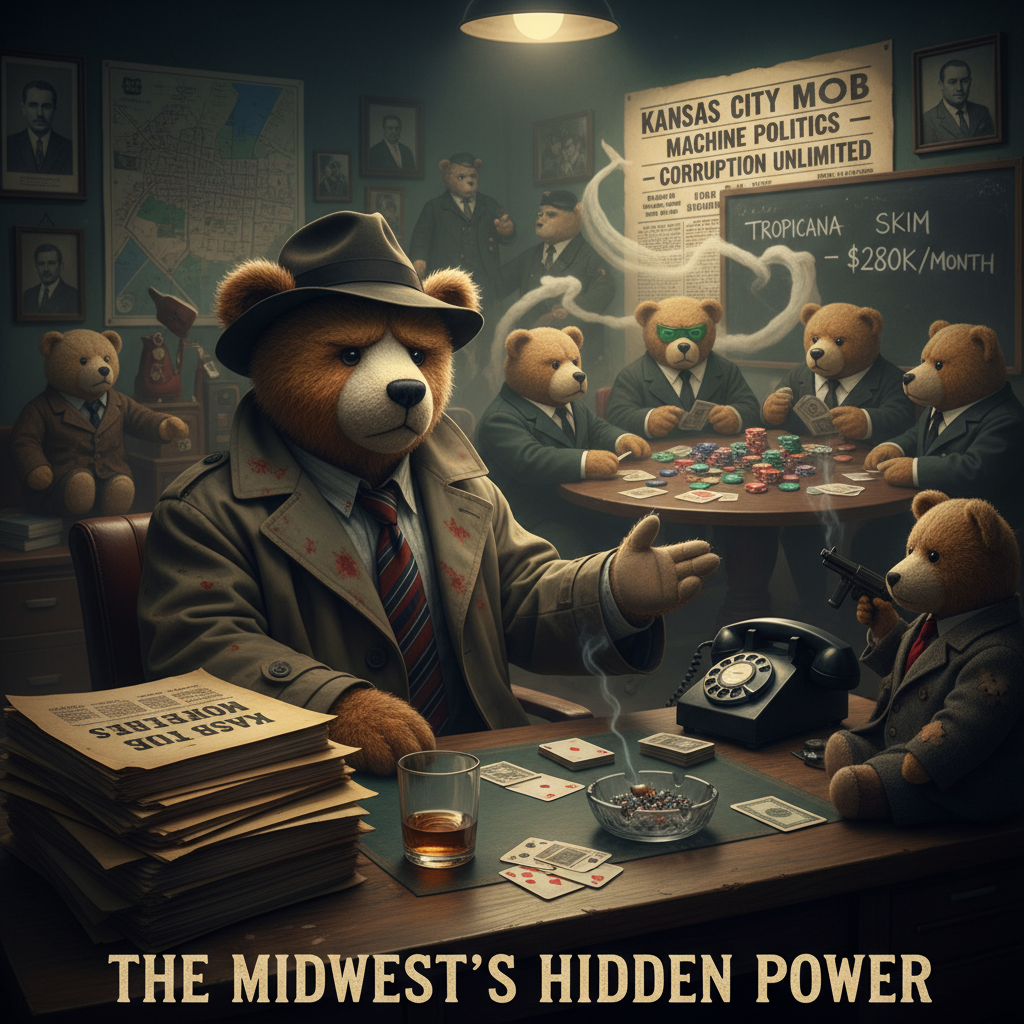
The Kansas City mob’s historical significance has almost nothing to do with Kansas City. It was the organization that managed the relationship between the Midwest crime families and Las Vegas, controlling the counting room at the Tropicana and skimming casino revenue on behalf of Chicago, Cleveland, and Milwaukee mobs for over a decade.^1^ The Kansas City family was the mechanism through which organized crime maintained its hold on Las Vegas gambling even after Nevada’s gaming regulations were supposed to have cleaned up the industry. When the FBI dismantled it, the evidence they assembled ended organized crime’s Las Vegas era.
Part of Regional Organized Crime — ← Back to series hub
Kansas City’s Machine Politics Created the Mob’s Foundation
Kansas City in the early twentieth century was governed by the Pendergast political machine, one of the most thoroughly corrupt municipal governments in American history. Tom Pendergast controlled city contracting, police appointments, judicial selections, and electoral outcomes from the late 1910s through his federal conviction for tax evasion in 1939. The criminal organizations that operated in Kansas City during the Pendergast era did so with machine protection, and when Pendergast fell, the mob maintained its position through the political relationships his machine had normalized.^1^
The Kansas City family — known variously as the Civella family after longtime boss Nick Civella — developed from Prohibition-era bootlegging operations run by figures including Dominic and Charles Binaggio, who combined political influence with criminal operations. Binaggio was murdered along with his chief lieutenant in April 1950 in a Kansas City Democratic Party political club, shot twice in the head. The murders drew a Congressional investigation that documented the family’s political connections in detail. Nick Civella became the dominant figure in Kansas City organized crime in the 1950s and held that position through the 1970s, maintaining close relationships with Chicago Outfit leadership and functioning as the Outfit’s representative in the Midwest region.
The Tropicana Skim Was the Most Documented Casino Fraud in History
The Tropicana Hotel and Casino in Las Vegas was the center of the Kansas City mob’s most significant criminal operation. In 1978, FBI surveillance of the Tropicana’s counting room documented organized crime figures from Kansas City, Chicago, Cleveland, and Milwaukee receiving cash payments from the casino’s unreported revenue — the “skim” that had been funding mob operations for two decades.^1^
Joseph Agosto, a Kansas City family associate who ran the Tropicana’s entertainment booking operation and had the access to the casino floor that the skim required, became a government cooperating witness in 1979 after the FBI confronted him with evidence of his role. His testimony and the recordings the FBI had made in the counting room produced the indictments in what became known as the “Strawman” cases — a series of RICO prosecutions targeting the organized crime families involved in the Vegas skim. Nick Civella died of cancer in March 1983, before the Strawman prosecutions concluded. Carl “Corky” Civella, his brother, and other senior family figures were convicted in 1985 and 1986 on racketeering charges that documented the skim operation and the family’s relationship with the other mob organizations involved.^1^
What Did the Las Vegas Skim Actually Generate?
The FBI’s investigation documented the skim operation in specific terms. The Strawman prosecutions established that the Tropicana skim was generating approximately $280,000 per month at its peak — roughly $1 million per month in 2024 dollars — distributed among Kansas City, Chicago, Cleveland, and Milwaukee families according to negotiated shares. The Stardust Hotel and Casino, which the Chicago Outfit controlled more directly, had a separate skim operation estimated at $2 million per month.^1^
The Nevada Gaming Control Board’s 1983 requirement that casino licensees be publicly traded companies, combined with the FBI investigations and the state’s aggressive revocation of licenses held by organized crime-connected operators, fundamentally altered the Las Vegas casino business. Corporate ownership replaced the mob-connected owner-operators who had built the city. By the mid-1980s, the era of organized crime Las Vegas was effectively over, and the Kansas City family’s function as the skim’s coordination point was no longer viable.
Kansas City After Las Vegas: A Local Operation With No National Role
The Kansas City family shrank dramatically after the Strawman convictions. Without the Las Vegas revenue and with its senior leadership imprisoned, the organization contracted to its local operations: gambling, loan sharking, and street tax collection in the Kansas City metropolitan area. FBI assessments through the 1990s described it as one of the smallest of the traditional American crime families.^1^
A 2009 RICO prosecution — Operation Hammer — resulted in additional convictions of Kansas City family figures and confirmed the organization’s continued existence as a criminal enterprise, though at a fraction of its former scale. The operation documented gambling, loan sharking, and extortion activities in Kansas City and produced guilty pleas from multiple defendants.
The Kansas City story is the Las Vegas story. The family’s significance was entirely a function of its geographic and organizational position as the intermediary between the established Midwest families and the casino skim. When the government dismantled that skim, the Kansas City mob lost its reason for being a national player. What remained was a local criminal organization without the revenue or the institutional connections that had made it briefly significant. The same pattern — national reach through a specific function, followed by collapse when that function was eliminated — played out differently in Detroit and Philadelphia, but the underlying dynamic was the same.
─────────
Sources:
- Roemer, William F., Jr. The Enforcer: Spilotro — The Chicago Mob’s Man Over Las Vegas. Donald I. Fine, 1994.
- Pileggi, Nicholas. Casino: Love and Honor in Las Vegas. Simon & Schuster, 1995.
- Liddick, Don. The Mob’s Daily Number: Organized Crime and the Numbers Gambling Industry. University Press of America, 1999.
- United States v. Civella, et al., 8th Circuit Court of Appeals, 1985.