Al Capone: How Chicago's Most Famous Gangster Built an Empire
Al Capone ran Chicago's bootlegging empire from 1925 to 1931, generating $60 million a year — and was ultimately brought down not by murder charges but by five counts of tax evasion.
Al Capone: How Chicago’s Most Famous Gangster Built an Empire
Al Capone ran Chicago’s criminal underground from 1925 to 1931, generating an estimated $60 million per year from bootlegging alone — roughly $900 million in 2024 dollars — and turned the city into a case study in what happens when local government decides corruption is cheaper than law enforcement.^1^ He was brought down not by murder charges or bootlegging prosecutions, but by five counts of tax evasion.
Part of Prohibition-Era Organized Crime — ← Back to series hub
The Brooklyn Kid Who Came to Chicago with Nothing
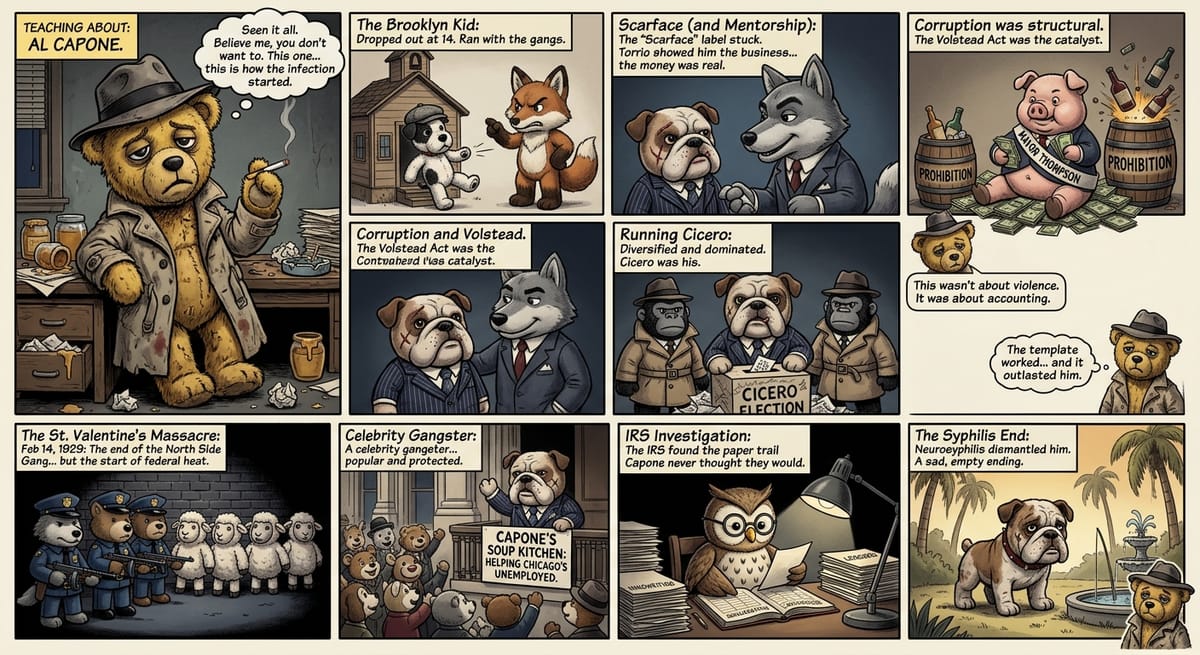
Alphonse Gabriel Capone was born in Brooklyn on January 17, 1899, the fourth of nine children of Italian immigrants Gabriele and Teresa Capone. He dropped out of school at fourteen after striking a teacher and spent his teenage years running with the Junior Forty Thieves and the Bowery Boys before catching the attention of Johnny Torrio, a racketeer who would become his mentor and the template for what professional organized crime could look like.
The facial scars that gave him the nickname “Scarface” — a name he despised — came from a 1917 fight at the Harvard Inn in Coney Island, where he insulted a woman and her brother responded with a razor. He never explained the scars publicly and preferred to claim war wounds, though he was never in the military. By 1919, after a brief stint in Baltimore working legitimate jobs following the birth of his son Albert Francis, Torrio called him to Chicago with a simple offer: the city was wide open and the money was real.
What Made Chicago the Perfect City for His Ambitions
Chicago in the early 1920s had a mayor — William Hale Thompson — who made corruption structural rather than incidental, and the Volstead Act had created a market worth hundreds of millions of dollars with no legal competition.^1^ Torrio had inherited the South Side rackets from his uncle “Big Jim” Colosimo after arranging Colosimo’s murder in May 1920 and brought Capone in as his second-in-command.
Torrio’s vision was businesslike: divide Chicago into territories, negotiate with rival gangs, and keep violence as a last resort because violence drew attention. Capone absorbed this philosophy and then abandoned it when Torrio retired to Italy after surviving a 1925 assassination attempt. Running the organization at twenty-six, Capone understood something Torrio didn’t quite grasp: in Chicago, theatrical violence could be as effective as actual violence because it made rivals believe he was capable of anything.
The Outfit didn’t just sell beer. By the mid-1920s, Capone had diversified into gambling operations across Cook County, prostitution through a network of brothels in Cicero, Illinois, and labor racketeering in the building and laundry trades. The Cicero operation was particularly lucrative — after his organization effectively ran the 1924 Cicero municipal election through armed intimidation of polling stations, Capone had a suburb he could operate from with near-complete impunity.
How He Kept the Territory Through Targeted Violence
Running an empire in Prohibition-era Chicago was a competitive exercise measured in murders. Between 1923 and 1930, over 700 gang-related homicides occurred in the city.^2^ The North Side Gang under Dion O’Banion and later Hymie Weiss and George “Bugs” Moran represented the only real challenge to Capone’s territorial ambitions, and that challenge had to be eliminated systematically.
O’Banion was murdered in his flower shop on November 10, 1924 — a hit Capone sanctioned after a dispute over the Sieben Brewery. Weiss survived one attempt but was killed in a Capone-arranged ambush on October 11, 1926, shot multiple times on the steps of Holy Name Cathedral. The campaign culminated in the St. Valentine’s Day Massacre of February 14, 1929, when seven men associated with Bugs Moran were executed in a garage at 2122 North Clark Street. Moran himself was supposed to be there but arrived late, saw the cars, and walked away. The massacre eliminated the North Side Gang as a functional rival but also drew federal attention that Capone had previously managed to avoid.
Capone was known to the Chicago press not merely as a criminal but as a celebrity. He attended the opera, held court at the Lexington Hotel at 2135 South Michigan Avenue, gave newspaper interviews, and was mobbed by fans at Cubs games at Wrigley Field. He distributed food through a soup kitchen on South State Street during the Depression, which generated favorable press. A famous gangster, he understood, is harder to prosecute than an anonymous one because the publicity creates political costs for the officials doing the prosecuting.
Why the Government Finally Had to Use Tax Law to Get Him
The federal government’s approach changed after President Herbert Hoover personally directed the Treasury Department to pursue Capone. The problem was evidence: Capone never signed checks, never appeared in business records, and never held any official position in any legal entity. Every witness to his crimes faced the reasonable concern that testifying would get them killed.
IRS agent Frank Wilson spent months in a basement office going through handwriting on betting slips, racing forms, and ledgers, ultimately identifying cashier’s checks traceable back to Capone sufficient to establish his net income.^3^ In parallel, Eliot Ness and the Untouchables — a squad of Prohibition Bureau agents chosen specifically because they had no existing ties to Chicago corruption — conducted raids that, while they never produced direct evidence against Capone, generated headlines that kept political pressure on.
Capone was indicted for tax evasion on June 5, 1931, on twenty-two counts covering the years 1925 through 1929. He was convicted on October 17, 1931, on five of those counts and sentenced to eleven years in federal prison, fined $50,000, and assessed court costs. He served time first at Atlanta Federal Penitentiary and then at Alcatraz, arriving on the island in August 1934 as Inmate #85.
The Syphilis That Finished What the Government Started
Capone left Alcatraz in 1939, transferred to Terminal Island in California due to deteriorating mental health. The syphilis he had contracted in his twenties, untreated because he refused to believe the diagnosis, had progressed to neurosyphilis — a late-stage infection that destroys brain tissue. By the time penicillin became widely available in the mid-1940s, the damage was irreversible.
He spent his final years at his Palm Island, Florida estate, fishing and hosting family, his mental capacity declining steadily. He died on January 25, 1947, at age forty-eight, from cardiac arrest following a stroke, his mind largely gone. The man who had terrorized Chicago and generated tens of millions per year died worth less than $1 million, his business long since dismantled.
The Capone template — corrupting local government, maintaining plausible deniability, diversifying into multiple revenue streams, presenting a public face that complicated prosecution — survived him. Lucky Luciano applied the same logic to New York and then formalized it through the Commission he established in 1931. Capone didn’t invent organized crime. He proved it could be run like a corporation, and that proof was the lasting part.
─────────
Sources:
- Bergreen, Laurence. Capone: The Man and the Era. Simon & Schuster, 1994.
- Kobler, John. Capone: The Life and World of Al Capone. Putnam, 1971.
- Okrent, Daniel. Last Call: The Rise and Fall of Prohibition. Scribner, 2010.
- Eig, Jonathan. Get Capone: The Secret Plot That Captured America’s Most Wanted Gangster. Simon & Schuster, 2010.