The Philadelphia Mob: Nicky Scarfo and the Most Violent Family
Nicky Scarfo ran the Philadelphia mob in the 1980s and ordered more murders per year than any comparable crime family — violence that ultimately generated the cooperating witnesses who destroyed the organization.
The Philadelphia Mob: Nicky Scarfo and the Most Violent Family
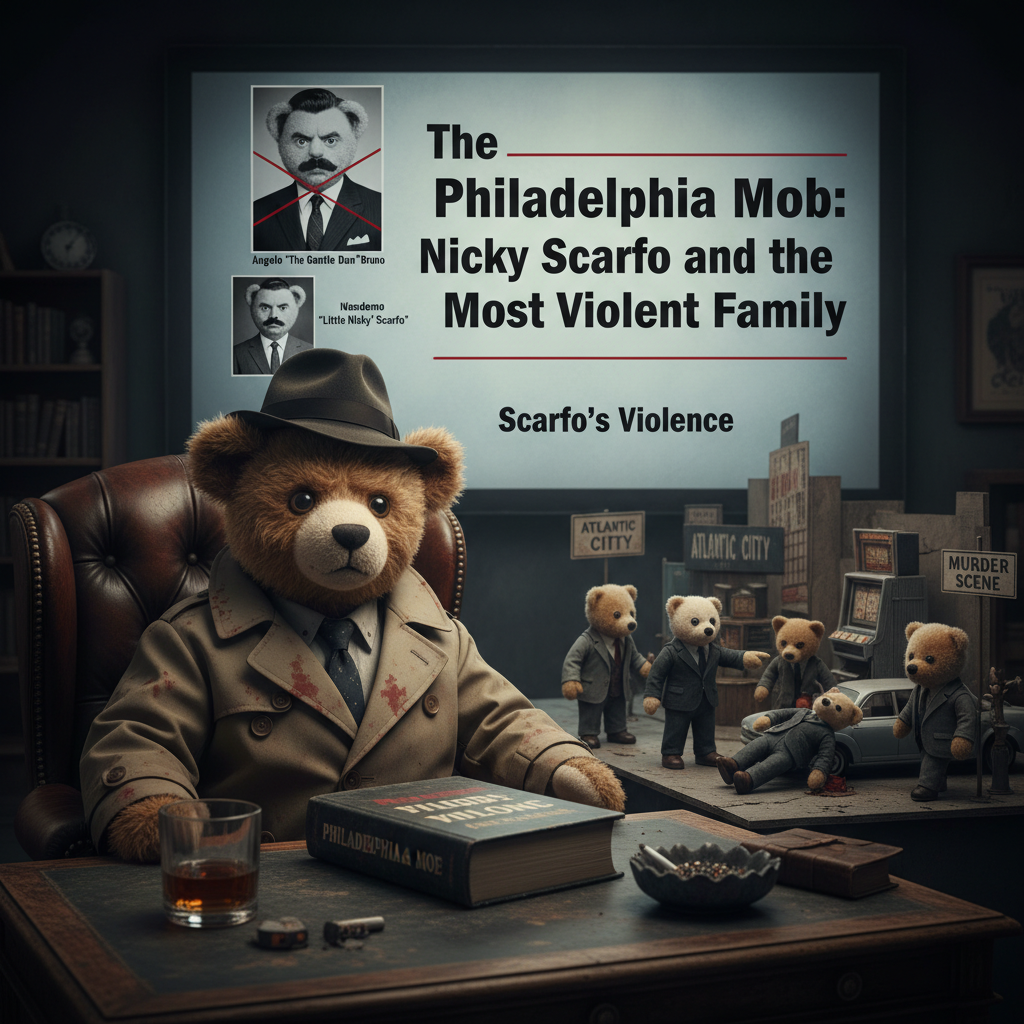
The Philadelphia mob under Nicky Scarfo ordered more murders per year than any comparable organized crime family of the 1980s — including several that served no obvious strategic purpose. Philadelphia’s organized crime family was never the largest, controlling a mid-sized city, an adjacent New Jersey shore territory, and a slice of the Atlantic City casino business. What distinguished it from comparable regional organizations was Nicodemo “Little Nicky” Scarfo, who stood five feet five inches tall and weighed approximately 135 pounds, and who ordered murders as a management tool rather than a last resort.^1^ By the time federal prosecutors finished their work in the late 1980s and early 1990s, they had documented more than thirty murders attributable to Scarfo’s leadership. The family had approximately sixty active members at Scarfo’s peak. The per capita murder rate was extraordinary.
Part of Regional Organized Crime — ← Back to series hub
Angelo Bruno Built a Family on Negotiation, Not Blood
The Philadelphia family traces its organized presence to the early twentieth century but didn’t achieve its postwar configuration until Angelo Bruno became boss in 1959. Bruno, known as “the Gentle Don” — the nickname reflected his preference for negotiation over murder rather than any actual gentleness — ran the family for twenty-one years with an emphasis on maintaining peace with the New York families and keeping violence minimal.
Bruno’s territorial reach extended from Philadelphia through South Jersey and into Atlantic City, which became significant when New Jersey voters approved casino gambling in 1976. The Casino Control Act of 1977 created a regulatory structure specifically designed to exclude organized crime from casino ownership, but the construction phase — union labor, concrete, electrical work, furnishings — was where Bruno expected the family to profit, along with loan sharking and gambling operations in the surrounding area.^1^ Bruno’s plan for Atlantic City was methodical and would likely have produced significant long-term revenue if he had lived to implement it. He was shot to death on March 21, 1980, sitting in his car outside his South Philadelphia home. The murder was arranged by his underboss Antonio “Tony Bananas” Caponigro, who had not obtained Commission permission — a violation of the established rules that produced Caponigro’s own murder by the Genovese family several weeks later. The chaos that followed Bruno’s death produced a succession of bosses who each served short terms before being murdered, imprisoned, or both.
Scarfo Turned Atlantic City Into a Murder Scene
Nicodemo Scarfo had been banished to Atlantic City by Angelo Bruno as punishment for a 1963 stabbing murder of a longshoreman over a card game. That banishment became an opportunity: Scarfo used his Atlantic City years to develop connections in construction and labor, and when the casino development boom arrived, he was positioned to profit. He became boss in 1981 following the murder of Philip Testa, who had himself become boss following Bruno’s murder.
Scarfo’s management philosophy differed from Bruno’s in every relevant respect. Where Bruno used violence reluctantly and only when operationally necessary, Scarfo used it as a management tool, ordering the murder of subordinates who displayed insufficient loyalty, rivals who challenged his authority, and associates who represented potential security vulnerabilities.^1^ Between 1980 and 1989, the Philadelphia family committed at least twenty-eight murders that federal prosecutors were able to document and attribute.
The murder of Frank “Frankie Flowers” D’Alfonso in July 1985 is illustrative. D’Alfonso was a South Philadelphia gambling figure who had refused to pay tribute to Scarfo’s organization. He was shot on a South Philadelphia street corner in broad daylight, witnessed by multiple people, and generated the kind of law enforcement attention that more disciplined organizations worked to avoid. Atlantic City’s casino construction produced significant revenue for the family through the early 1980s — the FBI estimated between $1 million and $2 million per month at peak operations in the mid-1980s — but Scarfo’s indiscriminate violence was consuming the institutional capital faster than the casino revenue could replace it.^1^
Scarfo’s Violence Created the Witnesses That Destroyed Him
The FBI’s Philadelphia organized crime investigation benefited from Scarfo’s violence in an unexpected way: it generated informants. Associates and members who feared being murdered for reasons they couldn’t predict had strong incentives to cooperate with the government, and several did. Nicholas “Nick the Crow” Caramandi and Thomas “Tommy Del” DelGiorno both turned government witness, providing detailed testimony about specific murders, the internal organization of the family, and Scarfo’s personal role in ordering killings.^1^
Scarfo was convicted in November 1988 on RICO charges that included the murder of Frank D’Alfonso and multiple other killings, racketeering, and extortion. He was sentenced to 55 years. A subsequent state murder conviction added 14 years. He died in federal prison in January 2017 at age eighty-seven.
Why the Philadelphia Family Never Recovered
The Philadelphia family did not recover from the prosecutions of the late 1980s and early 1990s. John Stanfa, a Sicilian immigrant who had been the driver the night Bruno was murdered and had his own complicated relationship with the Commission, became boss in the early 1990s and was himself convicted of racketeering and murder in 1995, sentenced to five life terms. The succession of convictions depleted the family’s active membership and institutional knowledge. By the 2000s, the Philadelphia family was assessed by the FBI as significantly weakened, with reduced membership and revenue, internal conflicts continuing over what remained of the Atlantic City-area operations, and none of the institutional stability that would allow it to recover the position it had held under Bruno.
Scarfo’s legacy is a case study in what excessive violence costs a criminal organization. The Chicago Outfit under Tony Accardo ran for four decades without Scarfo’s body count precisely because Accardo understood what Scarfo did not: that discretion is a competitive advantage. The murders Scarfo ordered to maintain control instead generated the cooperating witnesses and law enforcement attention that dismantled the organization. Every killing that served Scarfo’s personal sense of authority rather than any strategic organizational need was a liability that accumulated until the weight of it collapsed the structure it was supposed to be protecting.
─────────
Sources:
- Anastasia, George. Blood and Honor: Inside the Scarfo Mob — The Mafia’s Most Violent Family. William Morrow, 1991.
- Raab, Selwyn. Five Families: The Rise, Decline, and Resurgence of America’s Most Powerful Mafia Empires. St. Martin’s Press, 2005.
- Caramandi, Nicholas, and Thomas Reppetto. The Crow: Mafia, Law, and I. Warner Books, 1991.
- Griffin, Joe. Mob Nemesis: How the FBI Crippled Organized Crime. Prometheus Books, 2002.