The Detroit Partnership: Motor City's Mafia
Detroit's Mafia never produced a John Gotti, and that was the point. A handful of intermarried families ran the rackets for most of a century by keeping their names out of the paper.
Part of Regional Organized Crime: ← Back to series hub
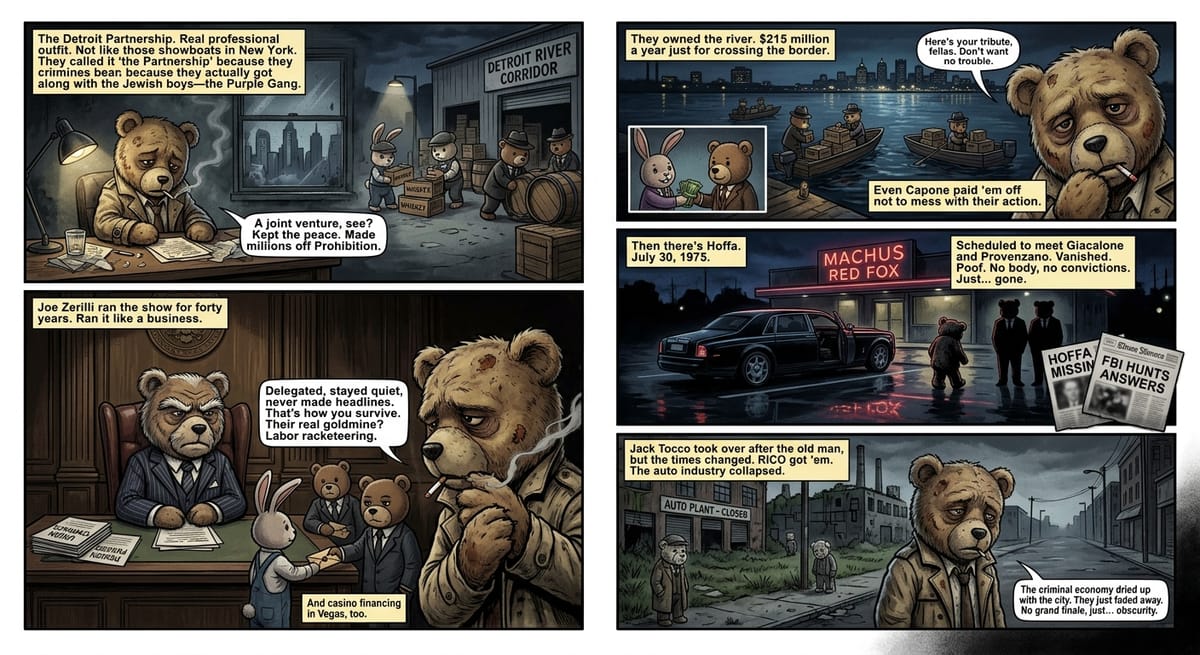
The Detroit Partnership is the name for Detroit's Mafia family, an alliance of a few intermarried Sicilian-American families that took shape after a gang war in 1930 and 1931 and controlled much of the city's rackets for decades.1 It was strongest from the 1930s into the 1970s under Joseph Zerilli and the Tocco family, its men are the leading suspects in Jimmy Hoffa's 1975 disappearance, and it survives today in a much smaller form.1 2
Its trademark was not violence but discretion. Most members are related by blood or marriage, which made informants rare and federal cases hard to build.1
The Prohibition River Made Everything Possible
Detroit sits across a narrow river from Windsor, Ontario. When Prohibition took effect in 1920, Canada still licensed distilleries and breweries to make liquor for export, and Windsor became one of the main smuggling points into the United States.3 (The earlier version of this page put the river trade at $215 million a year. We could not find a source for that figure and have removed it.)
The first gang to get rich on that river was not Italian. The Purple Gang was made up mostly of the American-born sons of Jewish immigrants from Russia and Poland, raised around Hastings Street on Detroit's lower east side.3 (The earlier version said they came from the "Maxwell Street" neighborhood. Maxwell Street is in Chicago.) The Purples hijacked other bootleggers' loads, hired a crew known as the Little Jewish Navy to run liquor across the river, and fought a vicious turf war with the Licavoli brothers' Italian crew.3
The old story that Al Capone paid the Purples tribute is better told the way the record supports it: Capone did not want a war in Detroit, so he made a business arrangement with the gang, which for several years supplied Canadian whisky to his organization in Chicago.3 By the early 1930s, internal feuding and prison sentences had broken the Purples, and the Italian families moved into the space they left.
The Families Behind the Partnership
The name describes the Italian side of Detroit's underworld, not a merger with the Purples. After the Crosstown Mob War of 1930 and 1931, the leaders of the Sicilian factions agreed to share power rather than keep killing each other. The ruling group included Angelo Meli, Joseph Zerilli, William "Black Bill" Tocco, John Priziola and Peter Licavoli.1 (The earlier version of this page described the Partnership as a formal joint venture between the Italian family and a Jewish organization. Standard accounts describe it as an alliance of Italian families; whatever cooperation existed with Jewish gangsters was a Prohibition-era arrangement, not the origin of the name.)
Zerilli turned the alliance into a family business in the literal sense. He encouraged his lieutenants to marry their children to the children of other Mafiosi, betting that relatives were less likely to inform on one another and less likely to fight.1 The bet paid off. Membership peaked at roughly 100 made men in the 1960s.1
Zerilli's Four Decades Proved Obscurity Is a Strategy
By 1936 Zerilli had taken operational control of Detroit's Italian rackets, and he remained the family's dominant figure until his death on October 30, 1977, apart from a brief retirement around 1970.4 After a 1956 meeting, Detroit and Philadelphia were added to the Commission, the Mafia's national ruling body, putting Zerilli alongside the New York bosses and men like Sam Giancana of Chicago and Carlos Marcello of New Orleans.1
Under Zerilli the family had heavy influence over Detroit labor unions, the cartage and waste-hauling industries and a range of legitimate businesses. It ran loansharking and gambling, especially horse and sports betting, along the Detroit-Pontiac corridor, and investigators have tied it to postwar heroin trafficking through its links to the Sicilian Mafia.1
It also reached into Nevada. In the 1960s and 1970s the Detroit family skimmed profits from the Frontier and the Aladdin in Las Vegas and the Edgewater in Laughlin, as the Chicago Outfit and other Midwest families did at their own casinos.1 Las Vegas also cost Zerilli his succession plan. His son Anthony "Tony" Zerilli took over when the old man retired in 1970, then went to prison for concealing interests in a Las Vegas casino, and Zerilli came back to run things.4
Did the Detroit Family Kill Jimmy Hoffa?
Jimmy Hoffa built his power in Detroit. He started as an organizer with Teamsters Local 299 in 1932 and rode the union all the way to its presidency.2 After prison, he wanted the presidency back, and several Mafia figures did not want him to have it. One was Anthony Provenzano, a New Jersey Teamsters leader and a captain in New York's Genovese family. Two others were Anthony Giacalone, a powerful figure in the Detroit family, and his brother Vito, who the FBI believes were positioning themselves as mediators between Hoffa and Provenzano.2
On Wednesday, July 30, 1975, Hoffa drove to the Machus Red Fox restaurant in Bloomfield Township, a Detroit suburb, for a 2 p.m. meeting with Giacalone and Provenzano. He had written "TG, 2 p.m., Red Fox" on his office calendar.2 Between 2:15 and 2:30 he called his wife from a pay phone behind the restaurant to complain that Giacalone had stood him up. The FBI estimates he left the lot, without a struggle, around 2:45 or 2:50, and one witness reported seeing him in the back of a maroon car with three other people.2 He was never seen again and was declared legally dead in 1982.2
No one has ever been charged. There is wide agreement among crime historians and investigators that the Mafia killed him, but not on who did it or where the body went.2 The leading theories, and that is all they are:
- A Detroit-area killing and cremation. Many experts think the body was destroyed locally; the criminologist James Buccellato has pointed to Detroit-area incinerators and a crematorium and doubts the mob hauled a body across the country.2
- A New Jersey landfill. A landfill worker's deathbed statement claimed Hoffa was buried in a steel drum beneath the Pulaski Skyway in Jersey City. The FBI surveyed the site under a warrant in October 2021 and announced in July 2022 that "nothing of evidentiary value was discovered."2
- A field in Oakland County. In 2013, Tony Zerilli claimed Hoffa had been buried in a field in northern Oakland County. In June 2013 the FBI dug for three days at a property in Oakland Township owned by Jack Tocco, and found nothing.2
- "The Irishman." Frank Sheeran claimed in Charles Brandt's 2004 book that he shot Hoffa in a Detroit house. That is his account, as told to Brandt, and no remains have been found to test it.2
The Detroit Family Faded Before It Fell
When Zerilli died, the family passed to his nephew, Jack Tocco, William Tocco's son.4 5 The federal government finally landed a major blow in March 1996, when the FBI's Operation Gametax produced racketeering indictments against 17 alleged members and associates, including Tocco and underboss Tony Zerilli.1 5 At the trial, prosecutors showed an FBI surveillance photo of a 1979 meeting celebrating Tocco's elevation to boss, believed to be the only time outsiders photographed such a gathering.5
Tocco was convicted of racketeering in 1998. His sentence became a scandal: the judge first ordered a year or less in a halfway house, from which Tocco could run his businesses by day, then re-sentenced him to a year at a federal medical prison in Minnesota. Prosecutors appealed, and in 2000 he was re-sentenced to 34 months. He was released in November 2001.5 (The earlier version of this page gave his sentence as eighteen months.) Tocco died on July 14, 2014.5
Is There Still a Detroit Mob?
Yes, though nobody would call it the Motor City's government anymore. A 2006 indictment charged 15 alleged members and associates with racketeering over bookmaking, money laundering and extortion, after an FBI investigation that began in 1998, and several pleaded guilty in 2007.1 Crime historians James Buccellato and Scott Burnstein estimated in 2011 that the family was down to 40 to 50 made members.1 Since Tocco's death, according to those who track the family, leadership has stayed within the old bloodlines, with a member of the Giacalone family at the top.1 A recent local history piece summed it up: dwindled significantly, but still believed to be in operation.6
Our read: the decline of Detroit's industrial economy took a lot of the old money away. Associates are still said to run gambling, loansharking, extortion and labor rackets alongside legitimate businesses, and one wing of the family has specialized in white-collar crime.1
That fits the family's whole history. It never produced a Gotti or a Nicky Scarfo, and it never needed to. Its men ran a major American city's rackets for most of a century by being boring, related to each other and hard to flip. Compare that with the Commission-era bosses in New York or the noisy Prohibition legends like Al Capone, and Detroit looks less like a lesser mob than a smarter one.
Frequently Asked Questions
Is there still a mafia in Detroit? Yes, in reduced form. Crime historians estimated about 40 to 50 made members in 2011, down from roughly 100 at the 1960s peak, and the family is still believed to operate in gambling, loansharking and white-collar crime.1 6
Which families made up the Detroit Partnership? The alliance formed in the early 1930s around leaders including Angelo Meli, Joseph Zerilli, William Tocco, John Priziola and Peter Licavoli.1 Over the following decades the Zerilli, Tocco, Giacalone, Meli and Corrado names kept recurring, held together by deliberate intermarriage.1
Did the Detroit mob kill Jimmy Hoffa? It is the leading theory, not a proven fact. Hoffa vanished on July 30, 1975, from the parking lot of a restaurant where he expected to meet Detroit's Anthony Giacalone and New Jersey's Anthony Provenzano.2 No one has been charged, and repeated FBI searches, most recently in New Jersey in 2021-22, have found nothing.
Who was the Purple Gang? A mostly Jewish bootlegging gang from Detroit's lower east side that dominated the Detroit River liquor trade in the 1920s.3 It hijacked rivals, supplied whisky to Al Capone's Chicago organization, and collapsed in the early 1930s under feuds and prosecutions.3
Who was Joseph Zerilli? A Sicilian-born mobster who took control of Detroit's Italian rackets by 1936 and dominated the family until his death in 1977. He sat on the Mafia's national Commission from the late 1950s and built the family around intermarriage and secrecy.1 4
How does the Detroit family compare to the Chicago Outfit? The Chicago Outfit was bigger, louder and far more famous. Detroit was smaller and quieter, but it shared the Midwest's Las Vegas skimming operations and kept a seat on the Commission, while avoiding most of the publicity that brought down better-known families.1
Part of Regional Organized Crime: ← Back to series hub
Related reading: The Chicago Outfit · The Commission · Al Capone · Bootlegging · The Philadelphia mob
─────────
Sources:
- "Detroit Partnership." Wikipedia. en.wikipedia.org
- "Jimmy Hoffa." Wikipedia. en.wikipedia.org
- "Purple Gang." Wikipedia. en.wikipedia.org
- "Joseph Zerilli." Wikipedia. en.wikipedia.org
- "Jack Tocco." Wikipedia. en.wikipedia.org
- "Unpacking Detroit's strong ties to the Mafia." Gander Newsroom. gandernewsroom.com
Further reading (books cited on the earlier version of this page):
- Burnstein, Scott M. Motor City Mafia: A Century of Organized Crime in Detroit. Arcadia Publishing, 2006.
- Brill, Steven. The Teamsters. Simon & Schuster, 1978.
- Moldea, Dan E. The Hoffa Wars: Teamsters, Rebels, Politicians, and the Mob. Paddington Press, 1978.
- Raab, Selwyn. Five Families: The Rise, Decline, and Resurgence of America's Most Powerful Mafia Empires. St. Martin's Press, 2005.