The Underground Railroad: America's First Resistance Network
Between 1820 and 1860 the Underground Railroad moved up to 100000 people to freedom — a decentralized network of conductors safe houses and people who broke federal law daily.
The Underground Railroad: America’s First Resistance Network
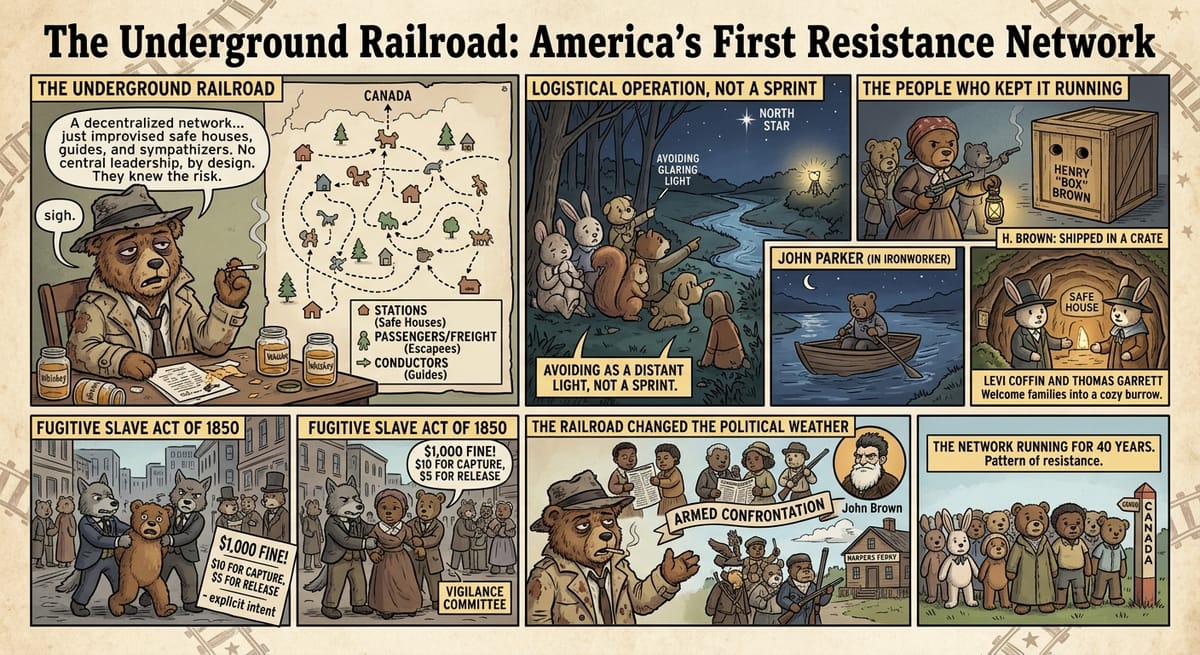
Between 1820 and 1860, the Underground Railroad moved somewhere between 30,000 and 100,000 enslaved people to freedom through a decentralized, improvised, constantly evolving network of safe houses, guides, and sympathizers. It had no central leadership, no formal membership, no headquarters, and no written records by design — built from necessity by people who knew the penalty for participating was severe, and it worked anyway. The name came from the language of steam railroads, which were new enough in the 1830s to feel like a metaphor for something fast and powerful. People who guided fugitives were “conductors.” Safe houses were “stations.” The people being moved were “passengers” or “freight.” The language was useful as code and stuck.
Part of Fighting Back: Slave Resistance in America — ← Back to series hub
Escape Was a Logistical Operation, Not a Sprint
Escape from enslavement was not a matter of running north and following friendly strangers. It was a logistical operation that required weeks or months of planning, physical endurance that most people cannot fully imagine, and access to resources that were genuinely difficult to obtain.
The first challenge was information. Enslaved people were systematically denied knowledge of geography — knowing where you were and what lay beyond the plantation was itself a form of power that enslavers tried to prevent. Henry “Box” Brown, who escaped from Richmond, Virginia, in 1849, did so by having himself nailed inside a wooden crate, 3 feet long by 2 feet wide, and shipped by freight to Philadelphia — a 27-hour journey during which he was at various points carried upside down and left in direct sun. He arrived alive. His escape required months of planning, the help of a free Black shoemaker named James Caesar Anthony Smith, and a white storeowner named Samuel Alexander Smith.^1^
Most fugitives traveled at night, navigating by the North Star and by following the Ohio River or other waterways northward. They moved through woods and swamps, not roads — roads had patrols. The journey from a deep South plantation to freedom could cover 500 to 1,000 miles on foot, and even reaching the Mason-Dixon Line did not mean safety. After the Fugitive Slave Act of 1850, it didn’t mean much at all.
The People Who Kept It Running Refused to Stop Even When the Law Caught Them
The network’s most famous conductor was Harriet Tubman, who escaped from Dorchester County, Maryland, in September 1849, walking roughly 90 miles to Philadelphia on her own with no guide. She then returned south at least 13 times between 1850 and 1860, leading approximately 70 people to freedom, including her own parents. She operated under the threat of a $40,000 bounty on her head — the equivalent of over $1 million today — and was never caught, never lost a passenger, and reportedly carried a gun that she used to discourage anyone who lost nerve from turning back.^2^
John Parker was a free Black ironworker in Ripley, Ohio, who personally guided hundreds of freedom seekers across the Ohio River from Kentucky in the 1840s and 1850s. He rowed across the river himself in the dark, located people in the brushes along the Kentucky side, and brought them back within sight of slave catchers and in direct violation of federal law. He later dictated a memoir, published posthumously in 1996, that described the work in matter-of-fact terms that are far more terrifying than any dramatization.^3^
The Quaker network — centered in Philadelphia, with nodes in Ohio, Indiana, and upstate New York — provided safe houses, food, clothing, and money. Levi Coffin, a Quaker merchant in Newport, Indiana (later Cincinnati), sheltered an estimated 3,300 freedom seekers over a 35-year period. He kept no records and reportedly said that he simply never turned anyone away.^4^
Thomas Garrett, a Quaker hardware merchant in Wilmington, Delaware, was convicted in 1848 for helping fugitives and fined so heavily that the court seized everything he owned. Standing in the courtroom after the verdict, the 57-year-old Garrett told the judge: “I say to thee and to all in this courtroom that if anyone knows a fugitive who wants a shelter and a friend, send him to Thomas Garrett and he will befriend him.” He then went home and kept doing it for another 20 years.
What Did the Fugitive Slave Act of 1850 Actually Change?
The Compromise of 1850 included a Fugitive Slave Act that was, by any measure, an extreme piece of legislation. It required citizens of free states to assist in the capture of freedom seekers, imposed federal penalties of $1,000 (roughly $38,000 today) on anyone who helped a fugitive, and created a system of federal commissioners who were paid $10 if they remanded a captured person to slavery and $5 if they did not — a payment structure that made the law’s intent explicit.^5^
It also made being Black in the North genuinely dangerous. Free Black people in Boston, Philadelphia, and Cincinnati could now be seized on the claim that they were escaped property, with minimal due process. Black communities in northern cities organized armed self-defense associations. Vigilance committees — which had existed informally since the 1830s — formalized and expanded. The law also radicalized white northerners who had previously been indifferent to slavery: watching federal marshals drag people through the streets of Boston in chains turned abstraction into proximity. The Underground Railroad saw an increase in activity after 1850, not a decrease. Canada, which had outlawed slavery in 1833, became the terminal destination for many freedom seekers who had previously stopped in the northern states.
The Railroad Changed the Political Weather That Made Emancipation Possible
Even 100,000 people was a fraction of the four million enslaved people in the United States by 1860. The Underground Railroad did not and could not bring down slavery. What it did was something arguably more significant to the political trajectory of the 1850s: it made slavery a personal, visible, ongoing emergency for white northerners, and it created a community of white and Black activists with practical experience in direct action and a growing willingness to break federal law explicitly.
Many of the most committed abolitionists — Frederick Douglass, William Still, the entire Philadelphia Vigilance Committee — were shaped by their Railroad work into people who understood that moral argument alone was not going to end slavery. The Railroad proved that the law could be defied at scale. It demonstrated that Black and white Americans could work together in sustained, dangerous, effective resistance. And it provided the network and the relationships that fed abolitionist journalism, political organizing, and eventually, for some of its participants, the argument for armed confrontation.
When John Brown raided Harpers Ferry in October 1859 with 21 men and the goal of sparking a wider slave revolt, he was not starting from nothing. He had spent years moving in the same circles as Harriet Tubman and Frederick Douglass, had been funded by the same networks, and had absorbed the same lesson from the abolition movement that the Railroad had been proving since the 1820s: freedom was not going to be granted, it was going to be taken.
The railroad ran for roughly 40 years. The names of most people who operated it were never written down. The names of most freedom seekers who used it were never recorded. What survived was a pattern of resistance so persistent and widespread that it changed the political weather of a nation.
─────────
Sources:
- Eric Foner. Gateway to Freedom: The Hidden History of the Underground Railroad. Norton, 2015.
- Catherine Clinton. Harriet Tubman: The Road to Freedom. Little, Brown, 2004.
- John P. Parker. His Promised Land: The Autobiography of John P. Parker, Former Slave and Conductor on the Underground Railroad. Norton, 1996.
- Levi Coffin. Reminiscences of Levi Coffin. Western Tract Society, 1876.
- Stanley W. Campbell. The Slave Catchers: Enforcement of the Fugitive Slave Law, 1850–1860. University of North Carolina Press, 1970.