Abolition's Martyrs: The Movement That Tore America Apart
The abolitionist movement built the moral and political infrastructure for emancipation — and the people who built it paid with their lives freedom and livelihoods.
Abolition’s Martyrs: The Movement That Tore America Apart
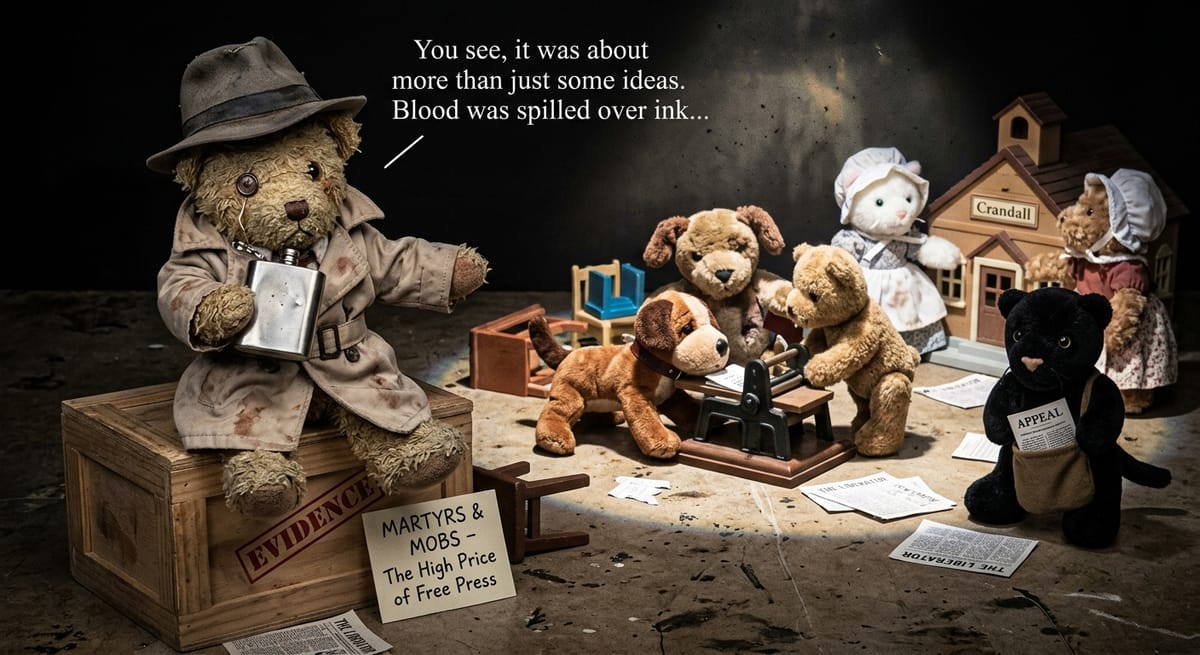
On the night of November 7, 1837, a pro-slavery mob attacked a warehouse in Alton, Illinois, for the third time in four months. Inside was a printing press belonging to Elijah P. Lovejoy, a Presbyterian minister and newspaper editor who had been printing anti-slavery material since 1833. This time they came armed. Lovejoy came out to defend the press and was shot five times. He was 35 years old. The mob threw his press into the Mississippi River. Lovejoy’s murder shocked the North in a way that years of abolitionist argument had not — when a white man was killed on free soil for publishing a newspaper, the abstract question of slavery became a question about whether the rights guaranteed to white Americans could survive it.
Part of Fighting Back: Slave Resistance in America — ← Back to series hub
The Abolitionist Movement Was Fractious, Not Unified — and That Mattered
The abolitionist movement was not a heroic march toward inevitable freedom. It was fractious, often internally contradictory, and produced intense disagreement about tactics, racial equality, and the role of violence. What its members shared was a conviction that slavery was a moral atrocity requiring immediate — not gradual — action, a position that put them at odds not only with the South but with most of the North.
William Lloyd Garrison launched The Liberator in Boston on January 1, 1831, with an opening statement that became one of the movement’s defining documents: “I will be as harsh as truth, and as uncompromising as justice… I will not equivocate — I will not excuse — I will not retreat a single inch — AND I WILL BE HEARD.” He was 25 years old. Over the next 35 years, he published the paper without missing a single issue.^1^
Garrison was a pacifist who believed slavery could be ended through moral suasion — convincing slaveholders and the public that the institution was wrong. He was also a consistent advocate for women’s participation in the movement at a time when that position was itself controversial. His 1833 founding of the American Anti-Slavery Society in Philadelphia, with 63 founding members, created the movement’s first national organizational structure.
What Did Abolitionism Actually Cost the People Who Practiced It?
The cost of abolitionism was not abstract. Garrison himself was dragged through the streets of Boston by a mob in October 1835, a rope around his waist, before the city constables rescued him. Prudence Crandall, a Quaker schoolteacher in Canterbury, Connecticut, opened a school for Black girls in 1832, was arrested in 1833 under a law Connecticut passed specifically to shut her down, had her well contaminated and her building’s foundation attacked with iron bars, and was finally forced to close after a night raid in September 1834 caused structural damage so severe the building could not be safely occupied.^2^
David Walker, a free Black man from Boston, published his Appeal to the Coloured Citizens of the World in September 1829 — a document that called explicitly for enslaved people to rise up and kill their enslavers if necessary. Southern states banned it immediately. Georgia put a $10,000 bounty on Walker alive and $1,000 dead. Walker was found dead in Boston in June 1830 under circumstances that were never fully explained. He was 36 years old.^3^
Frederick Douglass escaped from slavery in Baltimore in September 1838 and published his first autobiography, Narrative of the Life of Frederick Douglass, an American Slave, in 1845. The book named his enslavers, gave specific dates and locations, and was so detailed that it created genuine legal risk — he was still technically the property of Thomas Auld of Talbot County, Maryland, who could claim him under the Fugitive Slave Act. Friends raised $711.66 to purchase his legal freedom in 1846. He spent the next five years traveling through Britain, Ireland, and Scotland giving lectures, raising money, and building international pressure against American slavery.
The Movement Split Over Women’s Leadership — and the Fracture Accelerated Political Change
The abolitionist movement fractured in 1840 over the question of women’s leadership. Garrison’s faction maintained women’s full participation; the evangelical wing, led by Lewis Tappan, formed the breakaway American and Foreign Anti-Slavery Society. The split weakened organizational capacity but pushed a significant faction toward direct political action — the Liberty Party, founded in 1840, ran James G. Birney for president and received 7,000 votes. By 1848 its successor, the Free Soil Party, received 291,000 votes. By 1856, the Republican Party received 1.3 million.^4^
The trajectory from 63 founding members in 1833 to a major political party in 23 years was not inevitable, but it was also not coincidental. The movement produced the organizing infrastructure, the publications, the public figures, and the moral vocabulary that the Republican Party absorbed and — selectively — deployed. What the Republican Party did not absorb was the movement’s commitment to Black equality. Garrison and Douglass both understood that ending slavery was not the same as ending racism, and that a party built on free white labor would not necessarily serve Black Americans. They were right, as Reconstruction and its violent unraveling would demonstrate within a decade of the war’s end.
Lovejoy’s Murder Changed What Northerners Thought Was at Stake
Elijah Lovejoy’s murder in 1837 produced a galvanizing effect among northern observers who had previously thought abolitionism was an extremist fringe. The murder made the stakes of the debate concrete: this was not an argument about something happening far away to people who didn’t matter. It was an argument about whether the First Amendment meant anything, whether free speech survived south of the Ohio River, and whether a mob in service of slavery could operate with impunity on free soil.
John Quincy Adams, by 1837 a congressman from Massachusetts, read a petition into the Congressional Record the following year calling for the end of slavery in Washington, D.C. He was 71 years old and had been fighting the House’s “gag rule” — which automatically tabled all anti-slavery petitions without debate — since 1836. He kept fighting it until the rule was finally repealed in 1844. He died in the House chamber in 1848, still serving.
The abolitionist movement did not end slavery. A war did that, fought by men most of whom were not abolitionists and led by a president who, as late as 1862, said publicly that his goal was to save the Union rather than free enslaved people. But the movement created the moral and political conditions under which that war became possible — and under which emancipation became, eventually, the frame through which the war’s meaning was understood. The Underground Railroad, running in parallel throughout the same decades, was the movement’s practical arm: while abolitionists argued the moral case in print and in Congress, conductors and freedom seekers were proving with their lives that the system could be broken.
The martyrs are mostly forgotten now except as footnotes. Lovejoy has a college named after him in Illinois. David Walker is a footnote in survey courses. Prudence Crandall’s school is a Connecticut historic site. The movement they gave everything to did not deliver what they believed it would. It delivered something messier, more incomplete, and more consequential than any of them could have predicted.
─────────
Sources:
- Henry Mayer. All on Fire: William Lloyd Garrison and the Abolition of Slavery. St. Martin’s Press, 1998.
- Susan Strane. A Whole-Souled Woman: Prudence Crandall and the Education of Black Women. Norton, 1990.
- Peter P. Hinks. To Awaken My Afflicted Brethren: David Walker and the Problem of Antebellum Slave Resistance. Pennsylvania State University Press, 1997.
- James Brewer Stewart. Holy Warriors: The Abolitionists and American Slavery. Hill and Wang, 1976.