The Tuskegee Syphilis Study: 40 Years of Government-Sponsored Abuse
For 40 years the U.S. government withheld syphilis treatment from 399 Black men in Alabama — even after penicillin became standard care in 1947. The full story of what the PHS actually did.
The Tuskegee Syphilis Study: 40 Years of Government-Sponsored Abuse
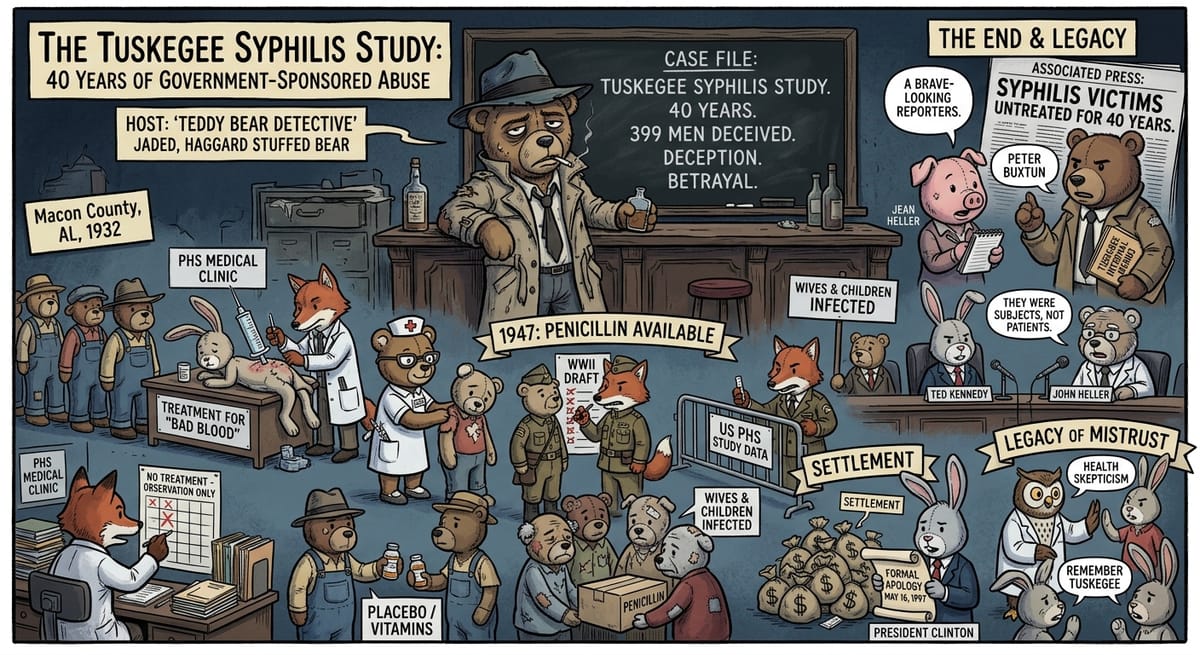
The Tuskegee syphilis study was a 40-year federal program in which the U.S. Public Health Service deliberately withheld treatment from 399 Black men with syphilis — including penicillin after it became the standard cure in 1947 — while lying to them about what the study was. When it finally ended in 1972, 128 men had died of syphilis or its complications, 40 wives had been infected, and 19 children had been born with congenital syphilis. In the most precise sense, it is a story of government betrayal: a federal health agency that chose scientific data over the lives of men who trusted it.
Part of Government Secrets — ← Back to series hub
The Study Was Designed to Deceive From the Start
The Public Health Service launched the “Tuskegee Study of Untreated Syphilis in the Negro Male” in 1932, during a syphilis epidemic in the rural South and in the middle of the Great Depression. Macon County, Alabama had a syphilis rate of 36 percent in its Black male population — the highest in the six counties the PHS surveyed. The plan was to document the natural progression of untreated syphilis in Black men, compare it with an existing Norwegian study of untreated syphilis in white patients, and draw whatever conclusions the data yielded.
From the start, the study’s design was deceptive by intent. Participants were told they were being treated for “bad blood,” a local term covering a range of ailments. They were given placebos — aspirin, vitamins — and painful spinal taps described as “special free treatment.” The 399 men in the syphilis group and 201 controls received free meals on examination days, free burial insurance, and the attention of medical professionals in a county with almost no healthcare access for Black residents. None were told they had syphilis. None were told the study’s actual purpose.^1
The machinery of deception required active maintenance. When the military’s World War II draft boards identified 256 of the study’s participants as eligible for treatment programs — the military treated syphilis to keep soldiers deployable — the PHS intervened directly to have them removed from the treatment lists. In 1947, when penicillin became the standard of care for syphilis, curing most cases with a single course of injections, the study’s administrators made the decision not to offer it to participants. The study’s value, they reasoned, was in observing untreated progression. Treatment would ruin the data.^2
Why Did the Federal Government Let This Continue for Four Decades?
The Tuskegee study was not a rogue operation hidden from headquarters. It was funded, reviewed, and continued by federal bureaucracy for four decades across multiple administrations. The PHS published papers from the study in peer-reviewed medical journals throughout the 1950s and 1960s. The Centers for Disease Control — which absorbed PHS responsibilities — reviewed the study in 1969 and recommended its continuation. A panel of senior health officials agreed.
This is the institutional dimension that makes Tuskegee a story of governmental failure rather than simply individual misconduct. Dozens of doctors, nurses, and administrators knew what the study was and chose to maintain it. The men were tracked at Tuskegee Institute — a historically Black university — with the cooperation of the institution’s health department, which lent the program a veneer of legitimacy and community endorsement that it used to recruit and retain participants. Eunice Rivers, a Black nurse who was the study’s primary point of contact with participants for its entire 40 years, believed — or convinced herself — that the medical attention the men received, even if deceptive, was more than they would otherwise have gotten. Her cooperation was essential to the program’s longevity.^3
A Single Whistleblower Ended What Internal Review Never Would
The study ended not because anyone in the government decided it was wrong, but because a lone PHS employee refused to let it continue. Peter Buxtun, a venereal disease investigator for the PHS, first raised concerns about the study in 1966. He wrote internal memos arguing the study was ethically indefensible. His superiors disagreed and the study continued. In 1972, Buxtun took the information to reporter Jean Heller of the Associated Press. Her story ran on July 25, 1972, on the front pages of newspapers across the country.^4
The public reaction was immediate and sharp. The Department of Health, Education and Welfare convened an advisory panel within weeks. By October 1972, the panel had declared the study “ethically unjustifiable” and recommended terminating it. The study was officially ended that November — 40 years after it began.
Congressional hearings followed. Senator Edward Kennedy chaired hearings in February and March 1973 that put the study’s surviving administrators on the record. Dr. John Heller, who had directed the PHS’s Division of Venereal Diseases during the study, told the committee: “The men’s status did not warrant ethical debate. They were subjects, not patients; clinical material, not sick people.” That quote captured with unsettling precision what the program had always believed about its participants.
The National Research Act, signed into law in July 1974, created the National Commission for the Protection of Human Subjects of Biomedical and Behavioral Research — the first federal body charged with establishing ethical standards for research involving human participants. The resulting Belmont Report, issued in 1979, became the foundational document of American research ethics. It exists because of what the government did in Macon County.^5
The Settlement Came Decades Too Late to Fix the Damage
In 1973, the NAACP filed a class action lawsuit on behalf of surviving participants and their families. The government settled in 1974 for $10 million — about $67 million in 2024 dollars — without admitting liability. Survivors received $37,500 each; heirs of deceased participants received $15,000. A health benefits program for participants and their infected family members was established and operated until the last survivor died.
President Bill Clinton issued a formal apology on May 16, 1997, in a White House ceremony attended by eight surviving participants. “The United States government did something that was wrong — deeply, profoundly, morally wrong,” Clinton said. “It was an outrage to our commitment to integrity and equality for all our citizens.” The apology was real, but it came 25 years after the study ended and 65 years after it began.
The study’s legacy is measurable in mistrust. Research published in 2016 in the Journal of Medicine and Philosophy found that disclosure of the Tuskegee study’s details correlates with decreased medical engagement among Black men — fewer seeking preventive care, lower vaccination rates, heightened skepticism of clinical trials. The government’s 40-year deception did not end when the study did. Its effects travel forward through generations who know what happened and have rational reasons to remember.
The Tuskegee study is one of three documented programs in which the federal government ran covert operations against its own citizens for decades. For how the same institutional logic played out in FBI surveillance and CIA experimentation, see COINTELPRO and MKUltra. For the history of forced medical procedures targeting other vulnerable populations, see forced sterilization programs.
─────────
Sources:
- Jones, James H. Bad Blood: The Tuskegee Syphilis Experiment. Free Press, 1981.
- Reverby, Susan M. Examining Tuskegee: The Infamous Syphilis Study and Its Legacy. University of North Carolina Press, 2009.
- Smith, Susan L. “Neither Victim nor Villain: Nurse Eunice Rivers, the Tuskegee Syphilis Experiment, and Public Health Work.” Journal of Women’s History, 1996.
- Heller, Jean. “Syphilis Victims in U.S. Study Went Untreated for 40 Years.” Associated Press, July 25, 1972.
- National Commission for the Protection of Human Subjects. The Belmont Report. Department of Health, Education and Welfare, 1979.