MKUltra: The CIA's Mind Control Experiments
The CIA secretly dosed prisoners mental patients and soldiers with LSD for 21 years under MKUltra. When investigators got close Sidney Gottlieb spent three days shredding the evidence.
MKUltra: The CIA’s Mind Control Experiments
MKUltra was a CIA program that ran for 21 years — from 1953 to 1973 — testing drugs, hypnosis, electroconvulsive therapy, sensory deprivation, and psychological coercion on human subjects who did not know they were being experimented on. It funded research at 80 institutions including 44 universities, and left a trail of damaged and destroyed lives that would not be fully reckoned with until a Senate investigation in 1977. What makes MKUltra a political scandal rather than simply a scientific atrocity is the chain of authorization that ran from agency director Allen Dulles through layers of bureaucracy to the hospitals, prisons, and safe houses where the experiments took place — and the systematic effort to destroy the evidence before anyone could read it.
Part of Government Secrets — ← Back to series hub
The CIA Believed Mind Control Could Win the Cold War
The program grew from Cold War paranoia, specifically the fear that the Soviet Union and China had developed methods of “brainwashing” American prisoners of war — a fear stoked by the confessions extracted from American POWs during the Korean War. CIA Director Allen Dulles authorized MKULTRA on April 13, 1953, in a memo that described the need for “research and development of chemical, biological, and radiological materials capable of employment in clandestine operations to control human behavior.”^1
Richard Helms, then the CIA’s Deputy Director for Plans, was the program’s principal advocate inside the agency. Sidney Gottlieb, a chemist with a Ph.D. from Caltech who headed the CIA’s Technical Services Division, ran it operationally from 1953 until 1973. Gottlieb was genuinely convinced that LSD and other psychoactive compounds might be weaponized or used to extract confessions, incapacitate enemies, or program agents. Under his direction, the program grew into something far larger and stranger than its original mandate.
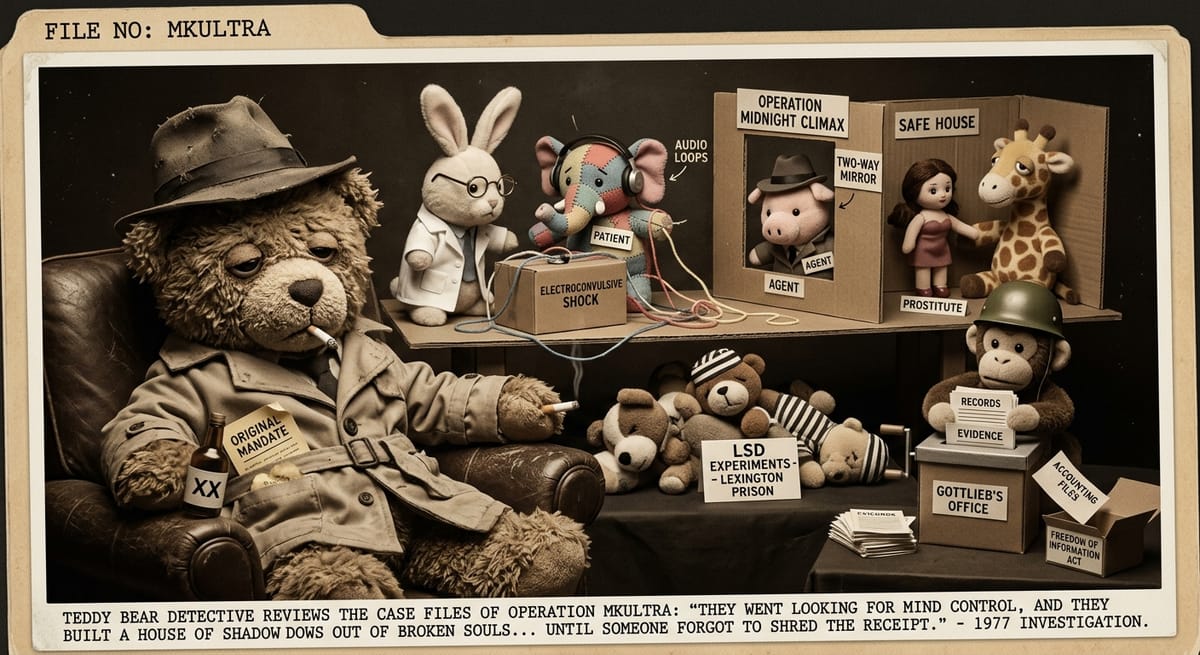
The CIA’s interest was not merely pharmaceutical. MKULTRA subprojects investigated hypnosis, sleep deprivation, sensory isolation, psychological torture, and the manipulation of memory. One subproject studied the effects of combining LSD with electroconvulsive therapy. Another examined whether subjects could be programmed to carry out acts they would otherwise refuse. Subproject 68, run by Dr. Ewen Cameron at McGill University’s Allan Memorial Institute in Montreal beginning in 1957, involved erasing patients’ existing personalities through repeated electroconvulsive shock, drug-induced sleep lasting weeks, and audio loops played to subjects during unconsciousness — a process Cameron called “psychic driving.”^2
They Specifically Chose Subjects Who Couldn’t Report What Was Done to Them
Unwitting experimentation was a design feature, not an accident. The CIA’s own documents show that Gottlieb and his team specifically sought subjects who could not or would not report what was done to them: prisoners, mental patients, drug addicts, and people in foreign countries. Operation Midnight Climax, a sub-program run by agent George White from 1954 to 1966, used CIA-funded safe houses in San Francisco and New York where prostitutes — recruited as unwitting assets — lured clients who were then dosed with LSD while agents watched through two-way mirrors. White later wrote to Gottlieb: “I toiled wholeheartedly in the vineyards because it was fun, fun, fun. Where else could a red-blooded American boy lie, kill, cheat, steal, rape and pillage with the sanction and blessing of the All-Highest?”^3
At the Addiction Research Center in Lexington, Kentucky, prisoners were given LSD, mescaline, and other hallucinogens in exchange for heroin. At state psychiatric hospitals, patients who had already been committed — and thus had no legal voice — were dosed without consent. Soldiers were subjected to experiments at Edgewood Arsenal in Maryland, some told only that they were testing “new equipment,” others not told anything at all.
Frank Olson, a civilian Army scientist who worked on the program, was dosed with LSD without his knowledge at a retreat at Deep Creek Lake, Maryland in November 1953. He became agitated and psychologically unstable in the days that followed. On November 28, 1953 — nine days after being dosed — he fell from the window of Room 1018A at the Hotel Statler in New York City. The CIA officially called it a suicide. His family disputed this for decades, and a 1994 exhumation found evidence consistent with homicide. No one was ever charged.^4
What Survived the Cover-Up Was Found by Accident
When James Schlesinger became CIA director in 1973 and ordered a review of questionable agency activities, Gottlieb spent three days destroying MKULTRA records before the order could be fully implemented. Entire filing cabinets of project documentation were shredded. The CIA’s inspector general had already flagged the program’s records as sensitive in 1963, recommending that “present practice of keeping full records” be reconsidered. The destruction was thorough enough that a complete accounting of the program remains impossible.
What survived the shredding was found by accident in 1977, when a researcher working on a Freedom of Information Act request discovered 20,000 documents in a financial records building in Rockville, Maryland — the accounting files had been stored separately from the operational records Gottlieb destroyed. Senator Edward Kennedy’s Subcommittee on Health and Scientific Research held hearings in August 1977. Admiral Stansfield Turner, the CIA director, testified that the program had involved experiments on “unwitting” human subjects and that “the CIA’s own internal review” had concluded the experiments were “ill-conceived, poorly planned, and hastily executed.”^5
Gottlieb himself testified at the 1977 hearings, invoking his Fifth Amendment right against self-incrimination on some questions while confirming the program’s broad outlines. He retired to a farm in Virginia, worked as a hospice volunteer, and died in 1999. No charges were ever brought against him or any other CIA official for MKULTRA.
The Church Committee investigation of 1975 first brought MKULTRA’s broad outlines to public attention, and the 1977 Senate hearings filled in the details the document destruction allowed to survive. President Gerald Ford issued an executive order in 1976 banning CIA experimentation on human subjects without informed consent. President Jimmy Carter’s administration declassified thousands of documents related to intelligence abuses.
Several MKULTRA survivors sued the government. The family of Frank Olson received a $750,000 settlement from Congress in 1976. Canadian survivors of Ewen Cameron’s experiments — who had been seeking treatment for depression and other conditions, not volunteering for CIA research — sued both Cameron’s estate and the Canadian government, which had also funded some of Cameron’s work. They settled for $100,000 CAD each in 1988.
The program ended. The institutional culture that produced it — the conviction that national security needs override legal and ethical constraints, that the ends justify covert and harmful means, that classification can protect wrongdoing indefinitely — did not end with it. What MKUltra exposed was not a malfunction. It was what happens when a powerful agency operates without oversight, believes its mission exempts it from the rules that govern everyone else, and knows it can destroy the evidence. It took a filing error to stop that from working.
The same pattern of authorized, concealed, long-running government programs that targeted vulnerable populations without their knowledge runs through COINTELPRO and the Tuskegee syphilis study. For how the government handled a similar accountability gap in political scandals, see Watergate and Iran-Contra.
─────────
Sources:
- Marks, John. The Search for the “Manchurian Candidate”: The CIA and Mind Control. Times Books, 1979.
- Collins, Anne. In the Sleep Room: The Story of the CIA Brainwashing Experiments in Canada. Lester & Orpen Dennys, 1988.
- Streatfeild, Dominic. Brainwash: The Secret History of Mind Control. Hodder & Stoughton, 2006.
- Albarelli, H. P. A Terrible Mistake: The Murder of Frank Olson and the CIA’s Secret Cold War Experiments. Trine Day, 2009.
- United States Senate. Project MKULTRA, The CIA’s Program of Research in Behavioral Modification: Joint Hearings Before the Select Committee on Intelligence. U.S. Government Printing Office, 1977.