Government Secrets: When America Experimented on Its People
COINTELPRO ran 15 years. Tuskegee ran 40. MKUltra ran 21. None ended because the government decided they were wrong. The pattern behind three of the most documented federal abuses in history.

Government Secrets: When America Experimented on Its People
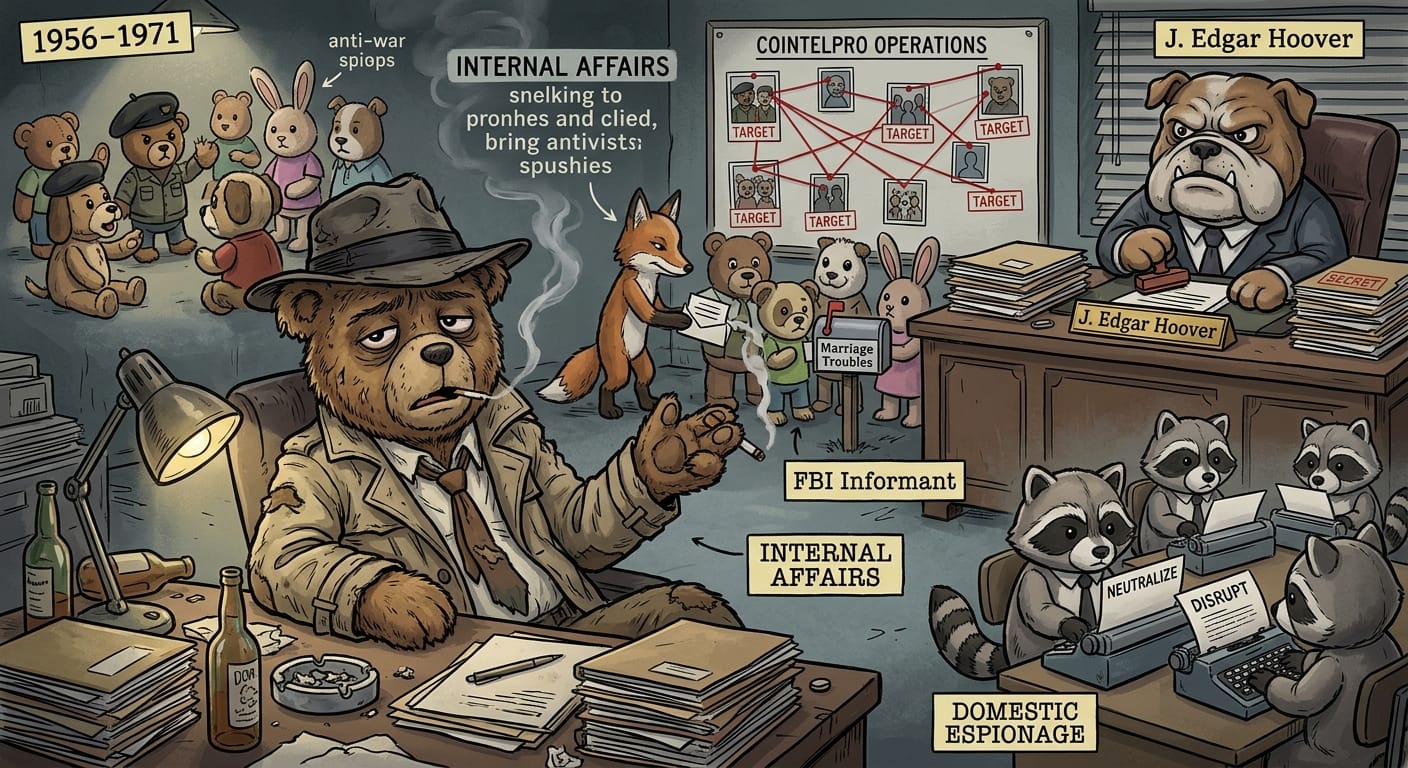
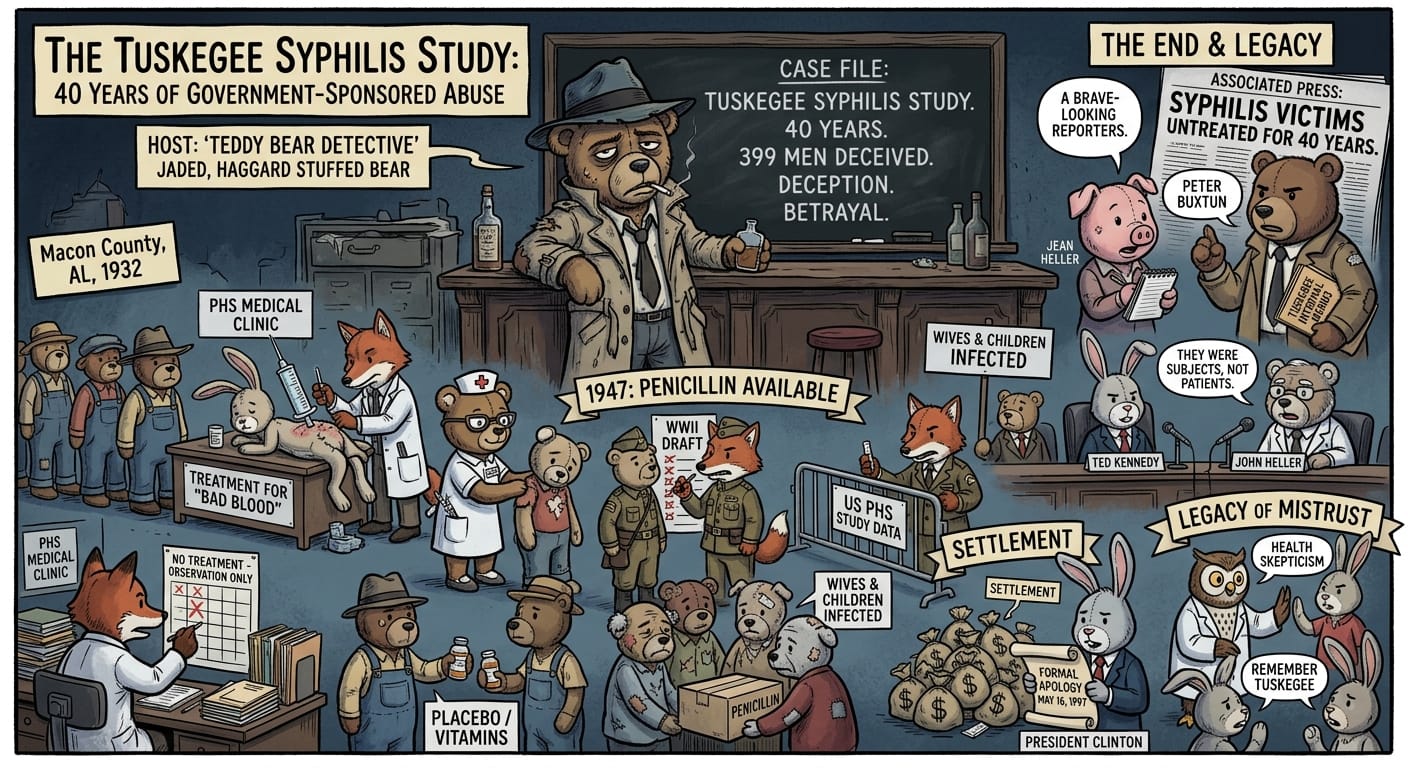
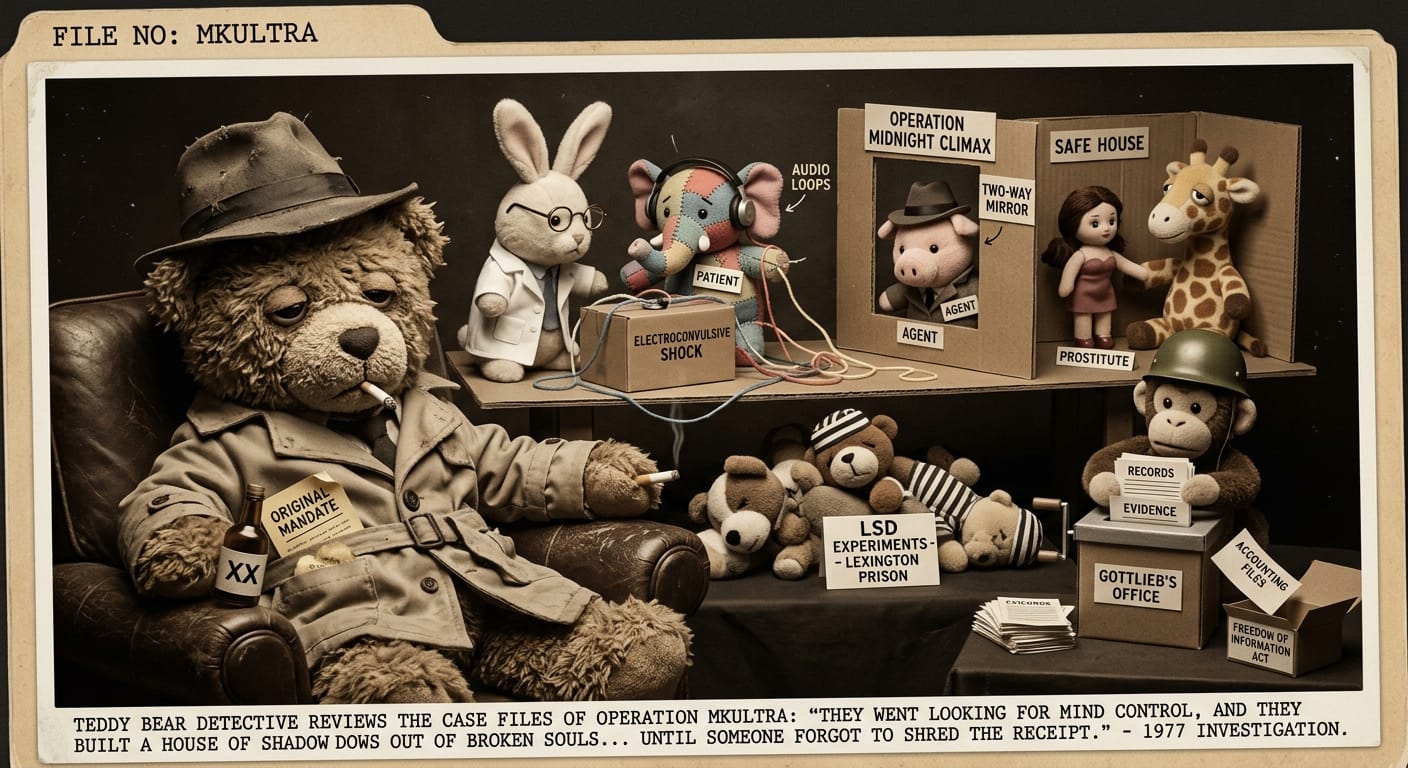
There is a pattern inside three of the most documented government scandals in American history. It is not the pattern of a rogue agent or a single bad administration. It is the pattern of an institution — the federal government — deciding that certain categories of Americans could be used, surveilled, manipulated, or experimented on without their knowledge or consent, and then building bureaucratic systems to do it, maintain it, and conceal it. COINTELPRO ran for 15 years. The Tuskegee syphilis study ran for 40. MKUltra ran for 21. None of them ended because the government decided they were wrong.
In This Series
- COINTELPRO: The FBI’s War Against Its Own Citizens
- The Tuskegee Syphilis Study: 40 Years of Government-Sponsored Abuse
- MKUltra: The CIA’s Mind Control Experiments
Three Programs Share the Same Structure of Authorized Abuse
Each program had three things in common. First, the targets were selected partly for their vulnerability to being targeted without pushback — Black Americans in Alabama with no healthcare access, political dissidents whose complaints would be dismissed as paranoia, mental patients and prisoners with no legal standing to report what was done to them. Second, each program was authorized at senior levels and reviewed repeatedly without being stopped. These were not rogue operations hidden from headquarters. COINTELPRO was approved by J. Edgar Hoover and reported on by field offices as routine bureau activity. The Tuskegee study was reviewed by the Centers for Disease Control in 1969 and recommended to continue. MKUltra’s subprojects were funded through CIA front organizations with the knowledge of multiple directors. Third, each program ended because of outside exposure — a stolen document, a leaked story, a Freedom of Information request — not because internal accountability mechanisms functioned.^1
The Tuskegee study’s administrators withheld penicillin from 399 men after it became standard treatment in 1947. This was not a passive omission but an active intervention: the PHS tracked participants specifically to prevent them from receiving treatment elsewhere, including blocking 256 of them from military treatment programs during World War II. The men were not missing from the system. The system was organized around them.
COINTELPRO’s targeting of the Southern Christian Leadership Conference, the Student Nonviolent Coordinating Committee, and Martin Luther King Jr. personally was not incidental to civil rights enforcement. The program’s 1968 memo stated explicitly that its goal was to prevent the rise of a “messiah” who could unify Black political movements. The FBI was not fighting crime. It was fighting political organization by Black Americans, using the tools of a criminal investigation agency.
The Laws Existed. What Failed Was the Will to Enforce Them.
The failure was not a failure of laws. By the 1950s and 1960s, constitutional protections against unreasonable search, against coerced participation in research, against government interference with political association were established law. What failed was the enforcement mechanism — the assumption that agencies powerful enough to conduct these operations would not also be powerful enough to protect themselves from accountability.^2
J. Edgar Hoover served as FBI Director from 1924 to his death in 1972, accumulating personal files on politicians, presidents, and public figures that functioned as implicit blackmail collateral. No president of the era effectively constrained him. Sidney Gottlieb ran MKUltra’s operations from 1953 to 1973 and spent three days shredding records when congressional scrutiny became imminent. The Tuskegee study’s Dr. John Heller told a Senate committee that the men were “subjects, not patients; clinical material, not sick people” — language that illuminates the institutional worldview that sustained the program for decades.
In each case, the congressional investigations that ultimately documented the programs — the Church Committee (1975–1976), the Kennedy subcommittee hearings (1977), the Ervin Committee’s broader inquiry into executive overreach — came years after the damage was done. They produced comprehensive documentation and meaningful legislative reform. They did not produce criminal accountability. No FBI agent was prosecuted for COINTELPRO. No CIA official was charged for MKUltra. No federal health administrator was indicted for Tuskegee.^3
What Mission-Driven Bureaucracies Do When No One Is Watching
These programs shared an institutional logic: that the mission — national security, scientific research, social order — justified the means, and that the people being used were expendable in service of a larger purpose. This logic is not anomalous. It is a recognizable feature of powerful bureaucracies that lack external accountability.
What makes the American version of this logic politically significant is the explicit contradiction with the nation’s stated values. The Declaration of Independence’s language about inalienable rights and the consent of the governed was not abstract to the men in Macon County who trusted the government with their health, or to the activists whose mail was opened and marriages were destroyed, or to the psychiatric patients dosed with LSD by CIA contractors. The contradiction between stated principle and operational practice was not incidental — it was functional. The public commitment to civil liberties was real enough to require that the operations be secret.
The Belmont Report, which emerged from the post-Tuskegee reckoning in 1979, established the foundational principles of informed consent in American research ethics. The Church Committee’s work led to the Foreign Intelligence Surveillance Act of 1978 and the first legal framework requiring judicial oversight of domestic intelligence. These reforms were substantial. They also took decades to produce and required the programs to be exposed first.^4
The Evidence Points to One Answer: Who Watches the Watchers?
The question these three programs force is not whether the government can act in ways that contradict its stated values — the historical record answers that definitively. The question is what conditions allow it to do so for decades without internal correction.
The answer the evidence provides is consistent: when the targets are populations without political power, when the operations are classified or concealed, when the agencies involved are large and prestigious enough to dismiss critics as uninformed or adversarial, and when senior officials have personal or institutional interests in continuation, the programs continue. What stops them is journalism, leaks, and congressional investigators willing to do the work — not the self-correction of institutions that have decided the rules don’t apply to them.
The reforms that followed each exposure were real. But they were reactive, not anticipatory. And the underlying institutional question — who watches the watchers, and what happens when they don’t — remains the same one it was in 1956, when COINTELPRO opened its first files.^5
For the parallel story of how the same accountability failures played out in electoral politics and foreign policy, see Political Corruption: America’s Other National Pastime.
─────────
Sources:
- Theoharis, Athan. Spying on Americans: Political Surveillance from Hoover to the Huston Plan. Temple University Press, 1978.
- Marks, John. The Search for the “Manchurian Candidate”: The CIA and Mind Control. Times Books, 1979.
- Reverby, Susan M. Examining Tuskegee: The Infamous Syphilis Study and Its Legacy. University of North Carolina Press, 2009.
- United States Senate. Final Report of the Select Committee to Study Governmental Operations with Respect to Intelligence Activities. U.S. Government Printing Office, 1976.
- Cunningham, David. There’s Something Happening Here: The New Left, the Klan, and FBI Counterintelligence. University of California Press, 2004.
The Series