Nat Turner's Rebellion: The Uprising That Terrified the South
Nat Turner's 1831 rebellion in Southampton County Virginia killed 55 people and triggered a continent-wide crackdown on Black literacy and religious assembly.
Nat Turner’s Rebellion: The Uprising That Terrified the South
Nat Turner’s rebellion began before midnight on August 21, 1831, when Turner and six other enslaved men gathered in the woods of Southampton County, Virginia, and made a decision that sent shockwaves through every slaveholding state in the South. By the time it ended, 55 white Virginians were dead, the Virginia legislature was debating emancipation, and every Southern state had tightened its slave codes into something close to a cage made of law. Turner was 31 years old. He had been planning this for months.
Part of Fighting Back: Slave Resistance in America — ← Back to series hub
Why Nat Turner Believed He Was Chosen — and Why That Belief Was Rational
Nat Turner was born into slavery on October 2, 1800, on the Benjamin Turner plantation in Southampton County, Virginia, roughly 70 miles southeast of Richmond. From early childhood, the people around him believed he was exceptional — his mother, Nancy, reportedly had to be restrained from killing him at birth rather than see him grow up enslaved, and neighbors recalled that he seemed to know details about his own birth before he could have been told them.^1^
Turner taught himself to read. He studied the Bible with an intensity that bordered on obsession, and by his mid-twenties he had become a lay preacher, moving between plantations with permission to hold religious meetings. What he was doing at those meetings was more complicated than preaching — he was building a network, taking the measure of men, watching and waiting.
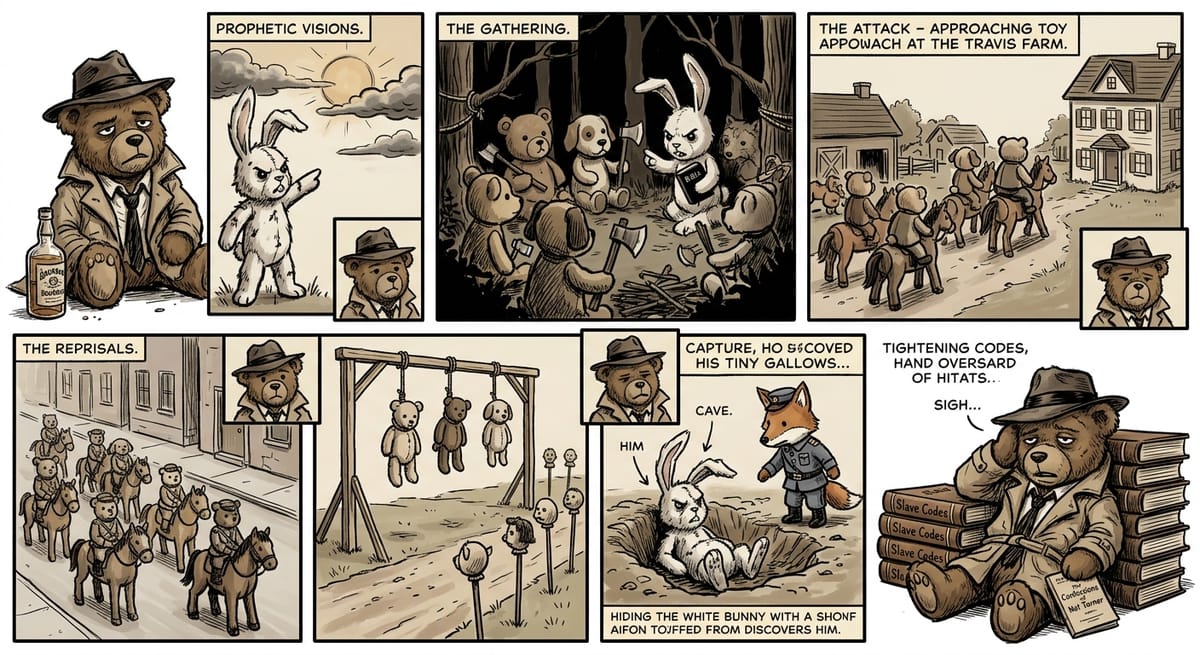
In 1825, Turner experienced the first of what he described as prophetic visions: figures in the sky, blood on corn, the Holy Spirit commanding him to take up the fight that white men had claimed in the Revolution but denied to Black people. He told his confessor, attorney Thomas R. Gray, that he interpreted a solar eclipse in February 1831 as the final sign. He set July 4th as his date, then postponed when he fell ill. The August 13th atmospheric disturbance — the sun turned bluish-green over much of the Eastern Seaboard — convinced him the time had come.^2^
How Did Nat Turner’s Rebellion Actually Unfold?
The rebellion started before midnight on August 21 at the farm of Joseph Travis, Turner’s current enslaver. Travis, his wife Sally, and their young son were killed in their beds. From there, Turner’s group moved farm to farm through the county, gathering both men and weapons. By dawn, the group had grown to approximately 70 enslaved men on horseback.
The violence was deliberate and total. Turner’s strategy was to kill every white person they encountered — no exceptions — to prevent any survivor from raising an alarm before the group could reach the county seat of Jerusalem, Virginia, seize its armory, and push into the Dismal Swamp, where they might hold out or recruit more fighters. The rebels killed 55 people in roughly 48 hours, among them Margaret Whitehead, whom Turner killed personally with a fence post — the only person he killed directly, by his own account to Gray.^2^
On August 23, the rebellion collapsed. Turner’s men ran into a group of armed white men at the farm of Dr. Simon Blunt and were routed. Turner himself hid for more than six weeks — a detail that amplified the terror considerably, since no one knew if he was organizing something larger.
Virginia’s Response Exposed the System’s Core Contradiction
The response from white Virginia was immediate and wildly disproportionate. Militia units, armed citizens, and eventually federal troops poured into Southampton County. In the days that followed, white mobs killed somewhere between 100 and 200 enslaved Black people across the region — most of whom had no connection to the rebellion at all. Heads were mounted on fence posts at crossroads as warnings.^1^
Turner was captured on October 30, 1831, when a farmer named Benjamin Phipps found him hiding in a cave near the Travis farm. He was tried on November 5 and hanged on November 11. His body was skinned, rendered into grease, and his skull reportedly passed between collectors for decades.
The Virginia legislature convened a rare special session to debate what had happened. For a brief moment in early 1832, Virginia legislators came closer to a gradual emancipation vote than any Southern state would get for the next three decades. The reformers lost. What Virginia chose instead was a comprehensive new slave code that made it illegal to educate enslaved people, restricted free Black movement, and explicitly banned Black preaching.^3^
Tightening the Codes Proved That the Threat Was Always Real
Every Southern state watched what Virginia did and followed. The next decade saw the systematic elimination of whatever narrow spaces enslaved people had previously occupied — religious assembly, literacy, unsupervised movement. The logic was explicit: Nat Turner had been literate, had been allowed to preach, had been permitted to travel. Those conditions had produced this. Remove the conditions.
What the logic missed — and what Southern legislators could not afford to admit — was that the conditions for rebellion were not Turner’s literacy or his faith. They were slavery itself. Turner said as much to Gray in November 1831, and Gray published it. He expressed no regret. He said he was not mistaken. He said he had been called.
The Confessions of Nat Turner, as Gray transcribed them, became the most widely distributed document in the South that year — in large part because slaveholders were desperate to understand what had happened. What the document actually showed was a man of extraordinary intelligence who had concluded, after decades of thought and observation, that the only response to an absolute system of violence was violence. Whether the reader found that monstrous or reasonable depended entirely on what they thought about the system he was fighting.
What Southampton County Looked Like After the Reprisals
The white death toll of 55 was the highest of any slave rebellion in American history. The Black death toll from the reprisals dwarfed it, though Virginia never produced an accurate count. Southampton County’s enslaved population lived under extraordinary surveillance and restriction for years afterward, and the county’s free Black population — which had numbered around 1,700 before the rebellion — was effectively dismantled through new residency laws and forced departure.^4^
Turner was dead at 31. The six men who had gathered with him at Cabin Pond were dead. Most of the 70 who had joined them were dead. The armory at Jerusalem was never reached. The Dismal Swamp plan never happened.
And still, for the next 30 years, every Southern legislature met under the specific awareness that it could happen again. Slaveholders slept with their doors locked and their weapons within reach. They built a surveillance system, a legal apparatus, and an ideology — the “positive good” argument that slavery benefited the enslaved — as a direct response to the proof Nat Turner had provided that none of it was believed by the people living under it.
The terror he caused in 1831 was real. The fear that produced the terror was also real — and it had nothing to do with Turner being wrong.
─────────
Sources:
- Stephen B. Oates. The Fires of Jubilee: Nat Turner’s Fierce Rebellion. Harper & Row, 1975.
- Thomas R. Gray. The Confessions of Nat Turner. Lucas & Deaver, 1831.
- Henry Irving Tragle. The Southampton Slave Revolt of 1831: A Compilation of Source Material. University of Massachusetts Press, 1971.
- Kenneth S. Greenberg, ed. Nat Turner: A Slave Rebellion in History and Memory. Oxford University Press, 2003.