The St. Valentine's Day Massacre: The Hit That Shocked a Nation
On February 14, 1929, seven men were shot in a Chicago garage in Capone's war against the North Side Gang — the event that finally forced the federal government to treat organized crime as a national problem.
The St. Valentine’s Day Massacre: The Hit That Shocked a Nation
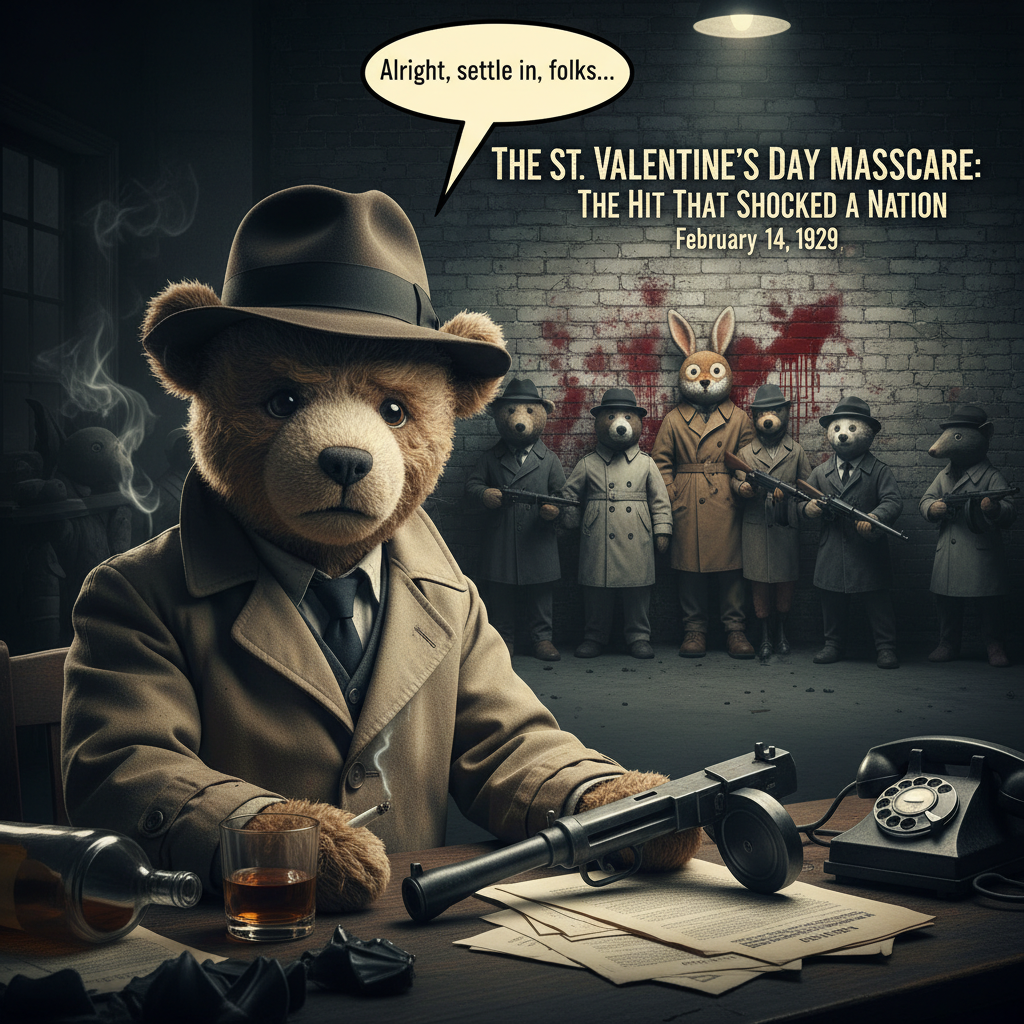
On February 14, 1929, seven men were lined up against the north wall of the S-M-C Cartage Company garage at 2122 North Clark Street in Chicago and shot a combined seventy times — and the event that followed transformed American organized crime from a local problem into a national scandal.^1^ Six of them were dead before the police arrived. The seventh, a mechanic named Frank Gusenberg, was still alive when officers reached the scene. Asked who had shot him, he said, “Nobody shot me.” He died three hours later.
Part of Prohibition-Era Organized Crime — ← Back to series hub
What Happened on North Clark Street That Morning
The garage on North Clark Street was a distribution point used by the North Side Gang, then nominally led by George “Bugs” Moran. The North Side Gang had been Al Capone’s primary rival for Chicago’s bootlegging territory since the early 1920s, and the campaign against them had already cost Moran two leaders: Dion O’Banion, murdered in 1924, and Hymie Weiss, killed in 1926. By 1929, Moran was the last significant obstacle to Capone’s complete domination of Chicago’s liquor trade.
At approximately 10:30 a.m., a black Cadillac that resembled a police detective’s car pulled up outside the garage. Five men got out — two dressed in police uniforms, three in civilian clothes. They entered the garage where Moran’s crew was expecting a shipment of bootleg whiskey. The seven victims were told to line up against the wall, a standard police procedure for a raid, and they complied. Someone opened fire from the doorway. The shooters used two Thompson submachine guns and two shotguns. The entire execution took less than a minute.
Moran himself was supposed to be at the garage that morning. He was late — accounts differ on how late — saw the police car outside, and left without going in. He was never prosecuted, never imprisoned for any role in the massacre, and lived until 1957, dying in Leavenworth federal penitentiary on a check fraud conviction.
Who the Seven Men Actually Were
Five of the seven dead were associated with the North Side Gang. Frank and Pete Gusenberg were brothers who had worked as enforcers for Moran and had made multiple prior attempts on Capone’s life, including a 1929 attack on Capone lieutenant Jack McGurn’s hotel room. Albert Kachellek, who went by the alias “James Clark,” was Moran’s brother-in-law and a senior figure in the organization. Adam Heyer was the gang’s business manager. Albert Weinshank ran several cleaning establishments as a front.
The sixth North Side associate was John May, an auto mechanic with seven children who had no criminal record and was at the garage doing legitimate repair work on a truck. The seventh victim was Reinhart Schwimmer, an optometrist who had no mob affiliation but had cultivated friendships with North Side Gang members as a form of social thrill-seeking. He was in the wrong place entirely.
The case was never officially solved. Jack McGurn, a Capone associate widely believed to have planned the operation, was indicted but the charges were dropped when his girlfriend — later his wife — provided an alibi. No one was ever convicted of any of the seven killings.
Why the Context That Made It Possible Matters as Much as the Event
Chicago in the 1920s had already seen roughly 400 gang-related murders, most of them unsolved, most generating only localized outrage. The city’s political establishment had a financial relationship with Capone’s organization — when Capone moved his headquarters to Cicero, Illinois, it was in part because Cicero’s government had been effectively captured by his allies. Police in Chicago were not simply corrupt in isolated cases; corruption was systematic, which is why gang figures knew that witnesses who survived tended not to talk.
The specific trigger for the massacre appears to have been a combination of territory and insult. Moran had been hijacking Capone liquor trucks, attacking Capone establishments, and publicly mocking Capone — he reportedly referred to him as “the Beast.” The final provocation may have been a deal involving Purple Gang bootlegger Jack Dalton, who set up the whiskey shipment that lured Moran’s men to the garage that morning, though Dalton’s exact role has never been definitively established.
How One Event Ended the Informal Arrangement That Had Protected Capone for Years
The massacre produced two significant consequences that Capone had not anticipated. The first was the destruction of the North Side Gang as a functioning organization, which Capone got. The second was a federal response he hadn’t bargained for. President Herbert Hoover, who had been in office for less than three weeks when the massacre occurred, was reportedly furious and directed federal agencies to pursue Capone by whatever means available. The IRS investigation that ultimately landed Capone in federal prison grew directly from the mandate that emerged after February 14, 1929.^2^
The massacre also triggered a public relations catastrophe. The Crime Commission of Chicago released its first “public enemies” list in April 1930, naming Capone first among twenty-eight targets. The terminology entered the American vernacular. J. Edgar Hoover’s Bureau of Investigation used the public enemies framework to build political support for expanded federal law enforcement authority.
Photographs from the scene at 2122 North Clark Street circulated nationally, and the image of bodies against a blood-soaked wall became the defining visual of Prohibition-era gangsterism. Public opinion, which had been ambivalent about bootleggers throughout the 1920s — many Americans saw them as businessmen satisfying legitimate demand — shifted after the massacre toward demanding enforcement. The event handed law enforcement reformers a concrete atrocity to point to.
What an Empty Parking Lot Tells You About What the Massacre Actually Meant
The garage on North Clark Street was demolished in 1967. A parking lot occupied the site for decades, and in 2018 a new building was constructed there — condominiums and retail. There’s no marker. Tourists who make the pilgrimage looking for something to stand in front of find a building like any other.
That absence is clarifying. The massacre mattered not because of what happened in that building — gang violence was constant in Prohibition Chicago — but because of what it meant to people watching from outside the city. It became the moment the country decided it was done pretending that bootlegging was victimless, that gangsters were folk heroes, that the whole arrangement was essentially harmless. Seven men died against a warehouse wall and the moral accounting that Americans had been avoiding for nine years of Prohibition suddenly became impossible to defer. The massacre didn’t end organized crime. It ended the public tolerance that had let organized crime operate openly.
The Capone organization’s time in Chicago did not end immediately — Capone continued operating through 1930 and into 1931. But the political environment after the massacre made it impossible to continue the informal arrangement he had with local government. Lucky Luciano would go on to formalize those lessons into the Commission he established that same year: keep the violence contained, keep it internal, and never give the federal government a reason to pay attention.
─────────
Sources:
- Bair, Deirdre. Al Capone: His Life, Legacy, and Legend. Nan A. Talese/Doubleday, 2016.
- Helmer, William J., and Arthur J. Bilek. The St. Valentine’s Day Massacre: The Untold Story of the Gangland Bloodbath That Brought Down Al Capone. Cumberland House, 2004.
- Okrent, Daniel. Last Call: The Rise and Fall of Prohibition. Scribner, 2010.
- Eig, Jonathan. Get Capone: The Secret Plot That Captured America’s Most Wanted Gangster. Simon & Schuster, 2010.