Bootlegging Empires: The Business of Breaking the Law
Prohibition-era bootlegging was a vertically integrated industry with syndicates, distributors, and retail speakeasies — generating billions in today's dollars and training the men who built modern organized crime.
Bootlegging Empires: The Business of Breaking the Law
Prohibition-era bootlegging was not a collection of individual criminals selling hooch from bathtubs — it was a vertically integrated industry that required manufacturing, logistics, retail distribution, and large-scale political corruption to function at scale.^1^ The Eighteenth Amendment took effect at midnight on January 17, 1920. By 12:01 a.m., six armed men had already hijacked a train car full of medicinal whiskey in Chicago. The bootleggers had been watching the calendar and were better prepared for Prohibition than the government was.
Part of Prohibition-Era Organized Crime — ← Back to series hub
What Is Bootlegging, and How Was It Actually Structured?
Bootlegging wasn’t a single activity — it was an industry with distinct tiers, from large-scale manufacturing operations that produced tens of thousands of gallons per week down to individual households selling home-brewed beer to neighbors. The romanticized version — the speakeasy, the flask, the bathtub gin — was only the retail end of a supply chain that ran from industrial distilleries to street-level distributors.
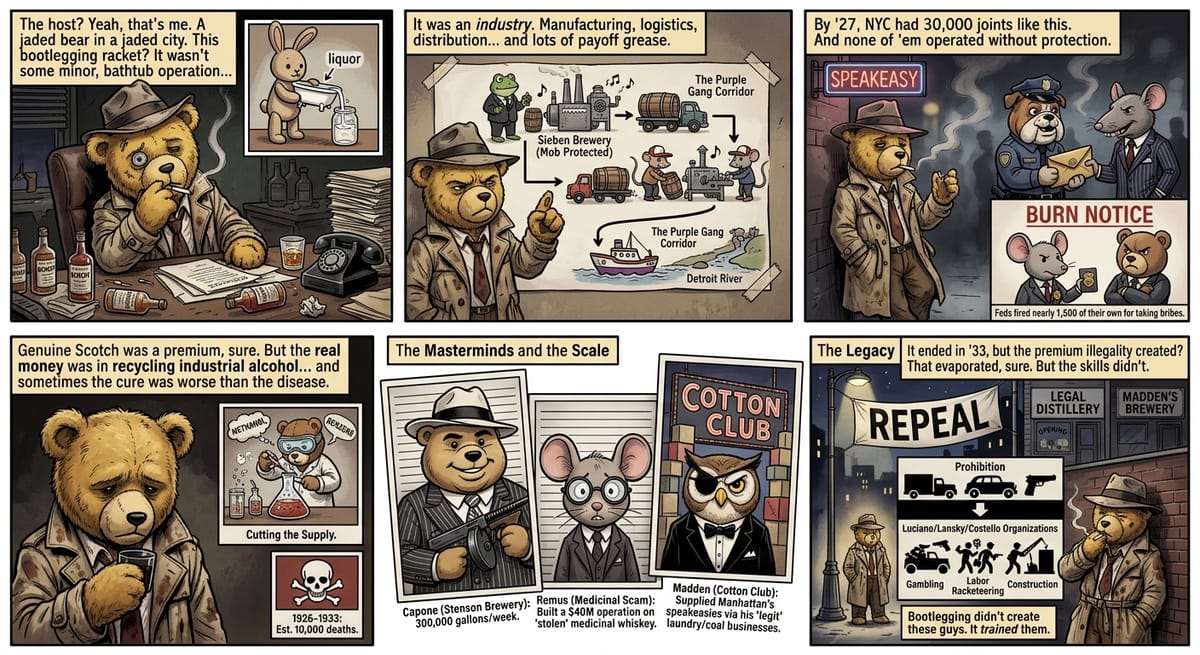
At the top were organized syndicates with access to commercial-grade distilling equipment, often repurposed from pre-Prohibition breweries and distilleries that had legally operated for decades. The Al Capone organization sourced significant quantities from Sieben Brewery in Chicago, which continued operating covertly under mob protection. In New York, the Reinfeld Syndicate imported genuine Scotch whiskey from Canada and Europe through corrupt customs officials, selling it at premiums that made the operation worth the risk. In Detroit, the Purple Gang controlled the rum-running corridor across the Detroit River from Ontario, where Canadian whiskey was legal and abundant. At peak operation in the late 1920s, the river crossing was generating an estimated $215 million per year in liquor revenue — roughly $3.7 billion in 2024 dollars.^1^
Below the syndicates were regional distributors who bought product wholesale and moved it through networks of speakeasies, restaurants, hotel bars, and private clubs. The speakeasy itself — there were an estimated 30,000 in New York City alone by 1927, roughly twice the number of legal bars that existed before Prohibition — was not usually operated directly by organized crime. It was a retail outlet that paid for protection and purchased product through mob-controlled supply chains.
The Corruption Required to Move Product Was Larger Than the Product Itself
The mechanics of bootlegging were straightforward: manufacture or import alcohol, transport it past law enforcement, distribute it to retail establishments, collect payment, and protect the operation through a combination of corruption and violence. Each step required infrastructure that organized crime provided better than individual operators could.
Transportation was the most visible vulnerability. In Chicago, Capone’s organization reportedly spent $75 million per year on bribes to police, judges, and city officials during the peak years of the mid-1920s.^2^ In New York, police captains in bootlegging neighborhoods were known to retire wealthy on salaries that didn’t explain their assets. Federal Prohibition agents were notoriously susceptible — the Prohibition Bureau between 1920 and 1933 fired nearly 1,500 of its own agents for corruption, a significant fraction of the total force.
The product itself ranged from genuine aged whiskey — imported from Canada, Scotland, or the Caribbean, or retrieved from pre-Prohibition warehouse stocks — to dangerous industrial alcohol that had been redistilled and flavored to taste like something drinkable. The federal government, frustrated by bootleggers who were using industrial alcohol as a raw material, ordered manufacturers to add poisonous denaturants — including benzene, methanol, and kerosene — to industrial alcohol starting in 1926. The bootleggers hired chemists to remove the denaturants. They couldn’t always remove them completely. Between 1926 and 1933, an estimated 10,000 Americans died from drinking tainted liquor, most of them consuming product from operators at the low end of the supply chain who had cut corners.^1^
Three Operations That Show the Scale of the Enterprise
The Stenson Brewery in Chicago, operating as a near-legitimate commercial enterprise under mob control, was producing 300,000 gallons of beer per week by 1927. The Capone organization also sourced beer from Sieben Brewery and other former commercial operations in the Chicago metropolitan area, running a supply chain that employed hundreds of people in semi-legitimate roles — drivers, warehouse workers, coopers maintaining barrels — alongside the enforcers and fixers.
In the Northeast, Owney Madden operated the Cotton Club in Harlem — a legitimate entertainment venue and one of the most famous nightclubs in America — while simultaneously running a bootlegging empire that supplied the bulk of Manhattan’s speakeasies. His Phoenix Cereal Beverages company produced Madden’s No. 1 beer from a brewery on West 26th Street, integrated into legitimate business at a level where his arrest records listed him variously as a laundry proprietor, a businessman, and a coal dealer.
George Remus, an Ohio lawyer who had represented bootleggers and understood the Volstead Act’s vulnerabilities better than most prosecutors, built what was arguably the most profitable single bootlegging operation in the country. He purchased distilleries legally to access medicinal whiskey stocks — the Volstead Act permitted limited production for medical use — then created a separate company to transport the whiskey, then had drivers rob his own trucks in transit, delivering the whiskey to his distribution network. The theft was staged. Between 1920 and 1922, Remus generated an estimated $40 million from this scheme and was convicted in 1922, serving two years in federal prison.
Why the Revenue from Illegal Liquor Built Everything That Came After
Bootlegging mattered beyond the money because of what the money bought. The revenues generated by Prohibition-era bootlegging were the financial foundation on which modern organized crime was built. Before Prohibition, American criminal organizations were largely local, relatively small-scale operations focused on gambling, prostitution, and street-level extortion. The bootlegging era forced the consolidation of these organizations into entities large enough to manage a genuine supply chain.^1^ Capone, Luciano, Lansky, Costello — all of them learned to manage operations with hundreds of employees, complex logistics, and multi-city distribution networks during Prohibition. When Prohibition ended in December 1933, the organizations they had built didn’t disappear. They pivoted into gambling, labor racketeering, and the other revenue streams they had been developing in parallel.
The other legacy was corruption. The scale of bribery required to protect bootlegging operations permanently altered the relationship between American organized crime and local government. Cities that had been corruptible before Prohibition became structurally dependent on mob money during it. Reforming those relationships after Prohibition required decades of effort and was never fully successful in some jurisdictions.
Prohibition was repealed by the Twenty-First Amendment, ratified on December 5, 1933. The bootlegging industry didn’t immediately collapse — it took several years for legal brewing and distilling to fully re-establish production capacity, and in some jurisdictions where local option laws maintained restrictions, bootlegging continued profitably into the 1940s. But the massive premium that illegality created evaporated with legalization. The organizations survived by diversifying, which they had already been doing. The men who had managed the logistics of moving millions of gallons of illegal liquor proved equally capable of managing gambling networks, union pension funds, and construction rackets. Bootlegging didn’t create those men. It trained them.
─────────
Sources:
- Okrent, Daniel. Last Call: The Rise and Fall of Prohibition. Scribner, 2010.
- Lerner, Michael A. Dry Manhattan: Prohibition in New York City. Harvard University Press, 2007.
- Kobler, John. Ardent Spirits: The Rise and Fall of Prohibition. Putnam, 1973.
- Behr, Edward. Prohibition: Thirteen Years That Changed America. Arcade Publishing, 1996.