Racial Terror in American History
Four series covering four centuries of organized racial violence in America — from slave patrols to the Buffalo supermarket shooting of 2022.
Racial Terror in American History
The United States has never had a period without organized racial violence. From the first slave patrols — formalized in South Carolina in 1704 — to the present, there has been a continuous infrastructure for the enforcement of white racial dominance through force. What changes across centuries is the organizational form, the legal framework, and the degree of official sanction. What does not change is the target and the purpose.
This section covers four centuries of that history across four series. It is not comprehensive — no single website could be. What it attempts is documentation with specificity: names, dates, places, counts. Not abstractions but the record of what happened to particular people in particular places because of how they were categorized and what that categorization permitted.
In This Series
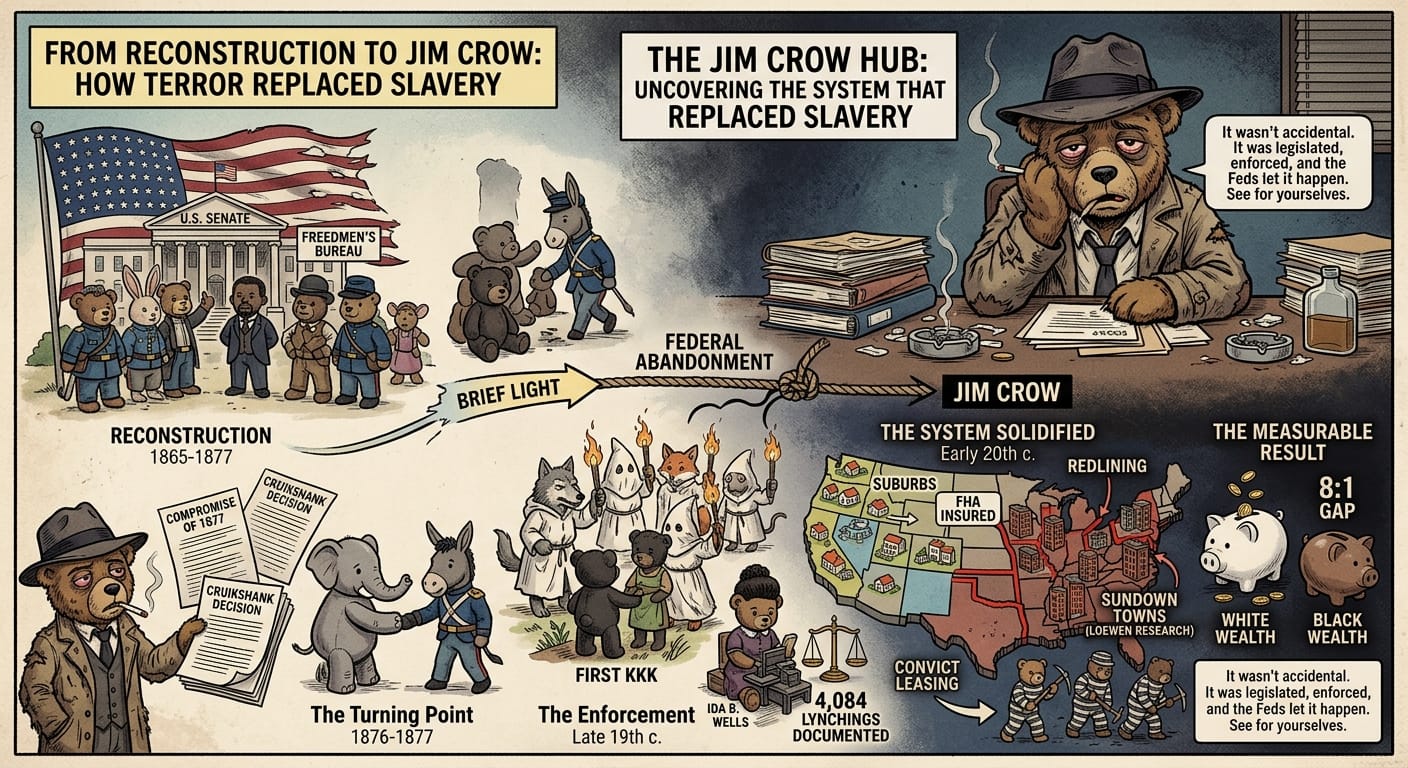
- From Reconstruction to Jim Crow: How Terror Replaced Slavery
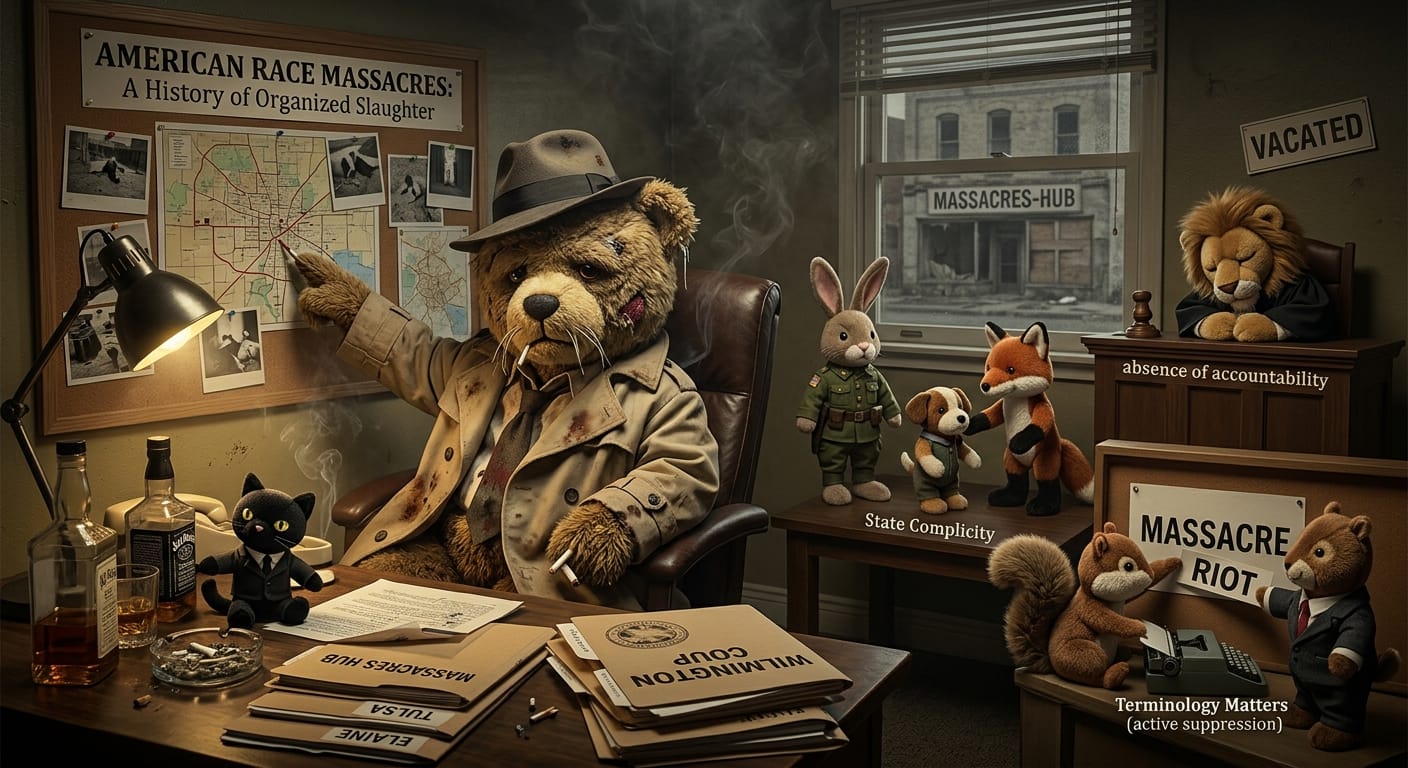
- American Race Massacres: A History of Organized Slaughter
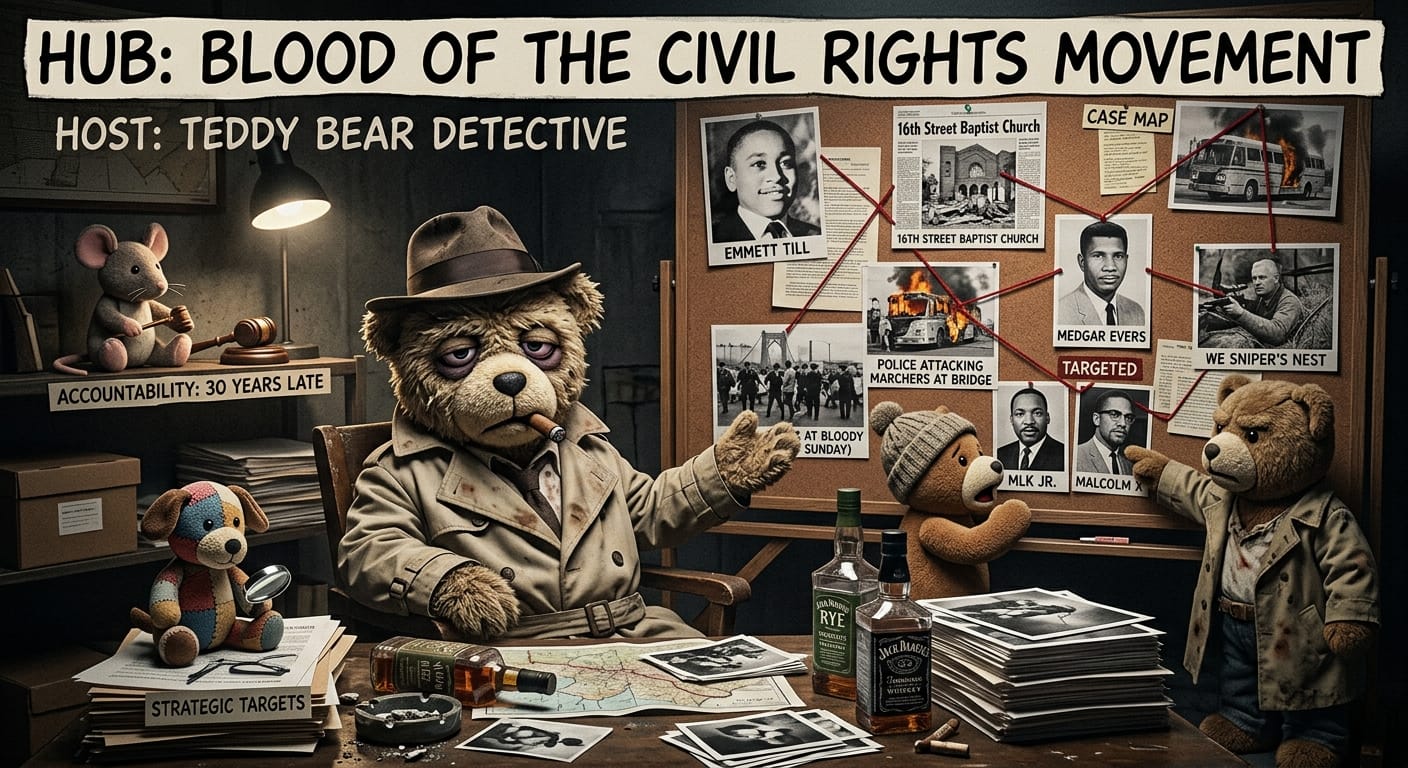
- Blood of the Civil Rights Movement
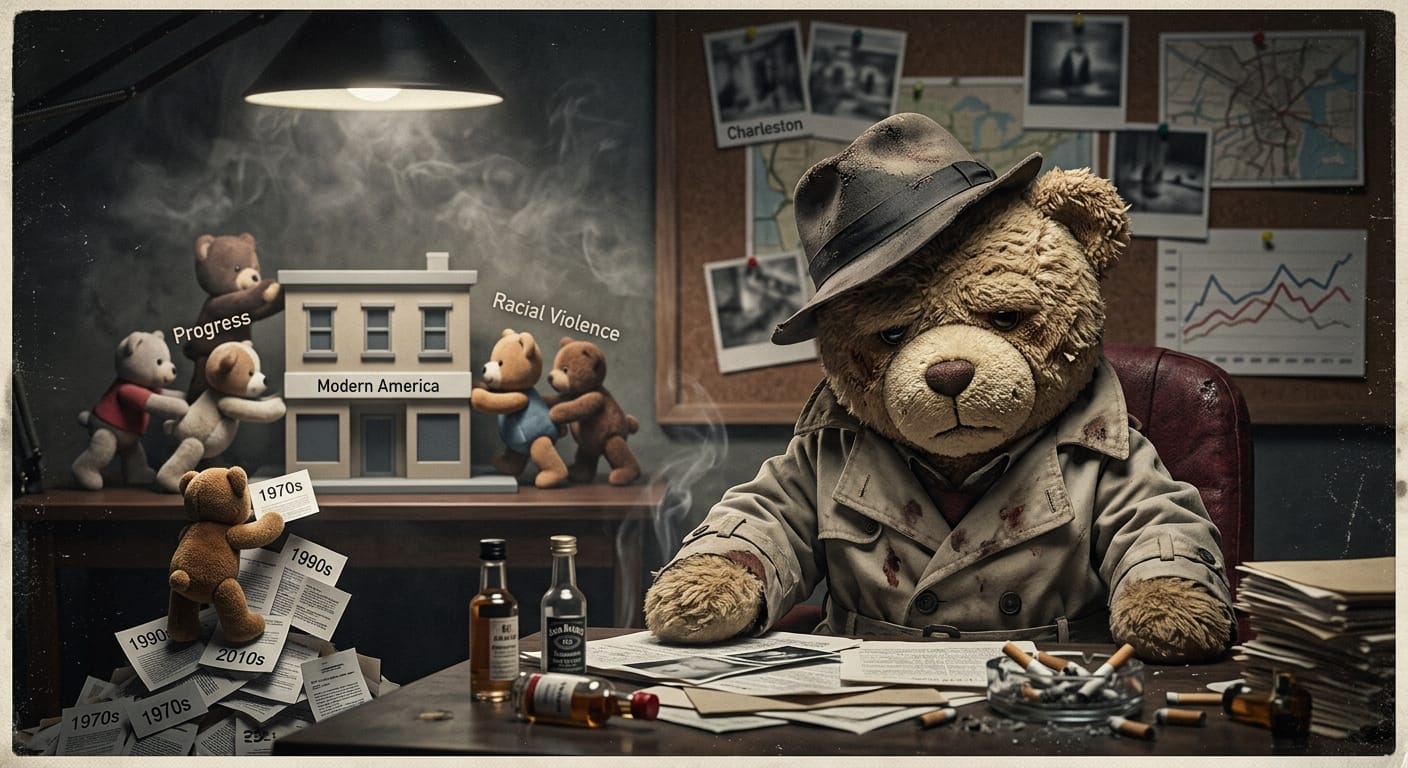
- Racial Violence in Modern America
How Racial Terror Has Operated Across Four Centuries
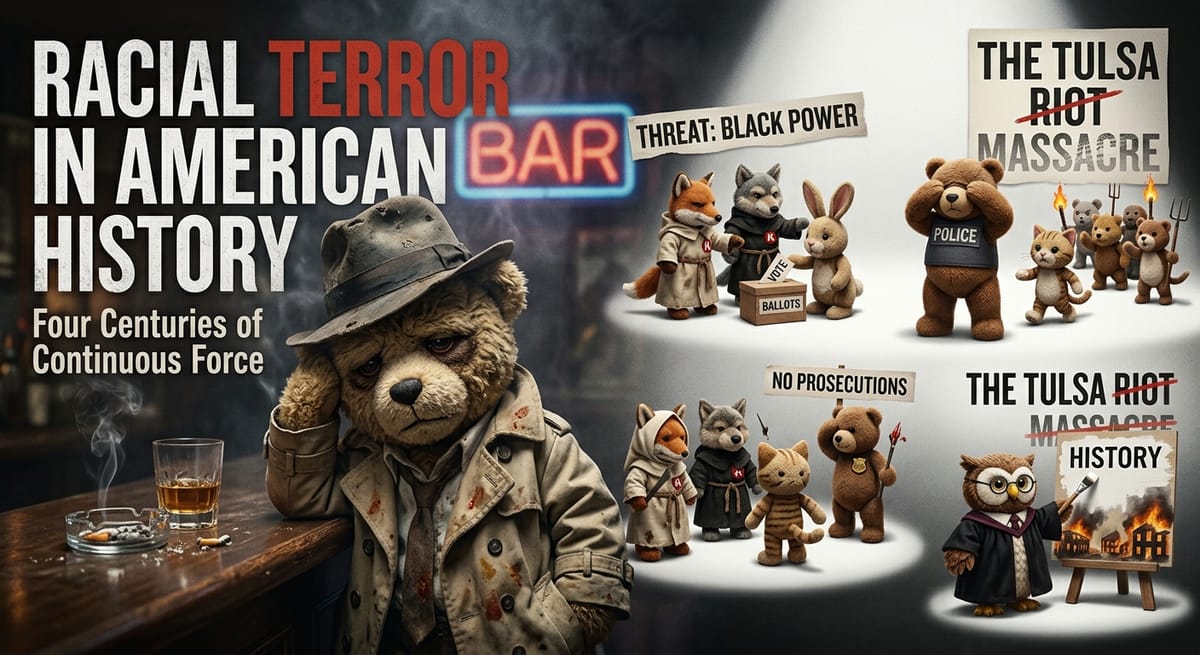
The mechanics of racial terror have followed a recognizable pattern across American history.
Identify a threat to the racial order. In Reconstruction, the threat was Black political participation. In the 1890s, it was Black economic success. In the civil rights era, it was organized challenge to legal segregation. Today, it is demographic change and the political power that comes with it. The specific content of the threat changes; the structure of the response is consistent.
Organize violence to suppress the threat. The Klan of the 1860s and 1870s was a paramilitary organization of Confederate veterans. The white mobs that destroyed Greenwood in 1921 included men deputized by the city of Tulsa. The men who bombed the 16th Street Baptist Church in 1963 were members of an organization with decades of documented history. The men who killed James Byrd Jr. in 1998 had explicit white supremacist beliefs and affiliations. The men who killed at Pittsburgh, El Paso, and Buffalo in 2018–2022 had been radicalized through networks that are still operational.
Ensure impunity. No one was prosecuted for the Tulsa massacre, the Elaine massacre, the East St. Louis massacre, or the expulsion of Forsyth County’s Black population in 1912. The men who bombed the 16th Street Baptist Church in 1963 were not convicted until 1977, 2001, and 2002. Byron De La Beckwith killed Medgar Evers in 1963 and was not convicted until 1994. The FBI suppressed evidence in multiple cases. The Supreme Court in 1876 ruled that the federal government could not prosecute private racial violence, a ruling that structured American racial terror for a century.
Rewrite the history. The Wilmington coup of 1898 was called a race riot in North Carolina textbooks for more than a century. The Tulsa massacre was not taught in Oklahoma schools until 2020. The Elaine massacre was described as a “negro insurrection” in official records until journalists and historians forced a reconsideration. Sundown towns are not in the standard American history curriculum. The systematic suppression of accurate historical memory is not incidental to the system — it is part of how the system perpetuates itself.
What Each Series Covers
Reconstruction to Jim Crow (1865–1930s) examines the construction of the replacement system after slavery’s formal end: the Black Codes, the first Klan, the national scope of lynching, Ida B. Wells’s investigative documentation of it, the geography of sundown towns, and the Red Summer of 1919 that demonstrated the violence was not regionally contained.
Race Massacres covers organized mass violence against Black communities: the Colfax massacre of 1873, which established the Supreme Court doctrine that gutted federal enforcement; the Wilmington coup of 1898, which overthrew an elected government; the East St. Louis massacre of 1917; the Elaine massacre of 1919; the Tulsa massacre of 1921; and the Rosewood massacre of 1923. Together these events destroyed communities, transferred wealth, and communicated to every remaining Black community what the cost of economic independence or political organization could be.
Civil Rights Era Violence (1955–1968) documents the violence against the movement that changed formal American law: the murder of Emmett Till, the bombing of the 16th Street Baptist Church, the assassination of Medgar Evers, the attack on Freedom Riders across three states, Bloody Sunday at the Edmund Pettus Bridge, and the assassinations of Martin Luther King Jr. and Malcolm X. The civil rights era is often taught as a story of moral progress. These articles are about what the progress cost.
Modern Racial Violence (1998–present) covers the continuity: the Charleston church shooting of 2015, the data behind hate crime patterns, and the contemporary white supremacist movement that connects the ideology of the 1860s to the Buffalo and El Paso attacks of 2019 and 2022. The modern period is where the history becomes the present tense.
The Victims Are the Through-Line
The through-line of this section is not ideology, not legislation, not demographic data. It is people. Addie Mae Collins, Cynthia Wesley, Carole Robertson, and Carol Denise McNair, killed in Birmingham on September 15, 1963. Green Cottenham, who died in a U.S. Steel subsidiary mine in Alabama in 1908 at approximately twenty-two years old after being arrested for vagrancy. The residents of Greenwood, Oklahoma, who built 1,256 homes and 191 businesses and watched them burn. Emmett Till, fourteen years old, visiting family in Mississippi. The nine killed in Charleston on June 17, 2015. The names in the Equal Justice Initiative’s National Memorial for Peace and Justice — 800 steel monuments, counties across the South, thousands of names, hundreds that say only “Unknown.”
The Unknown designation is itself a form of violence — the final erasure of people whose names were known to their families and communities, who were loved, whose deaths were mourned, whose killers in most cases were also known, and whose killers in most cases faced no consequences. Naming them, when the names survive, is the minimum the historical record can offer.
Why This History Has No Hopeful Ending
This section does not have a hopeful ending because racial terror in America does not have a historical endpoint. The FBI designated racially motivated violent extremism the leading domestic terrorism threat in 2019. Hate crimes against Black Americans documented by the FBI increased 67 percent between 2014 and 2019. White supremacist propaganda distribution reached record levels in 2022. The Voting Rights Act of 1965 was gutted by the Supreme Court in Shelby County v. Holder in 2013, reinstating the conditions that the act was designed to prevent.
The legislative gains of the 1960s were real. They are also under sustained legal and political attack by the same forces, operating through the same mechanisms — legislative, judicial, paramilitary — that have always characterized the American racial terror project. The history documented in this section is not safely in the past. It is the context for the present.
The people named in these articles deserved to live without that context. They did not get to.
─────────
Sources:
- Equal Justice Initiative. Lynching in America: Confronting the Legacy of Racial Terror. 3rd ed. EJI, 2017.
- Federal Bureau of Investigation. Strategic Intelligence Assessment and Data on Domestic Terrorism. FBI, 2021.
- Rothstein, Richard. The Color of Law: A Forgotten History of How Our Government Segregated America. Liveright, 2017.
- Wilkerson, Isabel. The Warmth of Other Suns: The Epic Story of America’s Great Migration. Random House, 2010.
- Coates, Ta-Nehisi. “The Case for Reparations.” The Atlantic, June 2014.
In This Section