Racial Violence in Modern America
Three articles on racial violence from 1998 to the present — Charleston Buffalo El Paso and the data showing it never stopped after the civil rights era.

Racial Violence in Modern America
The legislation of the 1960s — the Civil Rights Act of 1964, the Voting Rights Act of 1965, the Fair Housing Act of 1968 — changed what was formally legal. It did not change what people believed, what organizations existed to enforce white racial dominance, or whether that enforcement would continue. The period from 1968 to the present contains more documented incidents of racially motivated violence than the entire Klan era of the 1870s and 1880s, measured in absolute numbers — partly because the population is larger, partly because documentation has improved, and partly because the phenomenon never stopped.^1^
In This Series
- The Charleston Church Shooting: White Supremacy in a House of God
- Hate Crimes in America: The Data Behind the Pattern
- White Supremacist Resurgence: The Movement That Never Left
What Changed After 1968, and What Didn’t
The shift in the post-1968 period was primarily organizational and rhetorical. The Klan, which had reorganized in the 1950s and 1960s specifically to resist the civil rights movement, contracted in the 1970s under FBI COINTELPRO pressure and continued contraction through the 1980s. Its decline in formal membership was followed by the rise of neo-Nazi organizations, white power skinhead networks, Christian Identity movements, and by the 2010s, the dispersed online ecosystem of white nationalist forums, accelerationist Telegram channels, and social media radicalization pipelines.
The ideology stayed the same. The organizational form decentralized, which made it harder to prosecute as a conspiracy and easier to produce individual actors who carried out attacks without formal membership in anything.
What also did not change: the underlying social and political conditions that make racial violence available as a tool. Racialized policing, residential segregation, and economic inequality did not end with the civil rights legislation. The persistence of those conditions maintains the ecosystem in which organized racial terror operates — where racial hierarchy is not just an abstraction but a material daily reality that some people are invested in defending.
How Mainstream Politics Enabled the Violence
The most consequential development in modern American racial violence is the erosion of the boundary between mainstream conservative politics and white nationalist ideology. The Great Replacement theory — the claim that demographic change constitutes an orchestrated elimination of the white population — moved from white supremacist forums to mainstream media between approximately 2015 and 2022. Documented killers in Buffalo, El Paso, and Christchurch cited this theory in their manifestos and cited mainstream political figures as sources.
This is not an argument that mainstream political figures caused specific attacks. It is an observation about what the evidence shows: when the ideology circulating in violent extremist communities appears consistently in prime-time television programming and elected officials’ speeches, the communities whose members have always been willing to commit violence based on that ideology will commit more violence. The FBI documented a 67 percent increase in anti-Black hate crimes between 2014 and 2019. That increase did not originate in a vacuum.
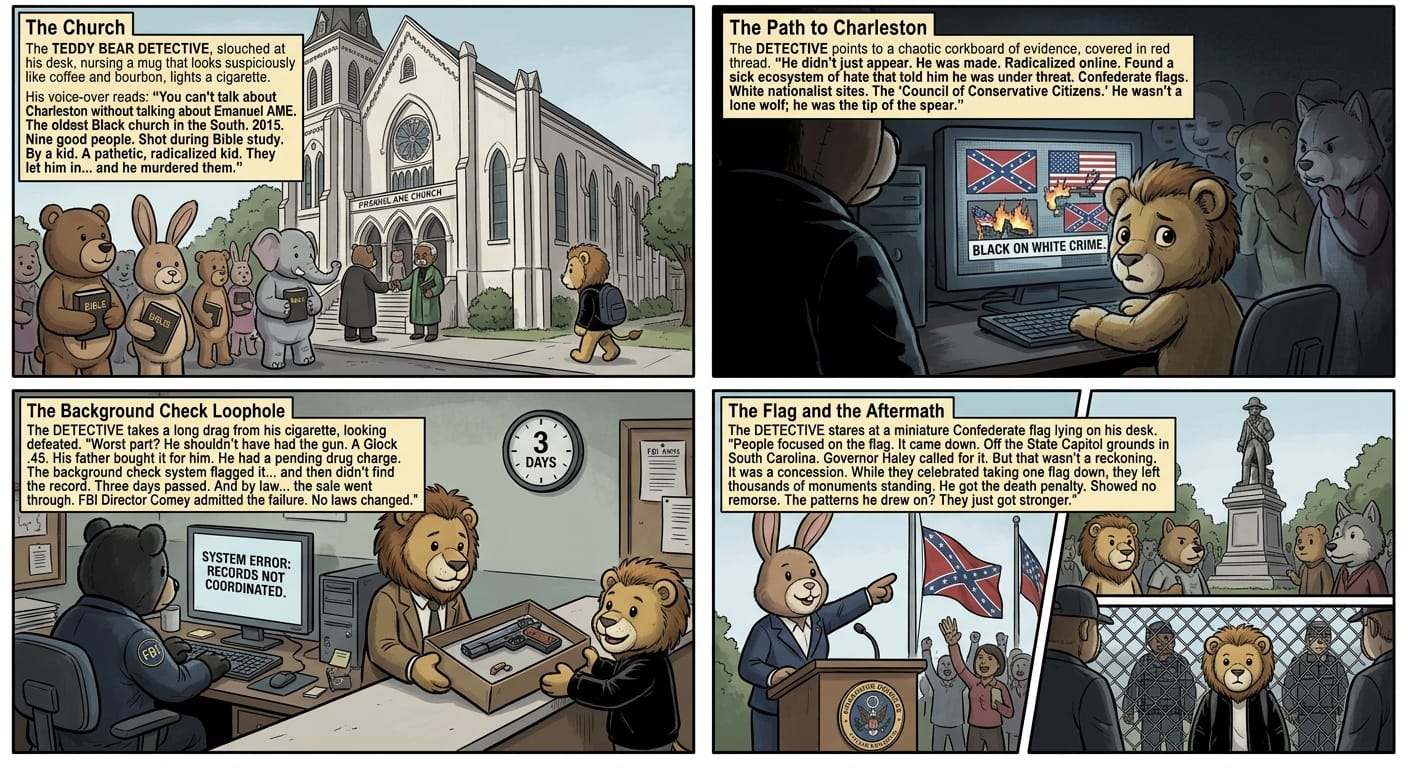
The Nine in Charleston
On June 17, 2015, nine Black people were murdered in their Bible study by a 21-year-old who had been radicalized online and wanted to start a race war. Cynthia Marie Graham Hurd. Susie Jackson. Ethel Lee Lance. DePayne Middleton-Doctor. Clementa C. Pinckney. Tywanza Sanders. Daniel Simmons Sr. Sharonda Coleman-Singleton. Myra Thompson. They were in a church. They had welcomed the man who killed them.
The response in the United States was to remove the Confederate battle flag from the South Carolina State Capitol grounds, which took three weeks of political pressure. The background check failure that allowed Dylann Roof to legally purchase his weapon was acknowledged by the FBI director and then not corrected by legislation. Roof’s trial produced a death sentence. The nine did not come back.
What the Numbers Show About the Ongoing Pattern
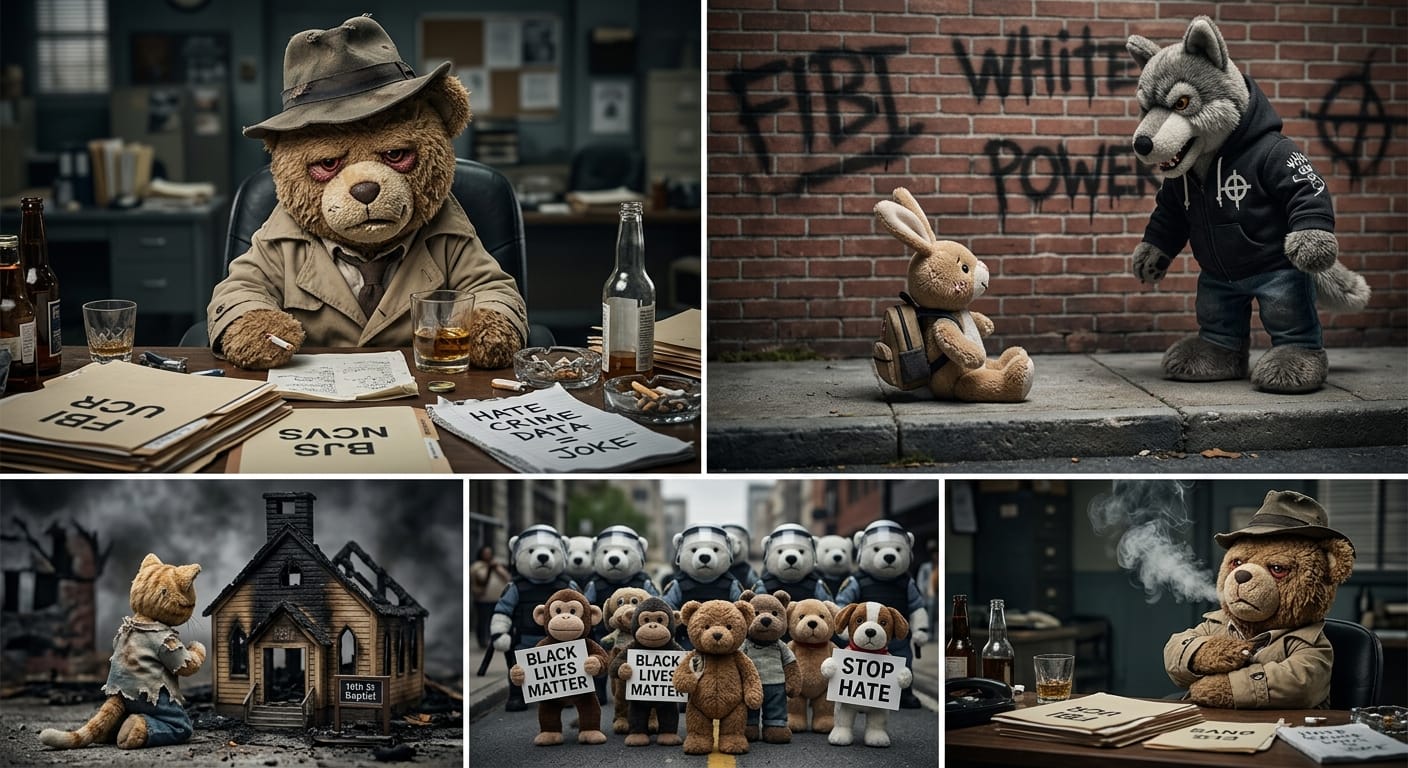
The FBI’s hate crime statistics, which undercount actual incidents by a factor estimated between five and thirty, show anti-Black hate crimes as the most frequent racial category every year since 1992. The Bureau of Justice Statistics’ victim survey finds approximately 265,000 hate crime victimizations per year. The SPLC documents hundreds of active white supremacist organizations. The ADL documents thousands of propaganda distribution incidents annually. All three metrics have trended upward since 2017.
The violence in this section is not historical. It is current. It will continue to be current by the time anyone reads this, because the conditions that produce it — the ideology, the organizational infrastructure, the political normalization, the absence of adequate federal response — remain in place.
Named above: Cynthia Marie Graham Hurd, Susie Jackson, Ethel Lee Lance, DePayne Middleton-Doctor, Clementa C. Pinckney, Tywanza Sanders, Daniel Simmons Sr., Sharonda Coleman-Singleton, Myra Thompson. Killed in Charleston, June 17, 2015. James Byrd Jr., dragged three miles behind a truck in Jasper, Texas, on June 7, 1998. The ten people killed at Tops Friendly Markets in Buffalo on May 14, 2022. They are not statistics. They are people with names.
← Back to Racial Terror section hub
─────────
Sources:
- Southern Poverty Law Center. The Year in Hate and Extremism 2021. SPLC, 2022.
- Federal Bureau of Investigation. Hate Crime Statistics, 2022. U.S. Department of Justice, 2023.
- Anti-Defamation League. ADL H.E.A.T. Map — 2022 Year in Review. ADL, 2023.
The Series