Baby Face Nelson: The Most Dangerous Man in America
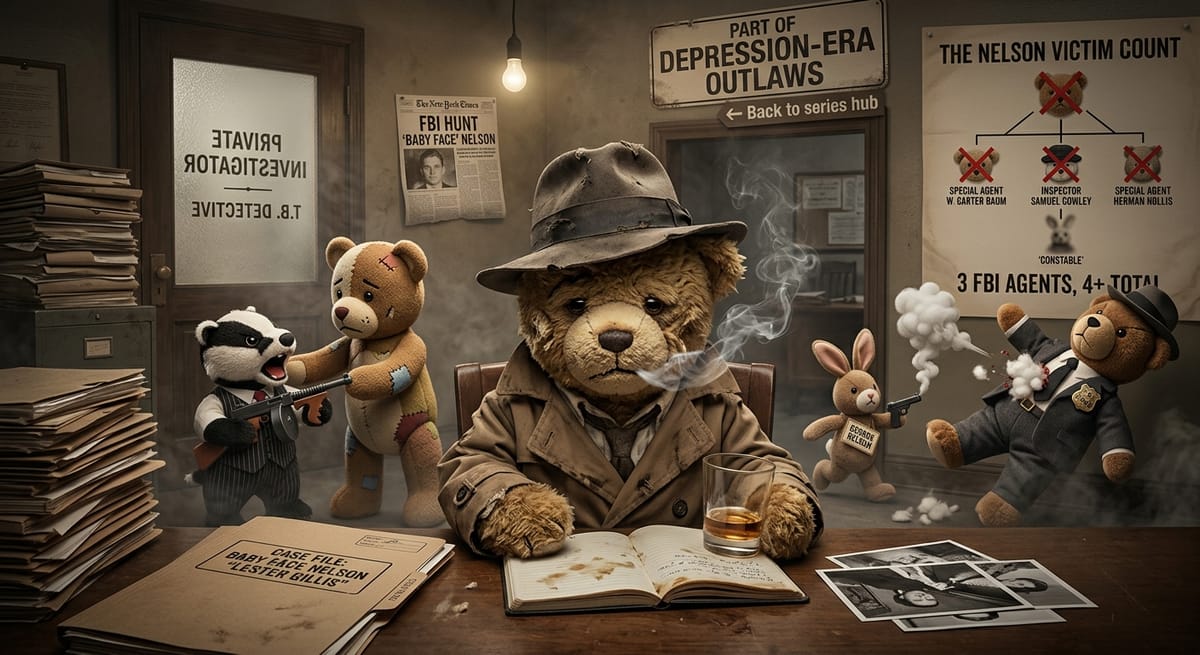
Baby Face Nelson killed more FBI agents than anyone in Bureau history — three — and died from 17 bullet wounds having just killed the two men who shot him.
Baby Face Nelson: The Most Dangerous Man in America
Part of Depression-Era Outlaws — ← Back to series hub
Baby Face Nelson killed more FBI agents than any other individual in the Bureau’s history. The count is three. He was 5 feet 4 inches tall, weighed 133 pounds, had a face people described as boyish, and was so openly proud of killing law enforcement officers that his own gang members found him unsettling. John Dillinger, who ran with him for a time and had his own comfortable relationship with violence, reportedly said Nelson was crazy and tried to limit contact.
Lester Gillis — who adopted the alias George Nelson — killed 3 FBI agents and at least 4 others during a career that lasted from 1930 to November 27, 1934, when he died from 17 bullet wounds on a road near Barrington, Illinois, having simultaneously killed the two agents who shot him. He was 25 years old.
Chicago Built Him Before the FBI Named Him
Lester Gillis was born December 6, 1908, in Chicago, the sixth of seven children of Belgian immigrants living in the city’s near North Side. He was arrested for auto theft at age 14 in 1922 and spent time at the Illinois State Training School at St. Charles. By his early twenties he was working as an enforcer and driver for the Chicago Outfit, handling jobs that required someone who didn’t hesitate.^1^
He was arrested for bank robbery in January 1931 and convicted of robbing a bank in Itasca, Illinois. At his sentencing in February 1931, witnesses noted his composure and what one reporter called his “baby face” — a description that stuck and that Nelson resented for the rest of his life. He was sent to the Illinois State Penitentiary at Joliet, escaped while being transported to Wheaton for a new trial in February 1932, and never went back to prison.
He married Helen Wawzynak in 1928, when he was 19 and she was 16. Helen stayed with him through his entire criminal career, present for many of the robberies, and was arrested after his death. She served two years in federal prison and lived until 1987.
His Violence Was Immediate and Disproportionate — Even By Gang Standards
Nelson’s approach to bank robbery was defined by his willingness to use overwhelming force immediately and his apparent enjoyment of it. Where Dillinger’s gang was theatrical and professional, Nelson was volatile. The Federal Reserve Bank job in Brainerd, Minnesota had to be abandoned in June 1933 because Nelson shot at bystanders on the street, alarming the rest of the crew.^2^
He robbed banks in Iowa, Wisconsin, and Indiana through 1933 and early 1934, sometimes with the Dillinger gang and sometimes with his own crew. The Security State Bank in Grand Haven, Michigan was hit on August 18, 1933. The First National Bank in Brainerd, Minnesota on August 18, 1933, netted $32,000 but produced a gun battle on the street. Nelson fired from a moving car at pursuing officers, a tactic that became characteristic.
The Little Bohemia Lodge incident on April 22, 1934 — when the FBI raided a Wisconsin resort where Dillinger’s gang was staying — was Nelson’s most conspicuous day. He was not at the lodge when the FBI arrived. Driving back toward it and encountering FBI agents at a roadblock, he shot and killed Special Agent W. Carter Baum and wounded two others. Baum was 29 years old and had been with the Bureau for two years.^3^
The Death Count, Laid Out Precisely
The arithmetic of Nelson’s victims is worth stating clearly because the mythology of the Depression era gangsters tends to be imprecise. Special Agent W. Carter Baum, killed April 22, 1934, at Little Bohemia. Inspector Samuel Cowley and Special Agent Herman Hollis, both killed November 27, 1934, during the battle on Route 14 near Barrington, Illinois. Three FBI agents. Additionally: a constable named Hans Thayer killed in 1933, and at least one other confirmed killing outside the FBI totals.^4^
The November 27 fight was the terminal event. Nelson and Helen and gang member John Paul Chase were driving on Route 14 when they spotted a car carrying Cowley and Hollis. They turned around and drove at the agents rather than away from them. The subsequent gun battle, conducted on the open road, left Cowley mortally wounded and Hollis dead at the scene. Nelson took 17 bullets, nine of them the penetrating type. He drove approximately 15 miles before dying in the car.
Chase dumped Nelson’s body in a ditch near Niles Center (now Skokie), Illinois, along with Helen’s coat, which led investigators to Helen. He was captured in December 1934 in California and sentenced to life in federal prison. Helen served her time and was released.
Why the Depression Outlaw Mythology Never Fit Nelson
The Depression era gangster mythology requires the outlaws to have some populist justification — they were striking back at the banks, they were products of an unjust system, they gave to the poor. This framework fits Dillinger awkwardly and fits Pretty Boy Floyd somewhat better. It fits Baby Face Nelson not at all.
Nelson didn’t rob banks because they had foreclosed on his neighbors. He robbed banks because he had been robbing things since he was 14 and had graduated to a higher tier. His resentment wasn’t economic or ideological — it was personal. He resented being looked down on, being called Baby Face, being underestimated. His violence was immediate and disproportionate by the standards of his own colleagues, who were themselves violent men.^5^
J. Edgar Hoover’s FBI used Nelson as evidence for why the Bureau needed machine guns and expanded powers, and in that sense Nelson was instrumentalized the same way Dillinger was — as a political argument for federal law enforcement expansion. The difference is that Nelson’s actual record makes the argument more honestly than the Dillinger mythology does. He was genuinely dangerous in a way that had nothing to do with romance.
The FBI’s Most Wanted program, formalized in 1950, builds on the Public Enemy framework that Hoover established using Dillinger and Nelson. The branding of federal criminals as public enemies — a marketing concept as much as a law enforcement category — originated with the 1933–34 crime wave. Baby Face Nelson, who hated his nickname and killed the men who came for him, became a permanent fixture in a story that was being written partly for political purposes while he was still alive to read it.
─────────
Sources:
- Girardin, G. Russell and William J. Helmer. Dillinger: The Untold Story. Indiana University Press, 1994.
- Burrough, Bryan. Public Enemies: America’s Greatest Crime Wave and the Birth of the FBI, 1933–34. Penguin Press, 2004.
- Nickel, Steven. Torso: The Story of Eliot Ness and the Search for a Psychopathic Killer. John F. Blair, 1989.
- Helmer, William J. with Rick Mattix. Public Enemies: America’s Criminal Past, 1919–1940. Facts on File, 1998.
- Potter, Claire Bond. War on Crime: Bandits, G-Men, and the Politics of Mass Culture. Rutgers University Press, 1998.