Ma Barker: The Mother Who Ran a Criminal Empire (Maybe)
J. Edgar Hoover called Ma Barker a criminal mastermind after shooting her in 1935. Her gang's actual planner says she did jigsaw puzzles while the men ran the jobs.
Ma Barker: The Mother Who Ran a Criminal Empire (Maybe)
Part of Depression-Era Outlaws — ← Back to series hub
J. Edgar Hoover called Arizona Barker the criminal mastermind behind the Barker gang after her death in the January 16, 1935 shootout in Ocklawaha, Florida. Her surviving son Lloyd disputed this, and most historians who have examined the record now believe Hoover invented her leadership role to justify killing a 61-year-old woman in a four-hour gun battle. The Barker sons were violent, dangerous criminals. Their mother was likely present for much of it. Whether she organized any of it is a different question — and it’s the question that makes the Ma Barker story worth examining rather than just accepting.
Arizona Donnie Clark and the Four Sons Nobody Could Manage
Arizona Donnie Clark was born October 8, 1873, in Aurora, Missouri. She married George Barker, a Missouri farmer, around 1892 and had four sons: Herman, Lloyd, Arthur (called Doc), and Fred. George Barker has largely vanished from the historical record — he was a quiet, peripheral figure who eventually separated from the family, living until 1941 without attracting attention from law enforcement or biographers.
The sons were another matter. Herman Barker committed his first robbery in Webb City, Missouri in 1910. He was killed in 1927 during a car chase after a robbery attempt in Wichita, Kansas, shot by police and apparently finishing the job himself. Lloyd was arrested for robbery in 1922 and sent to Leavenworth Federal Penitentiary, where he remained until 1938. Doc and Fred became the operational core of what newspapers called the Barker Gang.^1^
Arizona, by now called Kate by friends and family, followed her sons. She was present or nearby during their criminal activities in the late 1920s and through the 1930s. She traveled with Fred particularly, and the pair were living together in Ocklawaha, Florida when the FBI surrounded the house in January 1935.
The Gang’s Real Operations Were Run by Alvin Karpis
The Barker-Karpis Gang — the correct name, since Alvin “Creepy” Karpis was the operational planner — was responsible for a series of bank robberies and kidnappings in the early 1930s that were among the most lucrative crimes of the Depression era. The kidnapping of William Hamm Jr., heir to the Hamm’s Brewing Company, in St. Paul, Minnesota on June 15, 1933 brought a ransom of $100,000. The kidnapping of Edward George Bremer, a St. Paul banker, on January 17, 1934 produced another $200,000.^2^
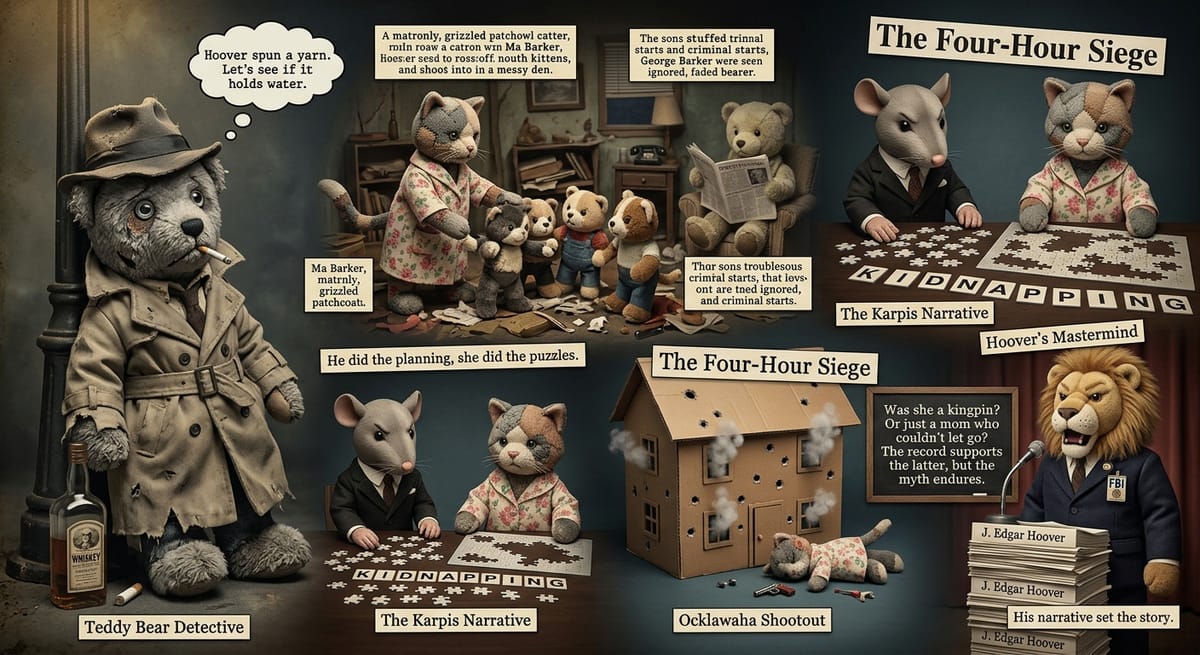
Karpis organized the kidnappings. He has said in interviews and in his autobiography that Kate Barker had nothing to do with planning the operations — that she was, in his description, a simple, not particularly bright woman who tagged along with Fred, who was her favorite son, and who spent her time doing jigsaw puzzles. Karpis worked with the gang for years and had no motive to minimize her role after the fact; he had already served 25 years in federal prison and was a Canadian deportee when he wrote his memoir.
The Barker-Karpis Gang killed several people during its operations: a night watchman named Arthur Dunlop, shot April 25, 1932, in Webster, Wisconsin; Sheriff C.R. Kelly, killed August 30, 1932 in Stockton, Missouri; Sheriff’s deputy John Coll, killed the same day in the same county.^3^
The Ocklawaha Shootout and What Happened After
The FBI traced Fred Barker and Kate to a house called Bradford Place on Lake Weir in Ocklawaha on January 16, 1935. Approximately 14 agents surrounded the property. A four-and-a-half-hour gun battle followed. When it ended, Fred Barker and Kate Barker were both dead inside the house. Fred had been shot multiple times. Kate had been shot once, through the head.
The subsequent narrative — that Kate was directing the fight, firing a Thompson submachine gun from a window — came from Hoover’s statements to the press. The physical evidence was less clear. The rifle that agents found near Kate’s body may have been placed there. Multiple agents present gave inconsistent accounts. Hoover had the narrative set before most journalists had time to ask questions, and by the time anyone was asking hard questions, Kate Barker had been transformed in the public record.^4^
Why Hoover Needed Her to Be a Mastermind
Hoover’s political situation in January 1935 was delicate. The FBI had just killed four major criminals — Dillinger in July 1934, Pretty Boy Floyd in October 1934, Baby Face Nelson in November 1934, and now the Barker gang. In each case, the killings had involved no trials, no due process, and at least one instance (Floyd) with questions about whether the suspect was shot while wounded on the ground.
Killing a 61-year-old woman required justification, and Hoover provided it by making Kate Barker the mastermind. If she was running the gang, she was a legitimate target. If she was just Fred Barker’s mother, the FBI had shot an elderly woman in a four-hour siege and left her dead on the floor of a Florida lake house.
The press largely accepted the mastermind story. Hoover repeated it for decades. His 1936 article in American Magazine presented “Ma” Barker as “the most vicious, dangerous and resourceful criminal brain of the last decade.” The article was written for publication, not accuracy.^5^
Alvin Karpis — who was captured alive in New Orleans on May 1, 1936, by Hoover personally in a famously staged arrest — disputed the Barker mastermind narrative explicitly. He was in a position to know. He was also a convicted kidnapper with limited credibility as a character witness. The contradiction between his account and Hoover’s has never been fully resolved, which is probably why the story remains interesting.
What the Record Actually Supports
Kate Barker knew what her sons were doing. She traveled with them, shared their safe houses, and was present or nearby during significant portions of their criminal career. Whether this constitutes leadership, complicity, or simply a mother who wouldn’t leave her sons — and who had nowhere else to go — is a judgment call that the available evidence doesn’t cleanly resolve. What the evidence does not support is the image of a criminal matriarch running a multi-state kidnapping and robbery operation from behind the scenes.
She is buried in Williams Timberhill Cemetery in Welch, Oklahoma, near Herman and Fred. Doc Barker was shot trying to escape Alcatraz in January 1939 and is buried there. Lloyd Barker was released from Leavenworth in 1938, went straight, worked at a restaurant in Colorado, and was shot and killed by his wife in 1949, a story that got very little coverage. The Bradford Place house in Ocklawaha burned down decades ago. The site is now private land. Lake Weir is still there. The FBI’s version of Ma Barker is still the one most people know — which tells you something about who controls the story when the story gets written.
─────────
Sources:
- Karpis, Alvin with Bill Trent. The Alvin Karpis Story. Coward, McCann & Geoghegan, 1971.
- Burrough, Bryan. Public Enemies: America’s Greatest Crime Wave and the Birth of the FBI, 1933–34. Penguin Press, 2004.
- Helmer, William J. with Rick Mattix. Public Enemies: America’s Criminal Past, 1919–1940. Facts on File, 1998.
- Powers, Richard Gid. Secrecy and Power: The Life of J. Edgar Hoover. Free Press, 1987.
- Hoover, J. Edgar. “The Real Public Enemy Number One.” American Magazine, April 1936.