Billy the Kid: The Teenager Who Became a Legend
Billy the Kid was dead at 21 with eight confirmed kills — not 21. The legend was built on a dime novel number and a broken promise from a governor.
Billy the Kid: The Teenager Who Became a Legend
Part of Outlaw Legends — ← Back to series hub
Billy the Kid was dead at 21, with eight confirmed kills and a legend claiming 21. Pat Garrett shot him in a darkened room in Fort Sumner, New Mexico on July 14, 1881. In the 145 years since, he has been the subject of more books, films, and television productions than virtually any other figure of the American West — most of them built on a number that never happened and a story that’s only half true.
He was a teenager for most of his criminal career. That fact is central to understanding both what he actually did and why Americans couldn’t stop telling stories about him.
An Orphan in a Territory With No Safety Net
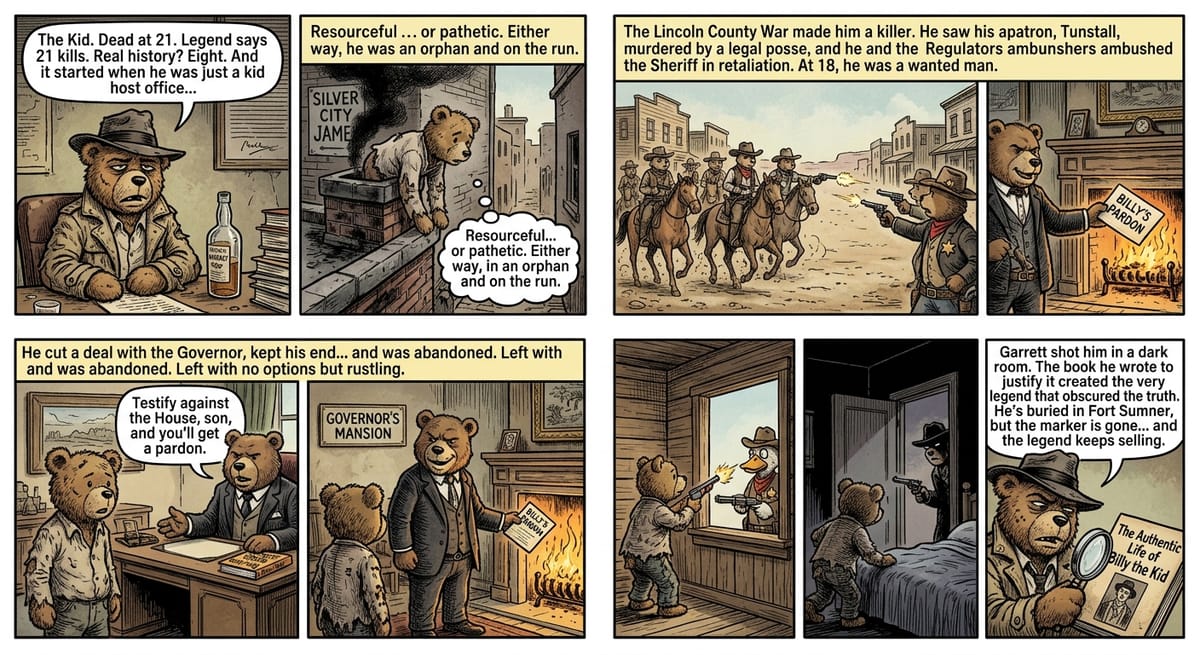
McCarty’s early life is murky by design — he left a trail of aliases and contradictions that biographers still argue over. What’s clear is that by the time he was 15, he was an orphan in Silver City, New Mexico Territory. His mother, Catherine McCarty Antrim, died of tuberculosis on September 16, 1874. His stepfather, William Antrim, was largely absent. A local sheriff named Harvey Whitehill briefly jailed the boy in 1875 for holding stolen clothing — he escaped through the chimney, which was either resourceful or pathetic depending on how you read it.
He drifted to the Arizona Territory, where on August 17, 1877, he shot and killed a blacksmith named Frank “Windy” Cahill at Fort Grant during a fight. Cahill had been bullying him. The killing was probably self-defense, but the Kid was 17 and unlicensed in the use of killing and had no family to advocate for him. He ran back to New Mexico rather than face a coroner’s inquest.^1^
What he found there was the Lincoln County War.
The Lincoln County War Made Him a Killer Before He Had a Choice
Lincoln County, New Mexico Territory, in 1878 was controlled by a business cartel known as the House, run by Lawrence Murphy and later James Dolan and John Riley. The House had monopolies on beef contracts, dry goods, and access to political power — including a friendly relationship with the territorial government in Santa Fe known as the Santa Fe Ring. When a competing merchant named John Tunstall arrived with his business partner Alexander McSween, they challenged the House’s control directly.
On February 18, 1878, a posse with dubious legal standing shot and killed Tunstall on a road south of Lincoln. The Kid was part of Tunstall’s outfit and witnessed the killing or its immediate aftermath. He later told people that Tunstall was the first man who had ever treated him with kindness. Whether that’s exactly true doesn’t matter much — it drove what came next.^2^
A group calling themselves the Regulators, with authorization that was legally shaky at best, began hunting Tunstall’s killers. The Kid was among them. On April 1, 1878, the Regulators ambushed Lincoln County Sheriff William Brady and his deputy George Hindman on Lincoln’s main street, killing both. The Kid was one of the shooters, established by witness testimony and his own later accounts.
The war peaked on July 19, 1878, in a five-day siege at McSween’s house in Lincoln. When the house was set on fire, McSween and several others tried to run. McSween was shot dead in the yard. The Kid escaped. At 18, he was now a wanted man with multiple killings behind him and no patron left alive to protect him.
Why Did Governor Wallace Break His Promise to Billy the Kid?
New Mexico Governor Lew Wallace — who would later publish Ben-Hur in 1880, giving the Lincoln County War an unusual footnote in literary history — offered a general amnesty in November 1878. The Kid met with Wallace secretly in Lincoln on March 17, 1879, and the two struck a deal: the Kid would testify about the war’s violence, Wallace would arrange a pardon. The Kid held up his end. Wallace did not. Charges against the Kid were not dropped, and he was left to operate on his own.^3^
What followed was cattle rustling in the Pecos Valley, mostly, punctuated by gambling and socializing. The Kid was reportedly charming and spoke Spanish fluently, which made him popular in the mixed Anglo-Hispanic communities of New Mexico. He killed two more men: Bob Olinger and James Bell, both deputies, when he escaped from the Lincoln County courthouse in April 1881 after being sentenced to hang. He shot Bell with Bell’s own gun and blasted Olinger with a shotgun from a second-story window.^4^
He was free for three months. Then Pat Garrett found him.
The Arithmetic of the Legend
The “21 kills at 21” figure dates to a dime novel published shortly after his death and has no historical basis. Historian Frederick Nolan, whose 1992 biography remains the most comprehensive, counts eight men killed, some of them in group actions where the Kid’s individual shots cannot be confirmed. The number is enough — he was genuinely dangerous — but the inflation to 21 was about marketing a product, not reporting a life.
What the legend actually preserves is something real about the Lincoln County War’s injustice. The House had political protection. Tunstall’s killers were never fully prosecuted. Governor Wallace broke his promise. The Kid was a teenager who attached himself to the wrong side of a land dispute and then couldn’t find a way out. He tried to negotiate. He cooperated with a governor who abandoned him. The system didn’t give him anywhere to go.
That doesn’t make him a hero. The men he killed had families. Bob Olinger left a mother in Oklahoma who reportedly said she wasn’t surprised her son died violently given what kind of man he was — a complicated detail that appears in multiple contemporary accounts.^5^ But it does mean the legend isn’t purely fabrication. There was something genuinely unfair in how the Lincoln County War played out for low-status participants like the Kid, and Americans have always had a soft spot for the person who fights the rigged system, even when that person also committed crimes.
What’s Left
Billy the Kid’s photograph — a tintype taken around 1879 or 1880, showing a young man with a rifle, bad teeth, and an unremarkable face — sold at auction in June 2011 for $2.3 million. It’s the only authenticated image of him. He looks ordinary. He looks young. He doesn’t look like 21 kills or a legend.
Pat Garrett wrote a book about the Kid immediately after killing him, titled The Authentic Life of Billy the Kid, which is neither particularly authentic nor a life so much as a series of anecdotes arranged to justify the killing. Garrett was trying to shape the story from the start. He didn’t entirely succeed. The Kid became the romantic figure; Garrett became the man who shot someone in the dark. That dynamic — the outlaw romanticized, the lawman diminished — repeats across the era. Jesse James had Robert Ford. Black Bart had James Hume. The detective or lawman who actually does the work rarely gets the story.
William H. Bonney was buried in Fort Sumner, New Mexico. The grave marker has been stolen three times. The institution that abandoned him is still there. The legend that replaced it is still being sold.
─────────
Sources:
- Nolan, Frederick. The West of Billy the Kid. University of Oklahoma Press, 1998.
- Utley, Robert M. Billy the Kid: A Short and Violent Life. University of Nebraska Press, 1989.
- Metz, Leon Claire. Pat Garrett: The Story of a Western Lawman. University of Oklahoma Press, 1974.
- Jacobsen, Joel. Such Men as Billy the Kid: The Lincoln County War Reconsidered. University of Nebraska Press, 1994.
- Keleher, William A. Violence in Lincoln County 1869–1881. University of New Mexico Press, 1957.