Purdue Pharma and the Opioid Crisis
Purdue Pharma launched OxyContin with false safety claims and suppressed abuse reports for years. Over 500000 Americans have died from opioids since 1999. No Sackler was ever charged.
Purdue Pharma and the Opioid Crisis
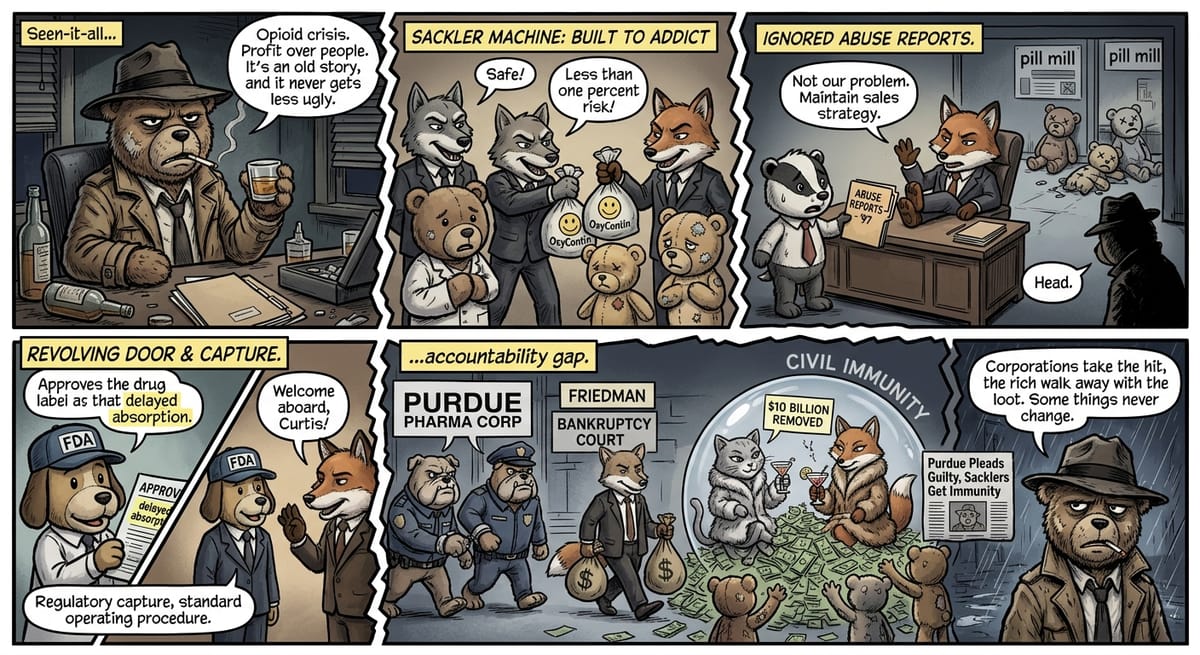
In 1996, Purdue Pharma launched OxyContin with a sales campaign built around a single central claim: because the drug released slowly over twelve hours, it was less likely to be abused than immediate-release opioids. The claim was false, and Purdue Pharma knew it. Internal documents from 1997 show company executives were told that OxyContin was being crushed and snorted in communities near rural sales territories — that the abuse potential the company was publicly denying was already a visible reality. By 2017, more than 200,000 Americans had died from overdoses involving prescription opioids. The total U.S. opioid death toll from all sources — prescription drugs, heroin, fentanyl — has exceeded 500,000 since 1999. Purdue Pharma drove the front end of that crisis deliberately and for profit.^1^
How the Sackler Family Built a Machine Designed to Addict People
Purdue Pharma was privately owned by the Sackler family, one of the wealthiest families in the United States. The company’s model for OxyContin combined an aggressive sales force with systematic manipulation of prescribing physicians. Purdue hired more than 900 sales representatives — unusually large for a company of its size — and paid them bonuses directly tied to opioid prescription volume.^1^
Sales reps were trained to overcome physician reluctance about prescribing strong opioids, particularly for non-cancer chronic pain — a market that had historically been treated conservatively because of addiction concerns. Purdue’s approach was to position OxyContin as categorically different from older opioids: safer, less addictive, appropriate for a much wider range of patients. The company distributed literature claiming that addiction in patients treated with opioids for pain was “rare” and that the risk was “less than one percent” — a figure derived from a brief, unreviewed letter published in the New England Journal of Medicine in 1980 about hospitalized patients, not outpatient chronic pain.^2^
The company sponsored continuing medical education programs, funded pain management advocacy organizations, and built relationships with key opinion leaders in pain medicine who promoted expanded opioid prescribing. Purdue spent more than $200 million marketing OxyContin in its first five years on the market.
Sales Reps Were Filing Abuse Reports the Company Ignored
The abuse of OxyContin was visible almost immediately after its launch. In Appalachian communities in Virginia, West Virginia, and Kentucky — where Purdue had concentrated its sales efforts — pharmacists, law enforcement officers, and emergency room physicians were reporting widespread diversion and abuse by 1997.^3^
A 2018 Wall Street Journal investigation and subsequent congressional document releases revealed that Purdue’s internal tracking systems logged reports from sales representatives about OxyContin abuse in their territories, that executives discussed these reports in internal meetings, and that the company chose to maintain its sales strategies rather than alert regulators or modify its marketing. A June 1997 internal document describes sales representatives reporting “pill mills” — physicians prescribing OxyContin in high volumes with minimal medical oversight — in areas including southwestern Virginia.
The FDA’s oversight was inadequate and, in at least one documented instance, corrupted. Curtis Wright, the FDA examiner who approved OxyContin’s original labeling — including the “delayed absorption” language that formed the core of Purdue’s safety claims — went to work for Purdue Pharma approximately two years after the drug’s approval. The mechanism here — regulatory capture following approval — echoes the structure of the asbestos industry’s relationship with regulators and the tobacco industry’s use of manufactured scientific doubt.
The Numbers Behind the Epidemic
OxyContin prescriptions grew from roughly 670,000 in 1997 to nearly 6.2 million in 2002. Purdue’s revenue from the drug reached $1.1 billion in 2000 and grew from there.^4^
As OxyContin became harder to obtain — through prescription monitoring programs, pharmacy restrictions, and a 2010 reformulation that made the pills harder to crush — many users who had become dependent on prescription opioids transitioned to heroin, which was cheaper and more available. The subsequent rise of illicitly manufactured fentanyl — roughly 100 times more potent than morphine — created a third wave of the opioid epidemic that has proven far more deadly than the prescription drug phase that preceded it.
The crisis did not affect all populations equally. Overdose death rates were initially highest in rural white communities in Appalachia and the rural Midwest — communities where Purdue’s early sales concentrated and where poverty, unemployment, and physical-labor injuries created both demand and vulnerability. By the mid-2010s, as fentanyl spread through urban drug markets, Black and Hispanic communities began experiencing disproportionate death rates.
What Half a Million Deaths Bought in Criminal Accountability
Purdue Pharma pleaded guilty to federal criminal charges in 2007, agreeing to pay $600 million in fines — the largest criminal fine against a pharmaceutical company at the time. The guilty plea was by the corporation; no individual executive faced criminal prosecution. Purdue’s president, Michael Friedman, and two other top executives signed misdemeanor pleas and paid a combined $34.5 million in fines. No Sackler family member was charged.^5^
Purdue declared bankruptcy in 2019. The bankruptcy proceedings produced a plan that would have distributed approximately $4.5 billion from the Sackler family while giving the Sacklers broad immunity from future civil suits — a deal the Supreme Court struck down in 2024 because it would have shielded people who had not themselves filed for bankruptcy. The Sackler family had removed approximately $10 billion from Purdue Pharma in the years before the bankruptcy filing.
Eight members of the Sackler family eventually settled with state attorneys general in 2021 for $4.5 billion — a fraction of what they had extracted from the company built on OxyContin’s devastation. None were criminally charged. The family’s name was removed from museum galleries and university buildings as institutions returned Sackler donations, a gesture of reputational consequence that left the underlying accountability gap unchanged. The same gap defined Bhopal, where Warren Anderson died in Florida having never faced trial, and Love Canal, where no Hooker Chemical executive was ever charged.
Part of Corporate Atrocities — ← Back to series hub
─────────
Sources:
- Keefe, Patrick Radden. Empire of Pain: The Secret History of the Sackler Dynasty. Doubleday, 2021.
- Van Zee, Art. “The Promotion and Marketing of OxyContin: Commercial Triumph, Public Health Tragedy.” American Journal of Public Health 99, no. 2 (2009).
- Quinones, Sam. Dreamland: The True Tale of America’s Opiate Epidemic. Bloomsbury Press, 2015.
- U.S. Department of Justice. United States v. Purdue Frederick Company Inc. Plea Agreement, May 10, 2007.
- Ryan, Harriet, et al. “OxyContin Goes Global.” Los Angeles Times, December 18, 2016.