Love Canal: The Neighborhood Built on Poison
Hooker Chemical buried 21000 tons of toxic waste and sold the site to a school board for $1. The neighborhood built on top of it required federal emergency declarations twice.
Love Canal: The Neighborhood Built on Poison
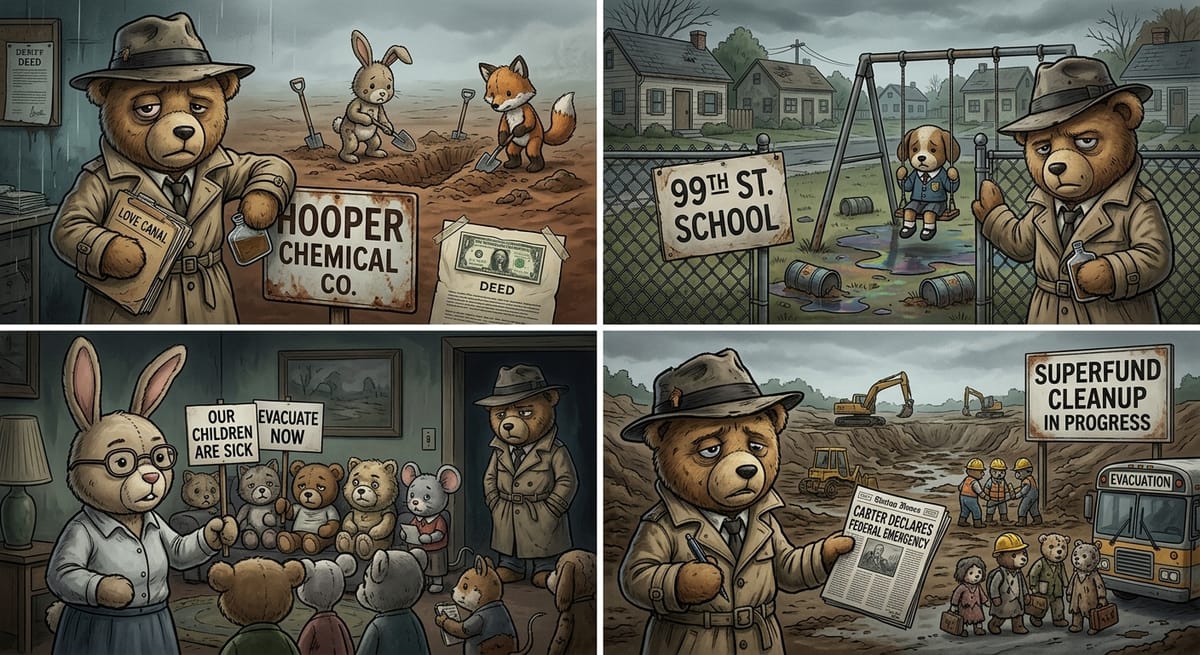
In 1953, Hooker Chemical Company sold a parcel of land in Niagara Falls, New York, to the local school board for $1. The land contained 21,000 tons of buried chemical waste — benzene, dioxin, chlorobenzenes, and dozens of other compounds — in a clay-lined canal trench that Hooker’s own engineers knew would not contain the chemicals permanently. A neighborhood grew up around the school built on top of it. By 1978, children were playing in chemical sludge seeping through their backyards, the school’s basement flooded with toxic waste, and the state of New York had ordered an evacuation. Love Canal became the catalyst for the Superfund program — America’s mechanism for cleaning up corporate messes that corporations left behind.^1^
A Chemical Dump, a Dollar, and a School
Love Canal takes its name from William T. Love, an entrepreneur who in the 1890s planned to connect the upper and lower Niagara River with a short canal to generate hydroelectric power. The project failed before completion, leaving a partially dug trench about a mile long and 60 feet wide. Hooker Electrochemical Company began using the abandoned canal as a chemical waste dump in 1942, with permission from the Niagara Falls city government and, ultimately, the Army, which also deposited chemical warfare residues there during World War II.^1^
By 1952, the canal trench was full. Hooker covered it with clay and tried to sell the property. When the Niagara Falls school board approached them seeking land for an expanding school system, Hooker offered the Love Canal site for $1. The company’s own employees had recommended against the sale, arguing the site was unsuitable for construction. Hooker sold it anyway, with a liability waiver in the deed.
Pressure from the growing postwar population pushed the school board to build the 99th Street Elementary School directly over the filled trench. It opened in 1955. A neighborhood of modest single-family homes — some 800 homes and roughly 240 apartments — developed around the school over the following decade.
The Chemicals Moved Because Chemistry Doesn’t Negotiate
By the 1960s, the chemicals were already moving. Residents noticed unusual odors and occasional puddles of oily liquid in their yards. Children played near leaking barrels half-buried in the soil. After unusually heavy rainfall in 1975 and 1976 raised the local water table, the movement of chemicals accelerated dramatically. Basements flooded with dark liquid. Yard surfaces settled and subsided as buried waste containers collapsed.^2^
Lois Gibbs, a homemaker at 101st Street, began noticing in 1977 that her son Michael had developed epilepsy, a blood disorder, and a urinary tract infection — multiple health problems in a child who had been healthy before starting school at 99th Street. When she read a series of articles by reporter Michael Brown detailing the chemicals buried under the neighborhood, she began organizing.
The Love Canal Homeowners Association, which Gibbs founded and led, collected health data from 900 families. What they found was striking: miscarriage rates in the southern end of the neighborhood were roughly triple the national average, rates of nervous system disease and urinary tract disorders were significantly elevated, and the incidence of birth defects was disproportionately high among children born to parents who had lived near the canal.^3^
How the Government Responded — and Who It Left Behind
New York State Health Commissioner Robert Whalen declared a health emergency in August 1978 and ordered the evacuation of 239 families — those living closest to the canal in the two directly adjacent blocks. This was too narrow: the chemical plume extended across multiple concentric rings of the neighborhood along old stream beds and drainage channels.
The 99th Street School was closed permanently. The state began a remediation effort involving drainage systems to capture leaching chemicals and a clay cap over the canal area. But residents in the outer rings of the neighborhood were not evacuated, and their health problems continued.
President Jimmy Carter declared a federal emergency at Love Canal in August 1978 — the first time a federal emergency had been declared for a man-made environmental disaster rather than a natural one. Two years later, in May 1980, following a study showing chromosomal damage in Love Canal residents, Carter declared a second emergency and approved the evacuation of all remaining residents who wished to leave — roughly 700 more families.^4^
Superfund Was Born Here, and No Executive Was Ever Charged
Hooker Chemical — by then a subsidiary of Occidental Petroleum — eventually paid $129 million in a 1995 settlement with the EPA for cleanup costs, and an additional $98 million to the roughly 1,300 families who had lived in the area. No Hooker Chemical or Occidental Petroleum executive was ever charged with a crime.
The Love Canal disaster was the direct catalyst for the Comprehensive Environmental Response, Compensation, and Liability Act of 1980 — universally known as Superfund — which for the first time created a federal mechanism and funding source for cleaning up contaminated sites, and established the principle that companies responsible for pollution could be held liable for cleanup costs even after the fact.
Lois Gibbs went on to found the Center for Health, Environment and Justice. The Love Canal site itself was remediated and de-listed from the Superfund National Priorities List in 2004, and the neighborhood was re-inhabited — a decision that some environmental scientists questioned at the time and continue to question.
Some former residents moved back. Others refused. The long-term health consequences of their childhood exposure have never been comprehensively tracked. The pattern here — corporate engineers who knew, a liability waiver that protected the company, and government response years too late — is the same structure that defines the Bhopal disaster and the radium girls’ case.
Part of Corporate Atrocities — ← Back to series hub
─────────
Sources:
- Gibbs, Lois Marie. Love Canal: The Story Continues. New Society Publishers, 1998.
- Brown, Michael. Laying Waste: The Poisoning of America by Toxic Chemicals. Pantheon Books, 1980.
- Levine, Adeline Gordon. Love Canal: Science, Politics, and People. Lexington Books, 1982.
- U.S. Environmental Protection Agency. Love Canal Site Fact Sheet. EPA Region 2, 2004.