The Asbestos Cover-Up: The Industry That Knew It Was Killing People
The asbestos industry knew its product caused fatal lung disease by the 1930s. A 1934 letter said say nothing. Over 40000 Americans still die from asbestos diseases each year.
The Asbestos Cover-Up: The Industry That Knew It Was Killing People
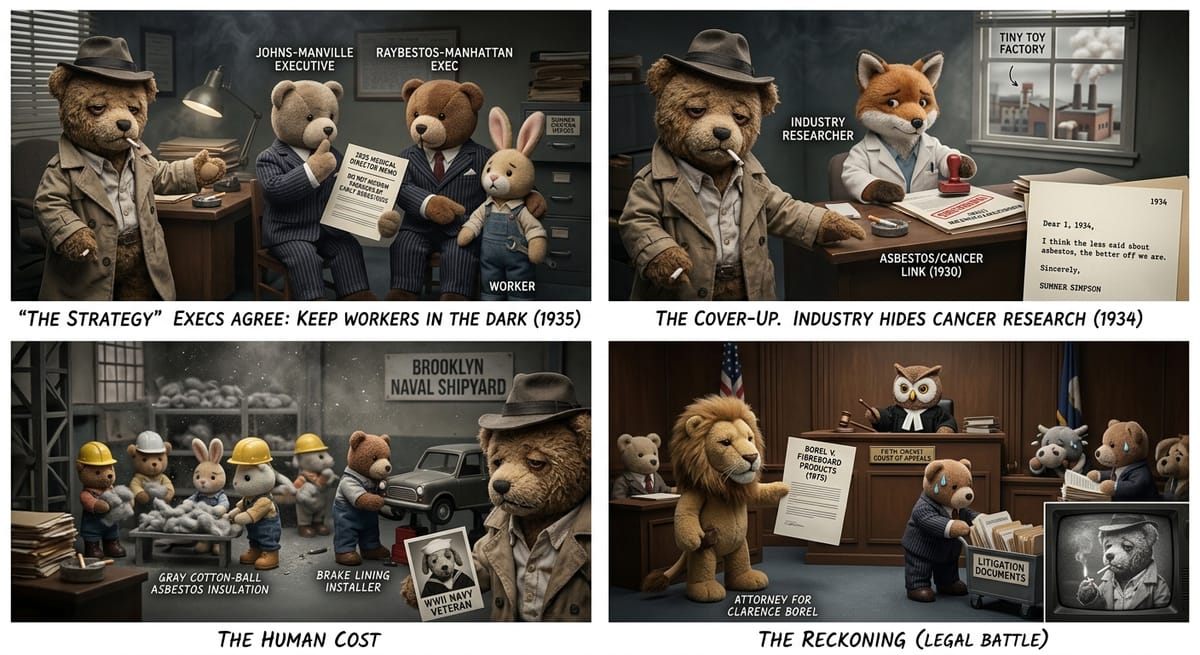
The asbestos industry knew its product caused fatal lung disease by the early 1930s — and spent the next fifty years hiding that fact. In 1977, researchers analyzing litigation documents from asbestos manufacturer Johns-Manville found a 1935 memo from the company’s medical director advising management not to inform workers with early signs of asbestosis that they were sick, because workers who knew about their condition might file claims. The first internal industry documents linking asbestos exposure to fatal lung disease date to the 1930s. The last major asbestos products were not banned in the United States until 1989 — and that ban was largely overturned by a federal court in 1991. More than 40,000 Americans still die each year from asbestos-related diseases.^1^
Why Asbestos Was Worth Killing People Over
Asbestos is a naturally occurring silicate mineral with exceptional heat resistance and tensile strength, which made it commercially indispensable: insulation for pipes and boilers, brake linings, fireproofing for buildings, roofing shingles, floor tiles, ceiling tiles, and dozens of other products. The United States used an estimated 30 million tons of asbestos in industrial applications between 1900 and 1980.
The health hazard is the fiber. Asbestos breaks into microscopic fibers that, when inhaled, embed permanently in lung tissue. The human body cannot expel or dissolve them. Over years and decades, the embedded fibers cause progressive scarring — asbestosis — and dramatically elevate the risk of mesothelioma, a cancer of the membrane surrounding the lungs that is almost exclusively caused by asbestos exposure and is almost universally fatal within 12 to 18 months of diagnosis. The latency period between initial exposure and disease onset typically ranges from 20 to 50 years.^1^
This time gap was central to the industry’s strategy. A worker exposed to asbestos in 1940 would not develop mesothelioma until 1970 or later. By then, the exposure was decades old, medical records might be incomplete or lost, and proving corporate knowledge was difficult.
What Did the Company Actually Know, and When?
The causal link between asbestos exposure and fatal lung disease was well established in the medical literature by the early 1930s. Dr. E.R.A. Merewether, a British factory inspector, documented the relationship comprehensively in 1930. American industry researchers had access to this literature.^2^
The “Sumner Simpson papers” — internal documents of Raybestos-Manhattan, another major asbestos manufacturer — were produced in litigation in the 1970s and revealed that industry executives had openly discussed the health hazard in correspondence dating to the 1930s. A 1934 letter from Sumner Simpson, Raybestos-Manhattan’s president, to Vandiver Brown, Johns-Manville’s corporate secretary, discussed suppressing a study of asbestosis among their workers: “I think the less said about asbestos, the better off we are.”^3^
Johns-Manville, which became the country’s largest asbestos manufacturer, had a standard practice through the 1940s and 1950s of conducting company physical exams on workers and not sharing results with workers who showed signs of asbestosis. The company paid death benefits quietly to families of workers who died of asbestos-related disease while strenuously denying any public link between their products and lung disease. This is the same operational logic that ran through the tobacco industry’s cover-up — internal knowledge maintained in parallel with public denial.
The Lawsuits That Forced the Documents Into the Open
The first major asbestos personal injury case to go to trial in the modern era was Borel v. Fibreboard Products, decided in 1973 by the Fifth Circuit Court of Appeals. Clarence Borel was a Texas insulation worker who had worked with asbestos insulation products for decades and developed both asbestosis and mesothelioma. The Fifth Circuit ruled that asbestos manufacturers had a duty to warn users of the known hazards of their products — a duty they had systematically failed to fulfill.^4^
The Borel decision opened the floodgates. By the 1980s, more than 30,000 asbestos lawsuits had been filed in federal courts. The litigation produced massive document releases from the major manufacturers, and those documents revealed the scope of what the industry had known and concealed. Scholars Paul Brodeur, Barry Castleman, and David Michaels — the last of whom later served as OSHA administrator — published detailed accounts of the internal documents showing decades of deliberate concealment.
Johns-Manville declared bankruptcy in 1982, citing asbestos liability — the first time a profitable, solvent company used Chapter 11 to manage ongoing tort liability. The bankruptcy created a trust fund for future victims that has paid billions in claims but has also limited individual recoveries significantly.
The Burden Fell on the People Who Built the Country
The burden of asbestos-related disease fell disproportionately on industrial workers — insulators, shipyard workers, construction workers, mechanics who replaced brake linings — and their families, who were exposed to fibers carried home on work clothes. During World War II, hundreds of thousands of shipyard workers worked with asbestos products at naval shipyards from Brooklyn to Puget Sound. The mesothelioma deaths from that wartime exposure peaked in the 1970s and 1980s.^5^
Navy veterans have an elevated mesothelioma rate compared to the general population. Workers who installed asbestos insulation in schools, hospitals, and office buildings built between the 1950s and the 1970s have elevated rates. Firefighters who responded to the collapse of the World Trade Center towers on September 11, 2001, were exposed to the asbestos insulation sprayed on the building’s structural steel — another exposure, another latency period, another generation of preventable deaths.
The asbestos industry spent decades and hundreds of millions of dollars in lobbying and litigation to delay, weaken, and reverse regulations. When the EPA issued a comprehensive ban on asbestos products in 1989, the asbestos industry challenged it in court and won — the Fifth Circuit overturned most of the ban in 1991, ruling that the EPA had not sufficiently demonstrated that the benefits of a ban outweighed the costs. Asbestos remains legal in the United States for many applications to this day. The full pattern of industry concealment, regulatory capture, and accountability failure that defines this case also runs through Love Canal and the opioid crisis.
Part of Corporate Atrocities — ← Back to series hub
─────────
Sources:
- Brodeur, Paul. Outrageous Misconduct: The Asbestos Industry on Trial. Pantheon Books, 1985.
- Castleman, Barry I. Asbestos: Medical and Legal Aspects. 5th ed. Aspen Publishers, 2005.
- Lilienfeld, David E. “The Silence: The Asbestos Industry and Early Occupational Cancer Research — A Case Study.” American Journal of Public Health 81, no. 6 (1991).
- Borel v. Fibreboard Paper Products Corp., 493 F.2d 1076 (5th Cir. 1973).
- Michaels, David. Doubt Is Their Product: How Industry’s Assault on Science Threatens Your Health. Oxford University Press, 2008.