Tobacco Industry Lies: How Cigarette Companies Denied Science for Decades
Tobacco companies knew smoking caused cancer and spent fifty years hiding it — funding fake research and lying under oath while an estimated 100 million people died.
Tobacco Industry Lies: How Cigarette Companies Denied Science for Decades
The tobacco industry knew smoking caused cancer and spent fifty years making sure the public didn’t. In January 1954, the major American cigarette companies ran a full-page advertisement in 448 newspapers titled “A Frank Statement to Cigarette Smokers,” pledging cooperation with research and assuring readers their products were safe. By that date, the companies’ own internal research had already confirmed the link between smoking and lung cancer. The “Frank Statement” was the opening move in what became the most sustained and expensive corporate deception campaign in American history — one that killed an estimated 100 million people over the course of the 20th century and whose methods were later adopted by industries from asbestos to fossil fuels.^1^
Science the Industry Buried Before the Public Saw It
The scientific evidence linking cigarette smoking to lung cancer began accumulating in the late 1940s. In 1950, British epidemiologists Richard Doll and Austin Bradford Hill published a landmark study in the British Medical Journal documenting a clear dose-response relationship between smoking and lung cancer. In 1953, American researchers Ernst Wynder and Evarts Graham published a study showing cigarette tar painted on the skin of mice caused cancer in 44 percent of subjects.^1^
These findings alarmed the tobacco industry. In December 1953, the chief executives of the major cigarette companies — Philip Morris, R.J. Reynolds, Brown & Williamson, American Tobacco, and others — met at the Plaza Hotel in New York City with John Hill, founder of the public relations firm Hill & Knowlton. Hill advised them that their challenge was not scientific but political: manufacture doubt about the science rather than dispute it directly.
The strategy they adopted was to create the appearance of ongoing scientific controversy where the scientific community was rapidly approaching consensus. The Tobacco Industry Research Committee, founded in 1954 and later renamed the Council for Tobacco Research, spent $282 million over the next four decades funding research designed to produce citable evidence of uncertainty, while suppressing or discrediting research that confirmed the cancer link.^2^
How Seven CEOs Lied Under Oath in the Same Room
The full scope of the industry’s internal knowledge became public through two channels: the 1994 congressional testimony of the seven tobacco company CEOs, and the massive document disclosure from the states’ attorneys general lawsuits of the 1990s.
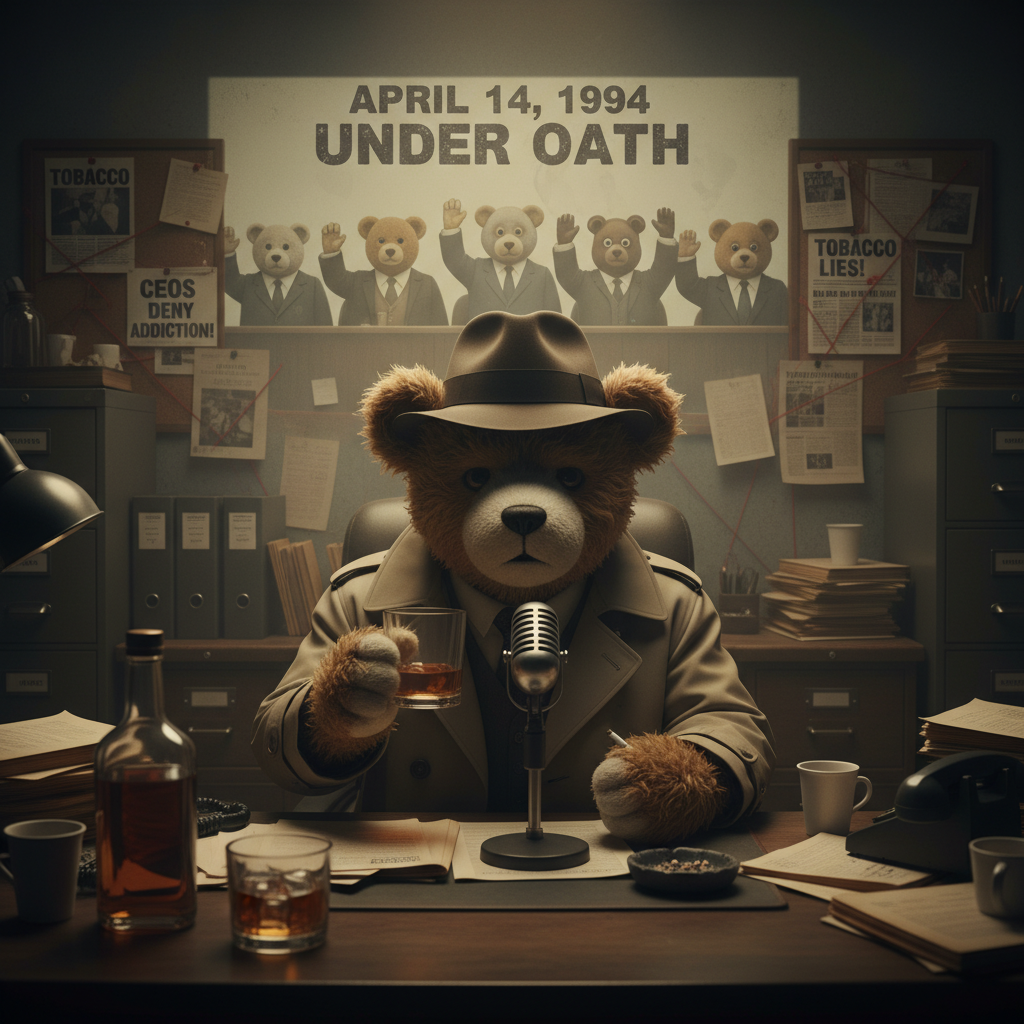
On April 14, 1994, the chief executives of Philip Morris, R.J. Reynolds, Brown & Williamson, American Tobacco, Lorillard, Liggett & Myers, and U.S. Tobacco raised their right hands before the House Subcommittee on Health and the Environment and, one by one, stated under oath that they did not believe nicotine was addictive. This was false. The industry’s internal research on nicotine addiction dated to at least the 1960s.^3^
Brown & Williamson documents that became public through whistleblower Jeffrey Wigand — a former research director at the company — showed that by the 1960s, the industry understood that nicotine was the addictive component of cigarettes and was actively researching ways to manipulate its delivery. A 1963 memo from Brown & Williamson’s general counsel, Addison Yeaman, stated: “We are, then, in the business of selling nicotine, an addictive drug.”
A $206 Billion Settlement That Changed Nothing About Criminal Accountability
In 1994, attorneys general in Mississippi, Minnesota, Florida, and Texas filed suits against the major tobacco companies to recover Medicaid costs attributable to smoking-related illness. Dozens of other states joined. In November 1998, the tobacco companies settled with 46 states in the Master Settlement Agreement — the remaining four had settled individually. The settlement required the companies to pay $206 billion over 25 years, restrict advertising targeting minors, dissolve the Council for Tobacco Research, and make millions of internal documents publicly available.^4^
No tobacco executive was ever charged with a crime in connection with the decades-long campaign to conceal the health effects of their products. Philip Morris paid $10 billion in profits and continued selling cigarettes. The documents disclosed under the settlement are now publicly available and constitute one of the most comprehensive records of corporate deception ever assembled.
Why the Tobacco Playbook Outlived the Tobacco Lawsuits
The tobacco industry’s methods — manufacturing doubt, funding “independent” research, delaying regulation through manufactured controversy — became the template for corporate disinformation in subsequent decades. Documents from the fossil fuel industry’s internal climate research, the asbestos industry’s response to mesothelioma research, the lead industry’s response to research on lead poisoning in children, and the sugar industry’s response to research on diabetes all show unmistakable structural similarities to what the tobacco companies developed with Hill & Knowlton beginning in 1953.^5^
Naomi Oreskes and Erik M. Conway documented this pattern exhaustively in their 2010 book Merchants of Doubt, showing that some of the same individual scientists moved from industry-funded tobacco doubt campaigns to industry-funded climate doubt campaigns. The machinery of corporate epistemic sabotage was built to last, and it did. The Purdue Pharma opioid strategy — manipulating medical research while actively hiding abuse data — is tobacco’s direct descendant.
An estimated 480,000 Americans still die each year from tobacco-related illness. The tobacco companies have paid their settlement installments, placed warning labels on their packages, and continue doing business. The “Frank Statement” of 1954 promised a commitment to the health of smokers. Seven decades later, that promise is still being broken.
Part of Corporate Atrocities — ← Back to series hub
─────────
Sources:
- Doll, Richard, and Austin Bradford Hill. “Smoking and Carcinoma of the Lung.” British Medical Journal 2, no. 4682 (1950).
- Brandt, Allan M. The Cigarette Century: The Rise, Fall, and Deadly Persistence of the Product That Defined America. Basic Books, 2007.
- Kluger, Richard. Ashes to Ashes: America’s Hundred-Year Cigarette War, the Public Health, and the Unabashed Triumph of Philip Morris. Alfred A. Knopf, 1996.
- National Association of Attorneys General. Master Settlement Agreement. November 23, 1998.
- Oreskes, Naomi, and Erik M. Conway. Merchants of Doubt: How a Handful of Scientists Obscured the Truth on Issues from Tobacco Smoke to Global Warming. Bloomsbury Press, 2010.