MKUltra: The CIA Dosed Americans With LSD
The CIA dosed strangers in bars, addicts in a federal prison and its own colleagues at a lakeside retreat. Then it shredded the files. A misfiled box of receipts is why we know any of it.
Part of Government Experiments: ← Back to series hub
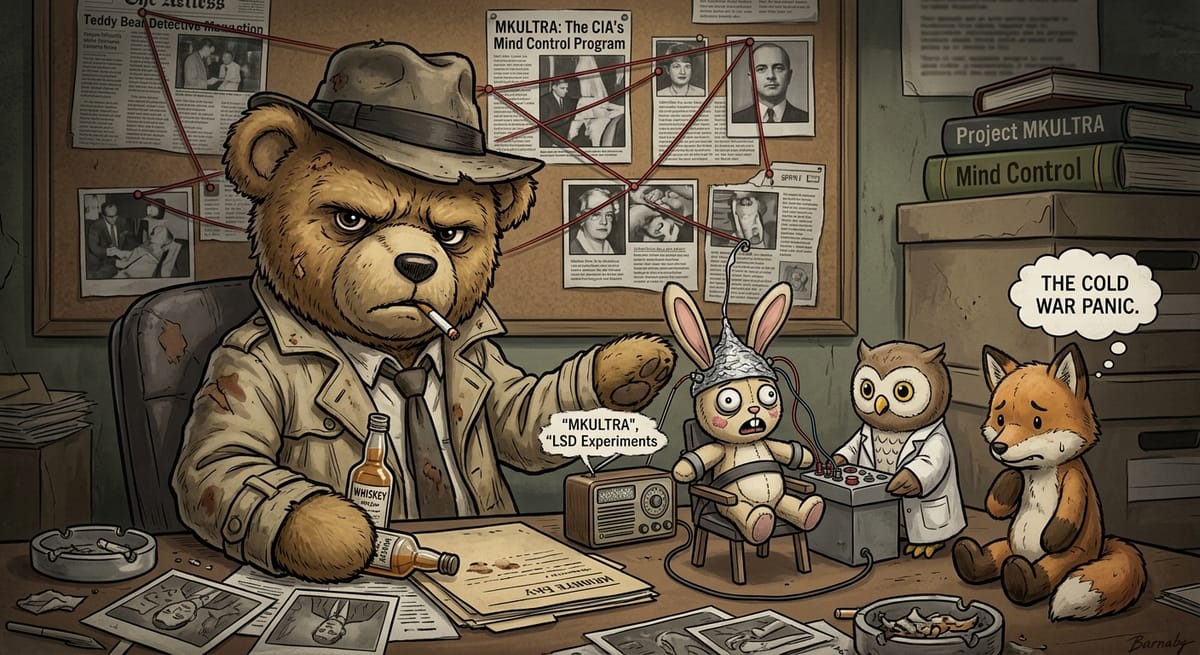
MKUltra was a secret CIA program, approved by Director Allen Dulles on April 13, 1953, that funded research into drugs and behavior control, including covert tests of LSD on people who had no idea they were being drugged.1 In January 1973 most of its records were destroyed on the orders of CIA Director Richard Helms, and the program would have stayed largely hidden if a set of overlooked financial files had not turned up in 1977 and led to Senate hearings that August.1 2 At least one man, the Army scientist Frank Olson, died after being dosed without his knowledge.1
Cold War Panic Built the Program
The fear behind MKUltra was specific. American intelligence officials watched American prisoners in the Korean War read out "confessions" and concluded that the Soviets and Chinese had found a way to control the human mind. The CIA wanted the same capability, and a defense against it. Helms, then an assistant deputy director for plans, proposed a special funding mechanism; Dulles approved it, noting that security concerns ruled out ordinary contracts.1
The program sat inside the CIA's Technical Services Staff and was run by Sidney Gottlieb, a Caltech-trained chemist who had headed the staff's Chemical Division since 1951.3 Money moved through cut-out foundations so that many researchers never knew who was paying them. The files that survived list 149 MKUltra subprojects, 185 non-government researchers and assistants, and 80 institutions: 44 colleges or universities, 15 research foundations or drug and chemical companies, 12 hospitals or clinics and 3 prisons.1 (The earlier version of this page named Harvard, Johns Hopkins, Stanford and the University of Chicago as participants. The Senate record does not name institutions, so we have removed the list.)
The CIA's own Inspector General understood the problem in 1963. Research into manipulating human behavior, his survey noted, was "considered by many authorities in medicine and related fields to be professionally unethical," which was exactly why the program was kept so secret.1
The CIA Chose Subjects Who Could Not Complain
Unwitting testing was a feature, not a slip. Experiments targeted mental patients, prisoners, drug addicts and prostitutes, "people who could not fight back," as one agency officer put it. In one case, a mental patient in Kentucky was given LSD for 174 days.2
At the federal narcotics hospital in Lexington, Kentucky, which was in practice a prison for addicts serving drug sentences, inmates who signed a general consent form were given hallucinogens. As a reward they received the drug they were addicted to.1 Senator Edward Kennedy put it more bluntly at the 1977 hearing: "heroin addicts were enticed into participating in LSD experiments in order to get a reward, heroin."1 CIA Director Stansfield Turner also disclosed that some unwitting tests had been run on "criminal sexual psychopaths" confined at a state hospital.1
The most notorious operation ran out of safe houses. Starting in 1954, Gottlieb set up a project under George Hunter White, a Federal Bureau of Narcotics agent who worked under the alias "Morgan Hall." Prostitutes on the CIA payroll lured men back to apartments in San Francisco, nearby Mill Valley and New York, where the men were secretly given LSD and other drugs while agents watched through one-way glass.4 The project was later nicknamed Operation Midnight Climax. It was sharply scaled back after a 1963 Inspector General report, and the last safe houses closed in 1965 and 1966.4 Turner told senators in 1977 that the agency did not know who those people were and was still looking for clues that might identify them.1
White, as quoted by the journalist John Marks, later summed up his time in the program in a letter to Gottlieb: "I toiled wholeheartedly in the vineyards because it was fun, fun, fun. Where else could a red-blooded American boy lie, kill, cheat, steal, rape, and pillage with the sanction and blessing of the All-Highest?"5
Not every subject was a stranger in a bar. In Montreal, the psychiatrist Donald Ewen Cameron received CIA money from 1957 to 1964 for work at McGill University's Allan Memorial Institute, where patients who had come in for ordinary psychiatric treatment were subjected to "depatterning" and "psychic driving": LSD, paralytic drugs, electroshock at many times the normal strength and recorded messages played over and over.6 7 The future novelist Ken Kesey, by contrast, volunteered for what turned out to be a CIA-financed drug study at the Veterans Administration hospital in Menlo Park, where he also worked as a night aide, a few years before he wrote One Flew Over the Cuckoo's Nest.2
Frank Olson: Dosed at a Retreat, Dead Nine Days Later
Frank Olson was a civilian biological warfare scientist at Camp Detrick, Maryland. In November 1953 he attended a working retreat at a cabin on Deep Creek Lake with colleagues from Detrick and the CIA. On the evening of November 19, Gottlieb and his deputy, Robert Lashbrook, spiked the liquor with LSD.8 Olson went home to Maryland the next day a changed man. At dinner he barely spoke, then blurted out to his wife, "I've made a terrible mistake."8
The CIA took him to New York to see a doctor with agency ties. At about 2 a.m. on November 28, 1953, Olson went through the window of his tenth-floor room at the Hotel Statler, which he was sharing with Lashbrook, and died on the sidewalk.8 (The earlier version of this page put the room on the thirteenth floor; police records cited by later accounts put it on the tenth, in room 1018A.) The government called it a suicide.
His family learned about the LSD only in 1975, after the Rockefeller Commission's report acknowledged the CIA's covert drug testing. They announced plans to sue. In 1976 they accepted a $750,000 settlement, and President Gerald Ford and CIA Director William Colby apologized.8
That was not the end of it. In 1994 Olson's son Eric had the body exhumed. A team led by James Starrs, a forensic scientist at George Washington University, found a large hematoma on the left side of the skull and an injury to the chest, and most of the team concluded those injuries happened before the fall, not during it. One member dissented. Starrs called the evidence "rankly and starkly suggestive of homicide."8
The family's position, which Eric Olson has argued for decades, is that his father was killed because he had become a security risk who might talk about what he had seen in the biological weapons program. That is the family's theory, and the official record does not confirm it. In 1996 the Manhattan district attorney's cold case unit took a preliminary look, deposed Lashbrook, and concluded there was no compelling case to take to a grand jury. A 2012 lawsuit by Olson's sons was dismissed in 2013, partly because of the 1976 settlement, though Judge James Boasberg wrote that "the skeptical reader may wish to know that the public record supports many of the allegations, farfetched as they may sound."8
Shredded in 1973, Found in a Box of Receipts in 1977
In January 1973, as Watergate made Washington nervous, Technical Services staff destroyed MKUltra's records on Gottlieb's verbal order; Gottlieb testified, and Helms confirmed, that he was carrying out a verbal order from Helms.1 2 Even before that, record-keeping had been thin by design. The Inspector General noted in 1963 that for the covert LSD testing, the "present practice is to maintain no records of the planning and approval of test programs."1 (The earlier version of this page reversed this, saying the IG recommended reconsidering a practice of "keeping full records." It also said James Schlesinger's 1973 review triggered the destruction; the Senate record attributes the order to Helms.)
So the 1975 investigations by the Church Committee and the Rockefeller Commission had to work mostly from testimony.2 9 Then, in 1977, a CIA employee handling Freedom of Information Act requests on behavioral drugs went looking in the agency's Retired Records Center outside Washington. Searchers in 1975 had skipped the retired files of the budget and fiscal section, assuming sensitive financial papers would be kept with the project itself. In this case they had not been. The employee found seven boxes of MKUltra financial records.1
Turner reported the find to Congress in July 1977. His staff first estimated the boxes held about 5,000 pages, then revised that to closer to 8,000; the cache is often described as roughly 20,000 documents.1 2 The files were mostly accounting records with few project details, but they named names, institutions and subprojects. Among the people pressing for them was John Marks, whose FOIA lawsuit the CIA was answering at the time.1
The Hearings Got Answers, Not Accountability
On August 3, 1977, the Senate Select Committee on Intelligence and Kennedy's Subcommittee on Health and Scientific Research held a joint hearing on the new documents.1 Turner called using a human being as a guinea pig "totally abhorrent" and promised to try to identify and notify the people who had been drugged.1 Kennedy complained that nobody could be found who remembered the details, not even Gottlieb, who had "a fuzzy memory about this whole area."1
Earlier, in 1976, Ford had issued the first executive order on intelligence activities, banning drug experiments on people without their written, witnessed consent.2 The Church Committee's final report found that the testing programs "resulted in massive abridgments of the rights of American citizens, sometimes with tragic consequences," and attributed two deaths to them.1
Nobody was prosecuted. Gottlieb retired from the CIA in 1973, saying he did not believe his work had been effective, spent his later years volunteering and farming in rural Virginia, and died in 1999.3 (The earlier version of this page gave his retirement as 1972.) The program never produced a reliable mind control technique. Some of its funding continued under a successor project, MKSEARCH, until fiscal year 1972.1
In Canada, the government in 1992 began paying $100,000 each, without admitting liability, to dozens of Cameron's former patients; CBC estimates about 70 were compensated, while hundreds more were rejected.7 (The earlier version of this page dated those payments to 1988.)
The pattern will be familiar to anyone who has read about the Tuskegee study, the Cold War radiation experiments or forced sterilization. An agency decided its mission outranked the rules, picked subjects nobody would listen to, and kept the paperwork thin. MKUltra differs in one way: the agency then destroyed what paperwork there was. It took a filing mistake to undo that.
Frequently Asked Questions
Did MKUltra really happen? Yes. It is documented in the CIA's own surviving records and in sworn Senate testimony from 1977, when the CIA director confirmed covert drug testing on unwitting Americans.1 Many popular claims about it go further than the evidence, but the core story of secret drugging, unwitting subjects and destroyed files comes from the government itself.
What happened to Frank Olson? He was secretly dosed with LSD by CIA officials on November 19, 1953, and fell to his death from a New York hotel window nine days later. The government called it a suicide.8 His family believes he was murdered, and a 1994 exhumation found head and chest injuries that most of the examining team thought occurred before the fall, but no charges were ever filed.8
How long did MKUltra last? The CIA described MKUltra itself as running from 1953 to 1964, with related work continuing under a successor project, MKSEARCH, until fiscal year 1972.1 The records were destroyed in January 1973.
Why did the CIA destroy the MKUltra files? Gottlieb ordered the destruction on Helms's verbal instruction in January 1973, as Watergate was unfolding.1 2 The stated reasons have never been fully explained, and Senate investigators complained in 1977 that no official could be found who remembered the details.1
Were any MKUltra victims compensated? A few. Frank Olson's family received $750,000 in 1976, and Canada paid about 70 of Cameron's former patients $100,000 each starting in 1992.7 8 Most of the people drugged in safe houses and institutions were never identified.
Part of Government Experiments: ← Back to series hub
Related reading: Government Experiments hub · The Tuskegee syphilis study · Cold War radiation experiments · COINTELPRO · Watergate · Iran-Contra · Government Secrets series
─────────
Sources:
- U.S. Senate, Select Committee on Intelligence and Subcommittee on Health and Scientific Research. Project MKULTRA, The CIA's Program of Research in Behavioral Modification. Joint hearing, 95th Cong., 1st sess., August 3, 1977. intelligence.senate.gov
- "MKUltra." Wikipedia. en.wikipedia.org
- "Sidney Gottlieb." Wikipedia. en.wikipedia.org
- "Operation Midnight Climax." Wikipedia. en.wikipedia.org
- "George Hunter White." Wikiquote, citing John Marks, The Search for the "Manchurian Candidate" (Times Books), p. 101. en.wikiquote.org
- "Donald Ewen Cameron." Wikipedia. en.wikipedia.org
- Thompson, Elizabeth. "Federal government quietly compensates daughter of brainwashing experiments victim." CBC News, October 26, 2017. cbc.ca
- "Frank Olson." Wikipedia. en.wikipedia.org
- U.S. Senate Historical Office. "Senate Select Committee to Study Governmental Operations with Respect to Intelligence Activities (The Church Committee)." senate.gov
Further reading (books cited on the earlier versions of this page):
- Marks, John. The Search for the "Manchurian Candidate": The CIA and Mind Control. Times Books, 1979.
- Kinzer, Stephen. Poisoner in Chief: Sidney Gottlieb and the CIA Search for Mind Control. Henry Holt, 2019.
- Streatfeild, Dominic. Brainwash: The Secret History of Mind Control. Hodder & Stoughton, 2006.
- Collins, Anne. In the Sleep Room: The Story of the CIA Brainwashing Experiments in Canada. Lester & Orpen Dennys, 1988.
- Albarelli, H. P. A Terrible Mistake: The Murder of Frank Olson and the CIA's Secret Cold War Experiments. Trine Day, 2009.