Radiation Experiments: When the Government Used Citizens as Guinea Pigs
Between 1944 and 1974 the U.S. government ran at least 4000 radiation experiments on more than 16000 subjects — plutonium injections radioactive cereal and soldiers marched into blast zones.
Radiation Experiments: When the Government Used Citizens as Guinea Pigs
Between 1944 and 1974, the United States government conducted thousands of radiation experiments on human subjects — hospital patients, prison inmates, soldiers, pregnant women, developmentally disabled children, and terminally ill cancer patients — many of them without informed consent and some without any disclosure at all. A 1994 investigation by the President’s Advisory Committee on Human Radiation Experiments identified at least 4,000 separate experiments involving more than 16,000 individuals. The experiments were conducted by the Atomic Energy Commission, the Department of Defense, the Department of Energy, the National Institutes of Health, and the Central Intelligence Agency. The subjects were chosen, in many cases, precisely because they were powerless to refuse.^1^
The First Experiment: A Plutonium Injection Without Consent
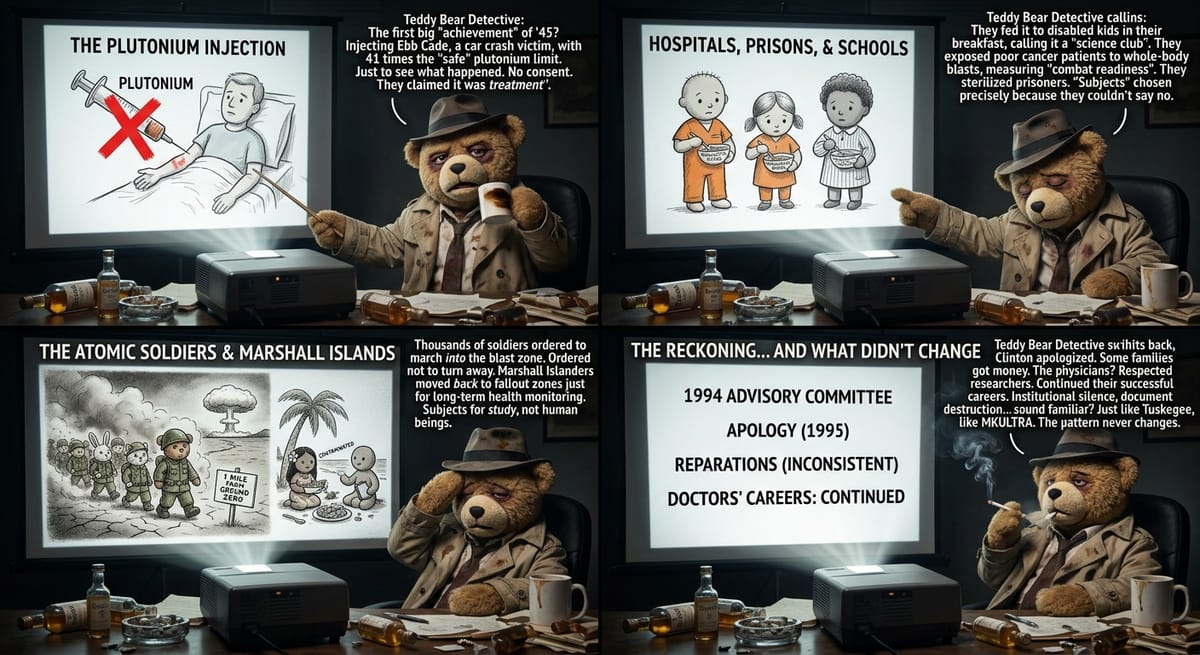
The first and most egregious experiments began in April 1945, less than a month before Germany’s surrender ended World War II. Ebb Cade, a 53-year-old Black worker from North Carolina who had been injured in a car accident near Oak Ridge, Tennessee, was admitted to a hospital run by the Manhattan Project. Without his consent or knowledge, Cade was injected with 4.7 micrograms of plutonium — approximately forty-one times the amount the AEC would later identify as the maximum safe lifetime exposure — as part of an experiment to measure how plutonium was absorbed and excreted by the body.^1^
Over the following two years, seventeen more patients at hospitals associated with the Manhattan Project received plutonium injections. Most were terminally ill cancer patients — selected, at least in part, because they were expected to die before any long-term effects could manifest. The youngest was a four-year-old boy named Simeon Shaw, son of a Los Angeles machine operator, who received a plutonium injection in April 1946. His parents were told the injection was a treatment.
Hospitals, Prisons, and Schools for Disabled Children
The plutonium injections were the beginning of a much larger pattern that extended across two decades and multiple government agencies. In Cincinnati between 1960 and 1971, Dr. Eugene Saenger — working under contract with the Defense Nuclear Agency — exposed 87 cancer patients to whole-body radiation doses of 25 to 300 rads, doses that caused acute radiation sickness and may have accelerated some patients’ deaths. The subjects were predominantly poor and Black, referred from public hospitals where they received indigent care. Most were told the treatment was intended to help their cancer. The Defense Nuclear Agency’s actual interest was in measuring the effects of radiation exposure on combat readiness — how quickly and severely radiation incapacitated humans.^2^
At the Fernald State School in Waltham, Massachusetts — an institution for children with intellectual disabilities — researchers from MIT and Harvard fed children radioactive iron and calcium in their breakfast cereal from 1946 to 1956. The parents were told only that the children were participating in a “science club” studying nutrition. The actual purpose was to measure how radioactive tracers moved through the digestive system. Roughly 70 boys participated.^3^
The Atomic Energy Commission funded experiments across the country in which prisoners at institutions including the Oregon State Prison and the Washington State Prison received radiation to their testicles — ostensibly to study the effects of radiation on sperm production. Between 1963 and 1971, 131 inmates at Oregon State Prison and 64 at Washington State Prison were irradiated. They signed consent forms; whether informed consent was possible in a prison environment, from men who were told they would receive favorable treatment for participation, is a question the 1994 advisory committee examined at length.
Soldiers Marched Into Contaminated Ground
Some of the most extensive radiation exposures were not medical experiments but fallout studies — deliberately exposing soldiers and civilians to observe the effects of nuclear testing. Between 1945 and 1962, the United States conducted 210 atmospheric nuclear tests at the Nevada Test Site and in the Marshall Islands.^4^
“Atomic soldiers” — military personnel who participated in exercises conducted at nuclear test sites — were positioned as close as one mile from ground zero of nuclear detonations at the Nevada Test Site. An estimated 400,000 service members participated in such exercises between 1945 and 1963. They were ordered not to cover their faces, not to turn away from the blast, and in some cases were marched through contaminated areas immediately after detonation to test whether combat operations were possible in nuclear conditions.
The residents of the Marshall Islands — particularly those on Rongelap Atoll — were exposed to significant fallout from the Castle Bravo thermonuclear test of March 1, 1954, which was larger than its designers expected. The Rongelap Islanders were evacuated 48 hours after the test, after visible fallout had already settled on their food and water supplies. From 1957, the AEC resettled the Rongelapese on their still-contaminated atoll — and then, from 1957 to 1964, monitored them as a “baseline study” of radiation’s effects on human health. Contaminated food was not restricted. Children who developed radiation-related cancers were medical subjects as well as victims.
What the 1994 Reckoning Actually Changed
The 1994 Advisory Committee report, commissioned by President Clinton and chaired by Ruth Faden of Johns Hopkins University, documented the scope of the experiments in unprecedented detail and recommended that the government apologize to surviving subjects and their families, establish a mechanism for compensation, and implement stronger ethical oversight of human subjects research.^5^
Clinton offered a formal apology in October 1995. The reparations process was inconsistent: some survivors and families received compensation; many did not. The statute of limitations had expired on most potential lawsuits. Compensation for “atomic soldiers” was available through the Radiation Exposure Compensation Act of 1990, but the act covered only specific populations in specific geographic areas and excluded many veterans.
The physicians who conducted these experiments were, in many cases, respected researchers at major universities. Several continued their careers without professional consequence. The patients who were injected with plutonium at Manhattan Project hospitals, the children fed radioactive cereal at Fernald, the prisoners irradiated in Oregon and Washington — most of them never knew what had been done to them. The same institutional silence that protected these programs ran through the Tuskegee study and the MKULTRA program, where document destruction and bureaucratic continuity kept programs hidden for decades.
Part of Government Experiments — ← Back to series hub
─────────
Sources:
- Advisory Committee on Human Radiation Experiments. Final Report. U.S. Government Printing Office, 1995.
- Welsome, Eileen. The Plutonium Files: America’s Secret Medical Experiments in the Cold War. Dial Press, 1999.
- Moreno, Jonathan D. Undue Risk: Secret State Experiments on Humans. W.H. Freeman, 1999.
- Miller, Richard L. Under the Cloud: The Decades of Nuclear Testing. Free Press, 1986.
- Faden, Ruth R., et al. “U.S. Medical Researchers, the Nuremberg Doctors Trial, and the Nuremberg Code.” JAMA 276, no. 20 (1996).