The Tuskegee Syphilis Study: 40 Years of Medical Abuse
The men were told they were being treated for bad blood. They were being watched. When a cure arrived, the government made sure they didn't get it, and kept that up for a quarter century.
Part of Government Experiments: ← Back to series hub
From 1932 to 1972, the U.S. Public Health Service ran a study in Macon County, Alabama, that tracked 399 Black men with syphilis, and 201 men without it as controls, without ever treating the men who had the disease or telling them what they had.1 Penicillin became the standard cure in the 1940s, and the men still went untreated, until a whistleblower handed the story to the Associated Press in 1972 and the government shut the study down that November.1 2 3
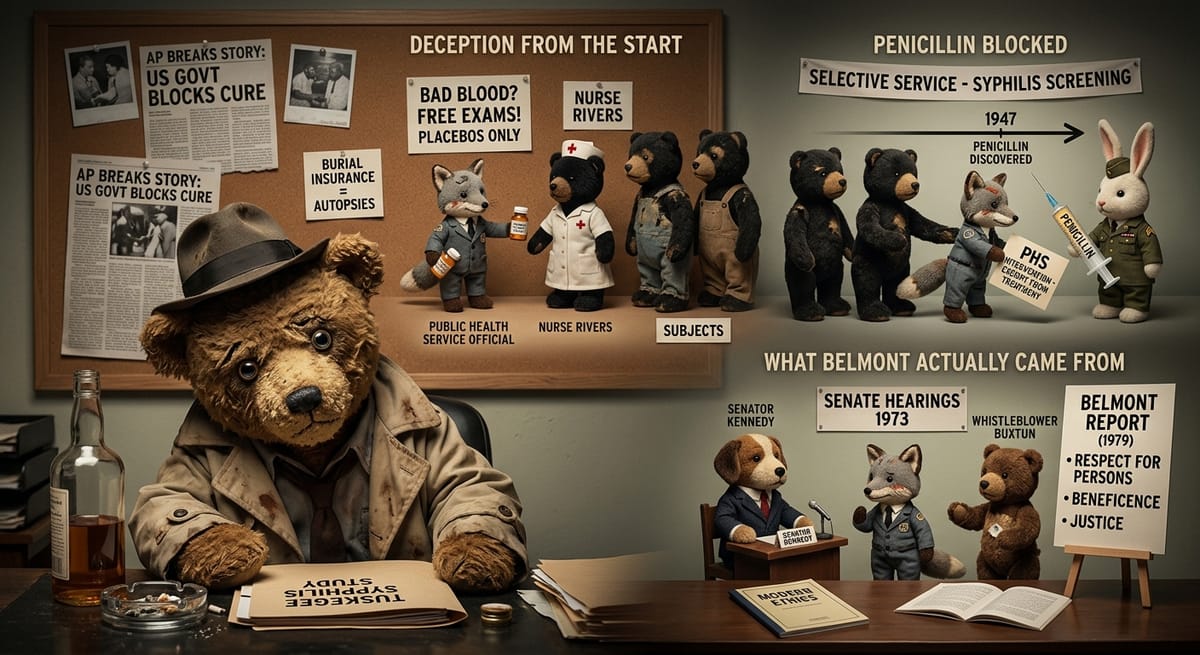
The men were told they were being treated for "bad blood," a local term that covered everything from anemia to fatigue. In exchange they got free medical exams, free meals and burial insurance.1 By 1969, at least 28 and perhaps as many as 100 of them had died as a direct result of syphilis, and the scientists kept going.2
The Study Was Designed to Deceive From the Start
The study began during the Depression, in one of the poorest corners of the rural South. Most of the men were sharecroppers with little or no schooling, working under white farmers in a system of debt peonage.2 The Public Health Service partnered with the Tuskegee Institute, the historically Black school founded by Booker T. Washington, and used its hospital. The institute's president and the head of its hospital both lent their names and resources.1 4
The original idea was a six-month look at syphilis in Macon County. It became something else: a long-term observation of what untreated syphilis does to the human body, meant to complement a Norwegian study that had pieced together the course of the disease in white men from old records. The prevailing medical belief of the era held that the disease attacked Black and white bodies differently.4
Deception was built into the protocol. To check whether the infection had reached the nervous system, researchers needed spinal taps, which are painful and frightening. So they told the men they were getting a "special free treatment," and one investigator wrote that the "details of the puncture techniques should be kept from them as far as possible." Burial insurance was the final lure, because the study needed autopsies.2
Nurse Eunice Rivers, who had trained at Tuskegee and worked at its hospital, was the men's main point of contact for most of the study's life. Researchers considered her the key to gaining their trust.4 Historians still argue about her: a Black woman with limited power inside a white federal agency, who gave the men the closest thing to medical attention many of them had ever had, and who also helped keep them in a study designed to watch them sicken.
Penicillin Existed, and They Were Kept From It
During World War II, 256 of the infected men registered for the draft, were diagnosed at induction centers and were ordered to get treatment before they could serve. The Public Health Service intervened. A local PHS physician asked that the men be excluded from the list of draftees needing treatment "in order to make it possible to continue this study on an effective basis."4
By 1943, penicillin was becoming the treatment of choice for syphilis.1 By 1947 the Public Health Service was opening rapid treatment centers across the country. There was no discussion of treating the Macon County men. If anything, the cure made the researchers more eager to continue, since this would be the last chance to watch untreated syphilis run its course.2
The study was never secret. It produced about a dozen medical journal articles over its first two decades, and no one in the profession publicly objected.2 3 When the CDC finally convened a panel to review it in February 1969, the discussion was not about the men. One panelist urged the agency to "take advantage of it" because "you will never have another study like this." Of 17 panelists, only one, Dr. Gene Stollerman, argued that the men were patients with a right to be treated. The panel warned that giving them penicillin now might be dangerous and recommended carrying on. When the men were eventually treated, not a single complication was observed.2 The data were not even clean: some of the men had picked up stray doses of penicillin along the way for other ailments, which made it less a study of untreated syphilis than of undertreated syphilis.2 This was not a rogue doctor hiding in the woods. It was a federal health agency, its peer reviewers and a respected Black institution, all looking at the same data and deciding the men's lives were worth less than the results.
A Single Whistleblower Ended What Internal Review Never Would
Peter Buxtun was hired by the Public Health Service in December 1965 to interview patients with venereal disease in San Francisco. When he overheard a colleague describe the Tuskegee study, he wrote to the CDC in 1966 raising ethical objections. In 1967 he was summoned to Atlanta and, in the words of his AP obituary, "chewed out" for impertinence. The man who did most of the chewing was Dr. John Cutler, a PHS investigator who had worked on the Guatemala experiments. Buxtun later recalled that Cutler "thought of me as some form of lunatic who needed immediate chastisement and he proceeded to administer it."2 He wrote again in November 1968, which is what prompted the 1969 review that told the CDC to keep going.2 3
He left the service and went to law school, but he could not let it go. In 1972 he gave documents to Edith Lederer, an AP reporter he knew in San Francisco, who passed them to investigative reporter Jean Heller. Heller's story ran on July 25, 1972, broke first in the Washington Star and made the front page of the New York Times the next day.2 3
Not every doctor was ashamed. Rudolph Kampmeier, a former president of the American College of Physicians, wrote that "the subjects were not deterred from obtaining treatment if they desired it or bothered to get what was available," and that their heart damage "lay at the subject's door and not in the Study's protocol."2 Blaming the men for not demanding a drug no one told them they needed was, in its way, the study's logic stated plainly. The government's response was fast once the public knew. An advisory panel declared the study "ethically unjustified" and advised stopping it in October 1972; the next month, federal health officials announced its end.1 Defending the study to reporters, John Heller, who had run the PHS venereal disease division in the 1940s, said: "There was no racial side to this. It just happened to be in a black community. I feel this was a perfectly straightforward study, perfectly ethical, with controls."2
Buxtun died on May 18, 2024, at 86.3
What the Study Changed
Senator Edward Kennedy held hearings in February and March 1973. They led to the National Research Act of 1974, institutional review boards, modern informed consent rules and protections for vulnerable research subjects.2 The national commission the act created produced the Belmont Report in 1979, the founding document of American research ethics.4 No physician or scientist was ever prosecuted.2
Medical care finally came too. In 1973 the government was told to provide all necessary care to the survivors, and the Tuskegee Health Benefit Program was created. Wives, widows and children were added in 1975. The last study participant died in January 2004; the last widow receiving benefits died in 2009, and some of the men's children still receive care.1
The Settlement and the Apology Came Decades Late
A class-action suit filed in 1973 ended in a $10 million out-of-court settlement in 1974. Living men from the syphilis group received $37,500 each, heirs of those who had died received $15,000, living controls received $16,000 and heirs of deceased controls $5,000.5
On May 16, 1997, President Bill Clinton apologized in the East Room. Eight survivors were still alive. Five attended, including Herman Shaw, about to turn 95, and Fred Simmons, who Clinton said "reckons he's about 110 years old." Three were represented by family.6 "The United States government did something that was wrong, deeply, profoundly, morally wrong," Clinton said. "What was done cannot be undone. But we can end the silence."6 He also announced a federal planning grant for a bioethics center at Tuskegee University, the school founded by Booker T. Washington, to serve as a museum of the study and a training ground for research ethics.6 The apology came 25 years after the study ended and 65 years after it began.
A Legacy Measured in Lives
The damage did not stop in Macon County. Economists Marcella Alsan and Marianne Wanamaker found that the 1972 disclosure was followed by rising medical mistrust and mortality among older Black men, and fewer visits to doctors. Their estimates imply that life expectancy at 45 for Black men fell by up to 1.5 years, about 35% of the 1980 life expectancy gap between Black and white men.7 Mistrust earned this way is not irrational. It is a memory.
The same institutional logic, in which officials knew exactly what they were doing while the subjects knew nothing, shows up in the Cold War radiation experiments, in the CIA's MKUltra program, and in the states' forced sterilization programs.
Frequently Asked Questions
Did the men get syphilis from the government? No. The 399 men already had syphilis when they were enrolled; the study recruited them because they were infected. What the government did was refuse to treat them, lie to them about it, and block treatment from other sources.1 4 The deliberate infection of human subjects happened in a different Public Health Service project, in Guatemala in the 1940s.2
How did the Tuskegee study end? Peter Buxtun, a Public Health Service employee, spent six years complaining internally and was ignored. In 1972 he went to the Associated Press, Jean Heller's story ran on July 25, and an advisory panel recommended ending the study that October. It was officially ended in November 1972.1 3
How many men died in the Tuskegee study? The exact number is uncertain. By 1969 at least 28 and perhaps 100 men had died as a direct result of syphilis.2 Widely repeated tallies add that 40 wives were infected and 19 children were born with congenital syphilis.4
Did the survivors receive compensation? Yes, though it was small. The 1974 settlement paid $37,500 to each living man with syphilis and $15,000 to the heirs of those who had died. The government also created a health benefits program that has outlived every one of the men.1 5
Was anyone punished? No. No physician or scientist involved was ever prosecuted, and several went on to distinguished careers.2 John Heller, who ran the division during the penicillin years, later led the National Cancer Institute.2
Part of Government Experiments: ← Back to series hub
Related reading: Government Experiments hub · Cold War radiation experiments · MKUltra · Forced sterilization programs · COINTELPRO
─────────
Sources:
- Centers for Disease Control and Prevention. "The Untreated Syphilis Study at Tuskegee Timeline." September 4, 2024. cdc.gov
- Tobin, Martin J. "Fiftieth Anniversary of Uncovering the Tuskegee Syphilis Study: The Story and Timeless Lessons." American Journal of Respiratory and Critical Care Medicine, 2022. PMC
- Associated Press. "Peter Buxtun, whistleblower who exposed Tuskegee syphilis study, dies aged 86." The Guardian, July 15, 2024. theguardian.com
- "Tuskegee Syphilis Study." Wikipedia. en.wikipedia.org
- Centers for Disease Control and Prevention. "About the Untreated Syphilis Study at Tuskegee." cdc.gov
- Clinton, William J. "Remarks by the President in Apology for Study Done in Tuskegee." The White House, May 16, 1997. clintonwhitehouse4.archives.gov
- Alsan, Marcella, and Marianne Wanamaker. "Tuskegee and the Health of Black Men." NBER Working Paper 22323; published in the Quarterly Journal of Economics, 2018. nber.org
Further reading (books and articles cited on the earlier versions of this page):
- Jones, James H. Bad Blood: The Tuskegee Syphilis Experiment. Free Press, 1981.
- Reverby, Susan M. Examining Tuskegee: The Infamous Syphilis Study and Its Legacy. University of North Carolina Press, 2009.
- Brandt, Allan M. "Racism and Research: The Case of the Tuskegee Syphilis Study." Hastings Center Report 8, no. 6 (1978).
- Smith, Susan L. "Neither Victim nor Villain: Nurse Eunice Rivers, the Tuskegee Syphilis Experiment, and Public Health Work." Journal of Women's History, 1996.