Forced Sterilization: America's Eugenics Campaign
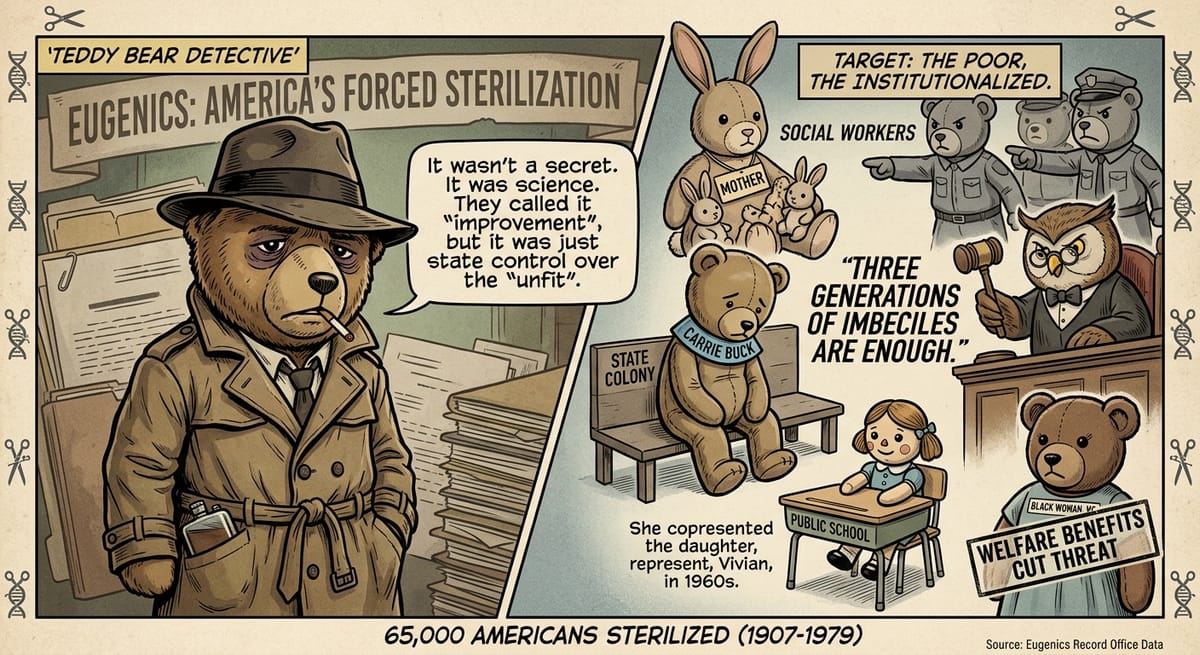
The Supreme Court said three generations of imbeciles were enough. Carrie Buck was not an imbecile, and neither were most of the tens of thousands who followed her onto the operating table.
Part of Government Experiments: ← Back to series hub
In 1927 the U.S. Supreme Court ruled 8 to 1 in Buck v. Bell that a state could sterilize people it judged "unfit" to have children, and in the decades that followed as many as 70,000 Americans were sterilized under state eugenics laws.1 2 The woman at the center of the case, Carrie Buck, was not intellectually disabled. The practice did not die with the eugenics movement, either: in the 1970s a federal investigation counted 3,406 sterilizations of Native American women in just four Indian Health Service regions over four years.3
Justice Oliver Wendell Holmes wrote the majority opinion, and in it the line that still gets quoted in law schools as a warning: "Three generations of imbeciles are enough." Only Justice Pierce Butler dissented, and he did not write an opinion explaining why.1
Eugenics Was Mainstream Science, Not a Fringe Hobby
Eugenics, the project of "improving" the human population by deciding who gets to reproduce, was not the work of cranks in basements. It had institutions, money and prestige. The biologist Charles Davenport founded the Eugenics Record Office at Cold Spring Harbor, New York, with money from the Harriman railroad fortune and the Carnegie Institution, and the Rockefeller Foundation also put money into eugenics work.4 Harry Laughlin, the office's superintendent from 1910 until it closed in 1939, published a Model Eugenical Sterilization Law in 1922. Eighteen more states passed laws based on it, Virginia among them in 1924.5
The science was wrong. The traits eugenicists wanted to breed out (poverty, "feeblemindedness," criminality, "promiscuity") are not simple inherited conditions, and the family pedigrees collected to prove otherwise were built on prejudice and sloppy method. That did not stop the laws. Indiana passed the first compulsory sterilization statute in 1907, and fifteen more states followed over the next two decades.6 Eventually 32 states made the practice legal.4
California ran the biggest program by far. Starting in 1909 and continuing for 70 years, it sterilized about 20,000 people in state institutions, roughly a third of the national total.4 A 1961 tally counted 62,162 eugenic sterilizations nationwide, 61 percent of them performed on women.4
Carrie Buck Was Chosen Because She Made a Good Test Case
Carrie Buck was born in Charlottesville in 1906 and placed with foster parents, John and Alice Dobbs. At 17 she was raped by Alice Dobbs's nephew and became pregnant. In January 1924 the Dobbses had her committed to the Virginia State Colony for Epileptics and Feebleminded, on grounds of feeblemindedness and promiscuity.7 Her mother, Emma, was already an inmate there.
Virginia had just passed its sterilization act, and the colony's superintendent, Dr. Albert Priddy, wanted a case that would take it to the Supreme Court. Carrie looked ideal to him: a "feebleminded" mother, a "feebleminded" daughter, and a baby who might be labeled the same, which would let the state claim three generations of inherited defect.2 The lawyer assigned to defend her, Irving Whitehead, had chaired the colony's board, was a close confidant of Priddy, and was a childhood friend of Aubrey Strode, the man who drafted the law. He mounted almost no defense.2 7 The surgeon who operated on her later wrote in his report that her case had been carried through the courts specifically to test the act.7
Buck was sterilized on October 19, 1927.7 Her daughter, Vivian, the third "generation" in Holmes's sentence, went to a Charlottesville public school, earned mostly Bs and Cs, and made the honor roll in April 1931. She died in 1932, at eight, of an intestinal infection that followed measles.7 Carrie was released, married twice, and lived until 1983. Researchers and reporters who met her later in life described a woman of normal intelligence.7 Virginia sterilized her sister Doris too, during an operation for appendicitis; Doris did not find out until 1980 why she and her husband could never have children.7
Is Buck v. Bell Still the Law?
Technically, yes. The Supreme Court has never formally overruled it.4 In 1942, in Skinner v. Oklahoma, the Court struck down an Oklahoma law that sterilized certain repeat criminals, but it did so on equal protection grounds and distinguished Buck instead of rejecting it. The opinion quotes Buck twice without disapproval.8 Virginia did not repeal its own sterilization law until 1974, after more than 7,000 people had been sterilized under it.4 9
Hitler's Lawyers Read American Statutes
The American programs were studied abroad. Germany's 1933 sterilization law was closely modeled on Laughlin's work, and in 1936 the University of Heidelberg gave Laughlin an honorary degree for his contributions to what it called the "science of racial cleansing."5 Nazi Germany went on to sterilize hundreds of thousands of people. Adam Cohen, whose book Imbeciles reexamined the Buck case, put it bluntly in a 2016 interview: "We really were on the cutting edge."2
The Targets Were Poor, Institutionalized, Black, Latina and Native
"Feebleminded" was an elastic label. It covered women who had children outside marriage, people with epilepsy, the deaf and blind, immigrants who did badly on English-language tests, and people who were simply poor. Minorities and "promiscuous" women were singled out.2
North Carolina is the clearest example of how the program shifted after World War II. Its Eugenics Board, created in 1933 after the state's 1929 law was struck down, let county welfare departments petition to sterilize their own clients.10 The state estimates that about 7,600 people were sterilized under the board's authority between 1929 and 1974.11 An ACLU attorney estimated that since 1964, about 65 percent of the women sterilized in the state were Black.10
The federal government was paying for a lot of this by the 1970s. HEW covered 90 percent of annual sterilization costs for poor patients, and sterilizations of women rose 350 percent between 1970 and 1975.6 In June 1973, an HEW-funded clinic in Montgomery, Alabama, sterilized Mary Alice and Minnie Lee Relf, Black sisters aged 12 and 14. Their mother, who could not read, had signed an X on a form she thought authorized birth control shots.6 The lawsuit that followed forced new federal rules on consent.
California's history kept repeating itself. A 2014 state audit found that 144 women in state prisons were sterilized by tubal ligation between fiscal years 2005-06 and 2012-13, and that in 39 of those cases the consent process was deficient. All but one of the 144 lacked the required approvals.12 (The earlier version of this page put the prison figure at 1,400 over 1997 to 2013, attributed to a 2020 legislative investigation. We could not confirm that figure; the audit numbers above are the official ones.)
The Indian Health Service Did It Under a Federal Moratorium
By the early 1970s, Native women were reporting the same pattern. Dr. Constance Redbird Pinkerton-Uri, a Choctaw and Cherokee physician and law student working in Oklahoma, began pressing the office of Senator James Abourezk of South Dakota about suspicious sterilizations at the Indian hospital in Claremore. Going through Claremore's records herself, she found that 132 Native women had been sterilized there, 100 of them in procedures labeled non-therapeutic, meaning sterilization was the only purpose.6 "We have a new enemy," she said, "and the enemy is the knife."6
Abourezk asked the General Accounting Office to investigate. Its report, released November 4, 1976, looked at four IHS areas (Aberdeen, Albuquerque, Oklahoma City and Phoenix) and found 3,406 sterilization procedures on Native women in fiscal years 1973 through 1976. Of those, 3,001 involved women of childbearing age and 1,024 were done at contract facilities.3
HEW had imposed a moratorium in July 1973 on federally funded sterilizations of anyone under 21. The IHS itself identified 36 violations of that moratorium between July 1973 and March 1976, 13 of them after area directors had been formally told about the rules in April 1974.3 The GAO also found that most consent forms failed to meet federal standards and that many IHS physicians did not understand the regulations. It did not find sterilizations done with no consent form on file, and it did not examine whether patients had been coerced.3 (The earlier version of this page said the GAO found at least three girls under 15 among the cases. The report says that, with one exception, every patient in the violation cases was 18 or older.)
The coercion stories came from the women and their advocates, not the auditors. Women were approached during labor, in pain and often medicated. Some were warned that welfare payments would stop or that their children could be taken if they had more.6 Marie Sanchez, chief tribal judge of the Northern Cheyenne Reservation, ran her own inquiry and found 30 women sterilized there between 1973 and 1976, including two girls under 15 who had been told they were having their appendix removed.6
How Many Native Women? Nobody Knows, and That Is Part of the Story
The GAO examined only four of the twelve IHS areas, a limitation Abourezk pointed out at the time.13 Some researchers, notably the historian Jane Lawrence in a 2000 article, have estimated that the IHS sterilized between 25 and 50 percent of Native women between 1970 and 1976.13 Treat that as an estimate built on partial records, not a count. The federal government never produced a full one.
Sanchez called it genocide.13 The argument is not rhetorical flourish. The UN Genocide Convention, which the United States joined in 1988, lists "imposing measures intended to prevent births within the group" as one of the acts that can constitute genocide.14 Whether the IHS program meets the convention's requirement of intent is a legal question historians and lawyers still argue over. What is not in dispute is the context: nations that had already lost land through the reservation system and broken treaties, and children to the boarding schools, were now losing births in a federal hospital system. In 1979 HEW issued new rules requiring a 30-day waiting period, discussion of other birth control methods and a clear statement that refusing would not cost a patient any benefits.4
Who Got Paid, and How Much
Apologies came first. Virginia's legislature expressed regret in 2001, and in 2002 Governor Mark Warner apologized at the unveiling of a historical marker for Carrie Buck.7 9 North Carolina's governor, Mike Easley, apologized the same year, making it the third state to do so after Virginia and Oregon.10 (The earlier version of this page called North Carolina the first state to apologize, in 2003. It was the third, in 2002.)
Money came later and in small amounts. North Carolina set aside $10 million, and the 220 victims the state certified received $20,000 in 2014, $15,000 in 2015 and a final check of almost $10,500 in 2018.15 Virginia's 2015 program paid $25,000 per verified claim to people still alive on February 1, 2015.16 California's program, open to survivors of state institutions from 1909 to 1979 and of state prisons after 1979, took applications through December 31, 2023. It received 574, approved 133 and paid each approved survivor $35,000, for a total of $4,655,000.17
Set those numbers against the tens of thousands sterilized and the pattern is plain. Most victims died before anyone offered to pay. The decision that blessed the whole enterprise is still on the books. Like the Tuskegee study and the Cold War radiation experiments, this was not a rogue doctor's crime. It was policy, run through courts, legislatures, welfare offices and hospitals.
Frequently Asked Questions
How many Americans were forcibly sterilized? The most common estimate is 60,000 to 70,000 under state eugenics laws in the 20th century. A 1961 count put the figure at 62,162, and NPR, drawing on Adam Cohen's research, uses "as many as 70,000."2 4 That total does not include the 1970s sterilizations of Native, Black and Latina women under federal programs, which were never fully counted.
Is Buck v. Bell still law? It has never been formally overruled. Skinner v. Oklahoma (1942) struck down a different sterilization law without rejecting Buck, and later privacy and reproductive rights cases have left it standing as a discredited but unrepealed precedent.4 8
Was Carrie Buck actually intellectually disabled? No. She was an average student until her foster family pulled her out of school to do housework, and people who met her later described a woman of normal intelligence. Her daughter made the honor roll before dying at eight.7
Did the Indian Health Service sterilize Native women without consent? The 1976 GAO report found that IHS consent forms routinely failed federal standards and that dozens of women under 21 were sterilized in violation of a federal moratorium.3 Accounts gathered by Native physicians, tribal judges and journalists describe women pressured during labor or misled about what the operation was.6 The full number remains unknown.
Did the victims get compensation? Some did. North Carolina, Virginia and California set up compensation programs, paying between $25,000 and $45,500 per approved survivor, but only a few hundred people in total were paid.15 16 17 No federal compensation program exists for the IHS sterilizations.
Part of Government Experiments: ← Back to series hub
Related reading: Government Experiments hub · The Tuskegee syphilis study · Cold War radiation experiments · MKUltra · Indian boarding schools · The Long War series
─────────
Sources:
- Buck v. Bell, 274 U.S. 200 (1927). Legal Information Institute, Cornell Law School. law.cornell.edu
- "The Supreme Court Ruling That Led To 70,000 Forced Sterilizations." Fresh Air, NPR, March 7, 2016. npr.org
- U.S. General Accounting Office. Investigation of Allegations Concerning Indian Health Service (HRD-77-3). November 4, 1976. gao.gov
- "Eugenics in the United States." Wikipedia. en.wikipedia.org
- "Harry H. Laughlin." Wikipedia. en.wikipedia.org
- Torpy, Sally J. "Native American Women and Coerced Sterilization: On the Trail of Tears in the 1970s." American Indian Culture and Research Journal 24, no. 2 (2000): 1-22. escholarship.org
- "Carrie Buck." Wikipedia. en.wikipedia.org
- Skinner v. Oklahoma ex rel. Williamson, 316 U.S. 535 (1942). Legal Information Institute, Cornell Law School. law.cornell.edu
- "Virginia Sterilization Act of 1924." Wikipedia. en.wikipedia.org
- "Eugenics Board of North Carolina." Wikipedia. en.wikipedia.org
- North Carolina Department of Administration. "About the Office of Justice for Sterilization Victims." doa.nc.gov
- California State Auditor. Sterilization of Female Inmates (Report 2013-120). June 2014. auditor.ca.gov
- "Sterilization of Native American women." Wikipedia. en.wikipedia.org
- "Genocide Convention." Wikipedia. en.wikipedia.org
- Associated Press. "Final Compensation Check Sent to NC Sterilization Victims." Sandhills Sentinel, February 9, 2018. sandhillssentinel.com
- Virginia Register of Regulations. "12VAC35-240, Victims of Sterilization Fund Administration (Emergency Regulation)." Vol. 32, Iss. 8, December 14, 2015. register.dls.virginia.gov
- California Victim Compensation Board. Forced or Involuntary Sterilization Compensation Program Annual Report (as of May 2025). victims.ca.gov
Further reading (books and articles cited on the earlier versions of this page):
- Kevles, Daniel J. In the Name of Eugenics: Genetics and the Uses of Human Heredity. Alfred A. Knopf, 1985.
- Black, Edwin. War Against the Weak: Eugenics and America's Campaign to Create a Master Race. Four Walls Eight Windows, 2003.
- Schoen, Johanna. Choice and Coercion: Birth Control, Sterilization, and Abortion in Public Health and Welfare. University of North Carolina Press, 2005.
- Lombardo, Paul A. Three Generations, No Imbeciles: Eugenics, the Supreme Court, and Buck v. Bell. Johns Hopkins University Press, 2008.
- Kühl, Stefan. The Nazi Connection: Eugenics, American Racism, and German National Socialism. Oxford University Press, 1994.
- Lawrence, Jane. "The Indian Health Service and the Sterilization of Native American Women." American Indian Quarterly 24, no. 3 (2000): 400-419.