John Wesley Hardin: The Deadliest Gunfighter in the West
John Wesley Hardin killed 27 documented men — more than any other gunfighter on record. His first victims were a Black man and three Union soldiers in Reconstruction Texas.
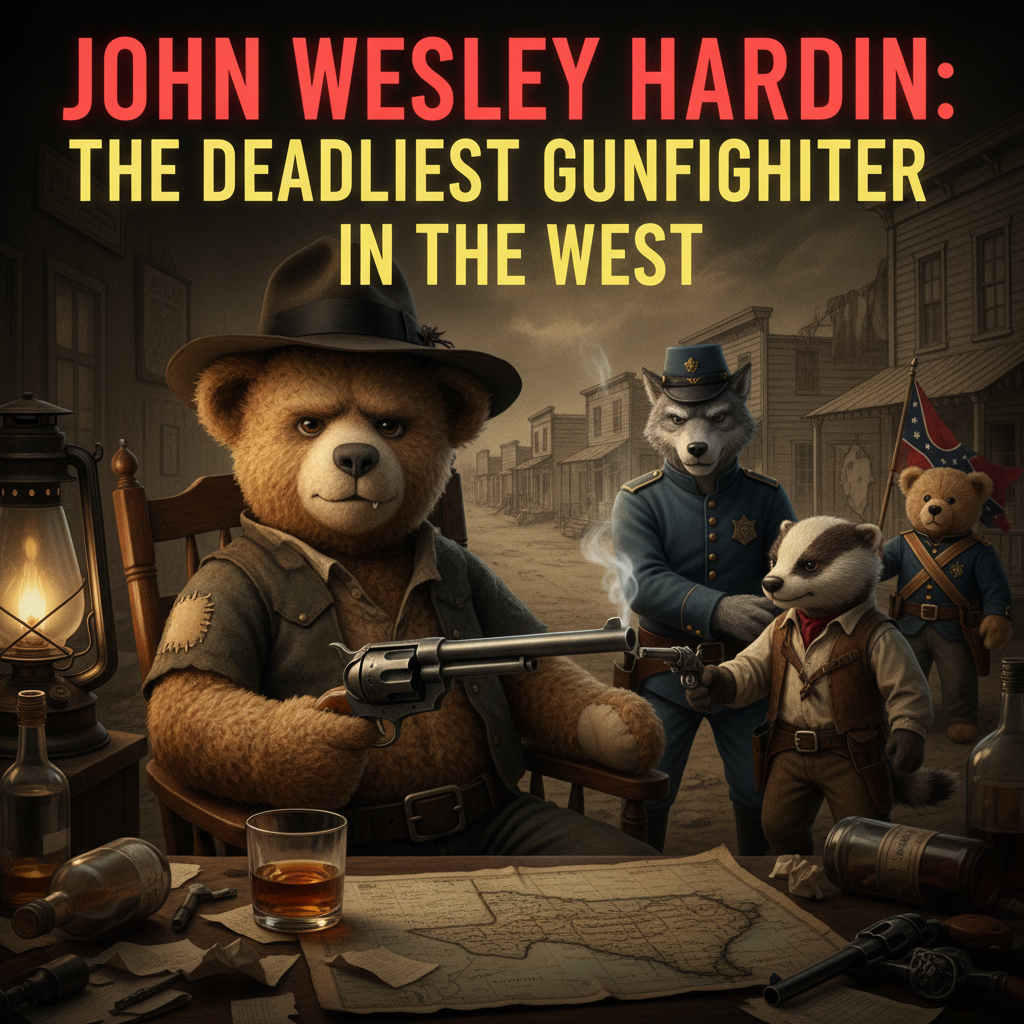
John Wesley Hardin: The Deadliest Gunfighter in the West
John Wesley Hardin claimed to have killed 42 men. The documented count runs closer to 27 or 28 — which still makes him, by any honest accounting, the deadliest gunfighter in the documented history of the American West. He killed his first man at 15, was named for the founder of Methodism by a preacher father, and died at 42, shot in the back of the head while playing dice in the Acme Saloon in El Paso, Texas on August 19, 1895.
The biography does not yield a simple lesson.
Part of Outlaw Legends — ← Back to series hub
Reconstruction Texas Produced a Killer With a Political Framework
Hardin was born May 26, 1853, in Bonham, Fanin County, Texas. His father, James Gibson Hardin, preached and practiced law and raised his children in a household that was culturally Confederate and deeply hostile to the federal occupation of Texas after the Civil War. John Wesley absorbed that hostility as doctrine.
His first killing came in November 1868 near Moscow, Texas, when he shot a formerly enslaved man named Mage during a wrestling match that escalated. Hardin was 15. The killing was not legally pursued immediately, but Hardin knew federal soldiers would want to question him, and he fled. Within weeks he had killed three more Union soldiers who were sent to arrest him.^1^
This is the part of the Hardin biography that his sympathizers often minimize. Hardin’s violence was not random — it was ideologically motivated, rooted in Confederate resistance to Reconstruction. The men he killed early in his career were disproportionately Black Texans and federal agents. His autobiography, The Life of John Wesley Hardin, published posthumously in 1896, frames these killings as self-defense — a claim that required treating a Black wrestling opponent as a mortal threat to a 15-year-old white boy in Reconstruction Texas, which the courts of the time might have accepted and historians should not.
Why Did Hardin Keep Killing Into His Twenties?
Between 1868 and 1877, Hardin killed at an extraordinary rate. In Abilene, Kansas on May 26, 1871 — his 18th birthday — he shot a man named Charles Cougar in a neighboring hotel room for snoring. This story, which Hardin himself told and which is probably accurate given his temperament, captures something essential: by his early twenties, Hardin killed reflexively, with minimal provocation, and justified it afterward.^2^
He worked cattle drives, gambled, fought, killed. In DeWitt County, Texas he was involved in the Sutton-Taylor feud, one of the bloodiest family conflicts in Texas history, killing at least three men connected to the Sutton faction between 1873 and 1874. On May 26, 1874 — his 21st birthday — he shot and killed Brown County Deputy Sheriff Charles Webb in Comanche, Texas after a confrontation in a saloon. Webb had reportedly been hired specifically to kill Hardin. Hardin claimed self-defense. Witnesses disagreed about who drew first.^3^
The Webb killing triggered a massive manhunt. Texas Rangers arrested and killed members of Hardin’s family as leverage. His brother Joe was lynched by a mob in Comanche in May 1874. Hardin fled to Florida under the alias J.H. Swain and was living in Gainesville when Pinkerton detectives and Texas Rangers tracked him down on a train in Pensacola on July 23, 1877.
Prison Taught Him Law, Not Restraint
Hardin was tried for the murder of Deputy Webb and convicted, sentenced to 25 years in the Texas State Penitentiary at Huntsville. He entered in October 1878. He studied law in prison, became a model prisoner by most accounts, and was pardoned on February 17, 1894, after serving approximately 16 years.^4^
He passed the Texas bar exam and set up practice in Gonzales, then moved to El Paso in 1895. The El Paso period was chaotic — heavy drinking, a reputation that attracted trouble, alliances with the wrong people. He allied himself with an El Paso lawman named John Selman Sr. and his son John Selman Jr., a relationship that ended badly when Hardin arranged for Selman Jr. to be arrested on a minor charge after a dispute.
On August 19, 1895, John Selman Sr. walked into the Acme Saloon and shot Hardin in the back of the head while Hardin was rolling dice at the bar. Selman fired three more times as Hardin fell. He was tried for murder, testified that Hardin had turned and reached for his gun, and the jury deadlocked. Before a new trial could be held, Selman was himself shot and killed in April 1896 during a dispute with a U.S. Marshal.^5^
The Autobiography Problem
Hardin finished his autobiography in the weeks before his death. It is a remarkable document — self-serving, internally inconsistent, and occasionally accidentally honest. He presents himself throughout as a man who only killed in self-defense, who was persecuted by Reconstruction authorities, who was fundamentally decent. The actual kill count he claims (42) is higher than what historians can document, which is a strange choice for a man claiming self-defense: to inflate the number of men you killed is to undermine your own case that each killing was necessary.
The autobiography sold well. Texas newspapers covered his death with a mixture of condemnation and grudging respect. The El Paso Daily Times ran a long retrospective that counted him as “the most feared man in Texas for twenty years” and noted that his legal practice had been “promising.” The sentence captures the cultural confusion perfectly: a man with 27 documented killings had a promising legal practice, and this was worth noting as a tragedy.
John Wesley Hardin is buried in Concordia Cemetery in El Paso alongside Chinese laborers who died building the railroads, Buffalo Soldiers, and victims of the 1918 influenza epidemic. The juxtaposition is unintentional and instructive. Compare him to Billy the Kid — another young man formed by the specific violence of his place and time — and the difference is the ideological scaffolding. Hardin had a framework. The Kid had a grudge. The framework made Hardin more dangerous, and the grudge made the Kid more sympathetic.
─────────
Sources:
- Hardin, John Wesley. The Life of John Wesley Hardin. Smith & Moore, 1896.
- Parsons, Chuck. John Wesley Hardin: Dark Angel of Texas. University of North Texas Press, 2018.
- Metz, Leon Claire. John Wesley Hardin: Dark Angel of Texas. Mangan Books, 1996.
- Sonnichsen, C.L. I’ll Die Before I’ll Run: The Story of the Great Feuds of Texas. Harper & Brothers, 1951.
- DeArment, Robert K. Deadly Dozen: Forgotten Gunfighters of the Old West. University of Oklahoma Press, 2003.