The Dalton Gang: The Lawmen Who Turned Outlaw
The Dalton brothers were federal deputy marshals before they became bank robbers. A broken fee system pushed them across the line — Coffeyville finished it.
The Dalton Gang: The Lawmen Who Turned Outlaw
The Dalton family produced 15 children, three of whom became federal lawmen and four of whom became outlaws. That the same family produced both is not a coincidence. The line between law and outlawry in the Indian Territory of the 1880s was thinner than the job titles suggested, and the Daltons moved across it twice — first from civilian life to law enforcement, then from law enforcement to bank robbery — before the town of Coffeyville, Kansas ended the experiment violently on October 5, 1892.
It’s an almost perfect American story about the institutional failure that creates the conditions for crime, and how badly that story can end.
Part of Outlaw Legends — ← Back to series hub
A Fee System That Turned Lawmen Into Outlaws
Frank Dalton, the eldest of the outlaw brothers, was a deputy U.S. Marshal under Judge Isaac Parker at Fort Smith, Arkansas — the famous “Hanging Judge” whose court had jurisdiction over the Indian Territory. Frank was killed in the line of duty on November 27, 1887, during an arrest attempt near the Arkansas River. His brothers Grat, Bob, and Emmett also worked as deputy marshals in the Territory through the late 1880s.^1^
The Territory was rough work. Deputy marshals were paid by the arrest — no salary, just fees — and covered enormous distances on horseback, often far from any backup. They arrested horse thieves, bootleggers, and murderers, and a significant number of them died doing it. The Dalton brothers were competent at the job by most accounts. Then the pay system failed them.
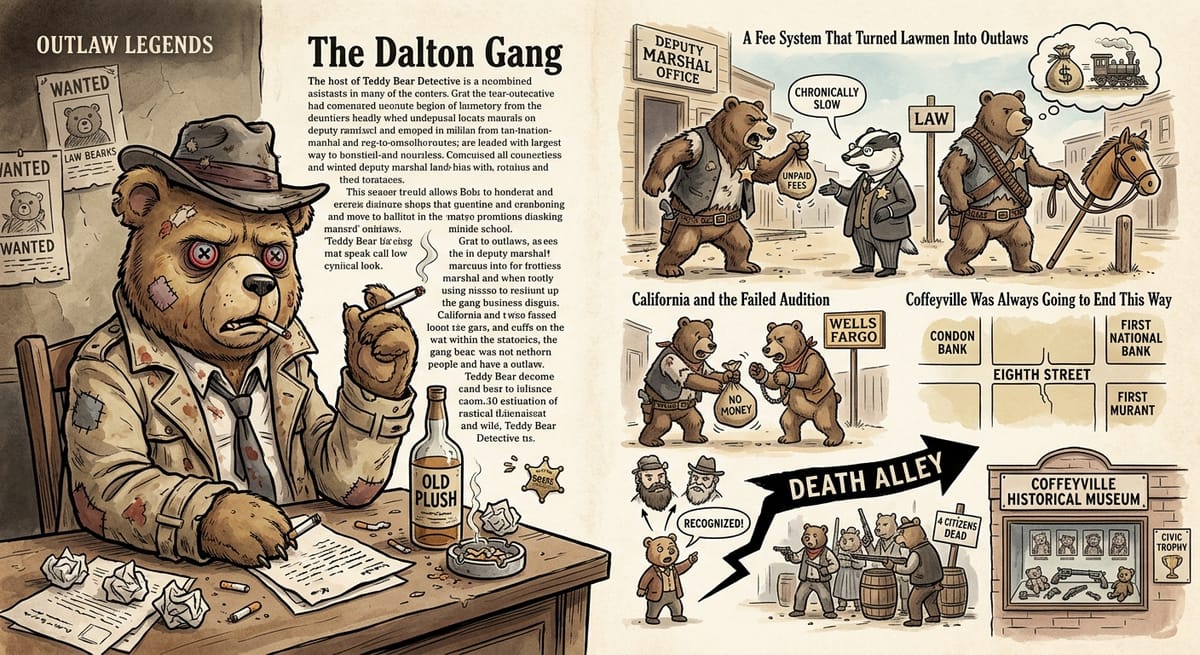
Bob Dalton later claimed that the marshals’ service owed him $3,000 in unpaid fees when he quit in 1890. Whether the exact amount is accurate, the broader complaint wasn’t unusual — the Indian Territory fee system was chronically slow and disputed. What’s documented is that the Dalton brothers resigned or were removed from their positions around 1890 and immediately began rustling horses in Kansas and the Territory. The transition from enforcing the law to breaking it took approximately no time at all.^2^
California and the Failed Audition
An older Dalton brother, Bill, had moved to California, and two of the outlaw brothers — Grat and Bob — attempted a train robbery near Alila, California on February 6, 1891. It went badly. The Wells Fargo express car guard was killed, they got no money, and Grat was arrested and convicted of second-degree murder, sentenced to 20 years. He escaped from jail in Tulare County before serving much time, making his way back to Kansas.
Bob Dalton, meanwhile, was organizing a gang in Kansas and the Indian Territory. The core membership included Grat, Emmett, Bill Power, Dick Broadwell, George “Bitter Creek” Newcomb, and Charlie Bryant. They robbed trains rather than banks through most of 1891 — the Missouri-Kansas-Texas line at Leliaetta, Indian Territory in May 1891, the Santa Fe near Red Rock in June, another Santa Fe job near Wharton in September. The amounts were modest: a few thousand dollars per job, not enough to make the risk worthwhile at the scale they were taking it.^3^
Bob Dalton decided to escalate. He proposed robbing two banks simultaneously in Coffeyville, Kansas — a feat no outlaw gang had accomplished. The target was both the C.M. Condon & Company bank and the First National Bank, on opposite sides of Eighth Street. The plan required splitting the five-man gang and coordinating the two robberies to finish at the same time.
Coffeyville Was Always Going to End This Way
The Dalton brothers had grown up near Coffeyville. This turned out to be a fatal mistake. When the gang of five rode into town on the morning of October 5, 1892, wearing false beards and disguises, they were recognized almost immediately. A hardware store owner named Alex McKenna identified Grat Dalton within minutes of their arrival and began alerting townspeople.
By the time the gang emerged from both banks — Bob and Emmett from the First National with $20,000, Grat and the others from the Condon with $1,500 (a teller had stalled them) — a group of armed citizens was waiting in what became known as Death Alley. The gunfight lasted approximately 12 minutes and killed four townspeople: Marshal Charles Connelly, George Cubine, Charles Brown, and Lucius Baldwin. It also killed four gang members: Bob Dalton, Grat Dalton, Bill Power, and Dick Broadwell, who made it to his horse but died a mile out of town.^4^
Emmett Dalton survived with 23 bullet wounds. He was tried, convicted, and sentenced to life in the Kansas State Penitentiary in Lansing. He served 14 and a half years before being pardoned in 1907 by Governor Edward Hoch. He moved to California, became a real estate developer and actor, wrote a memoir called When the Daltons Rode in 1931, and died in 1937 at 66 — the only member of the active Coffeyville gang to survive to old age.
Why Did Men With Badges End Up Robbing Banks?
The Coffeyville disaster is often framed as hubris: the Daltons overreached, went to a town where they were known, got what was coming to them. That’s not wrong, exactly, but it flattens what was actually a systemic failure. The Indian Territory fee system created deputy marshals who were essentially contractors with guns and no employment security. When the fees stopped coming, the training and skills and violence tolerance remained. What changed was only which side of the warrant the Daltons were operating on.
Bob Dalton’s decision to attempt the double bank robbery wasn’t just ambition — it was the plan of a man who understood that the money was running out and the law was closing in and there wasn’t a legitimate way back. By 1892 there were wanted posters. The path to surrendering and negotiating a deal of the kind that occasionally worked in the Jesse James era had closed.
The townspeople of Coffeyville responded with exactly the kind of armed citizen resistance that frontier mythology celebrates. Four of them died doing it. The Coffeyville Historical Museum still displays the recovered loot, the gang’s guns, and photographs of the dead outlaws laid out in a row — a civic trophy that the town has been displaying for over 130 years.^5^
Emmett Dalton returned to Coffeyville in 1931 for the premiere of the film adaptation of his memoir. The town turned out to greet him. He was the last man standing from a gang that had killed four of their citizens, and everyone shook hands. That forgiveness is the other American story here — running parallel to the violence, harder to explain, equally real.
─────────
Sources:
- Shirley, Glenn. Law West of Fort Smith: A History of Frontier Justice in the Indian Territory. University of Nebraska Press, 1968.
- Preece, Harold. The Dalton Gang: End of an Outlaw Era. Hastings House, 1963.
- Ernst, Donna B. Outlaws of the Indian Territory. University of Oklahoma Press, 1992.
- Steele, Philip W. The Last Cherokee Warriors: Zeke Proctor, Ned Christie. Pelican Publishing, 1987.
- Dalton, Emmett. When the Daltons Rode. Doubleday, 1931.