Industrial Disasters: When Negligence Kills
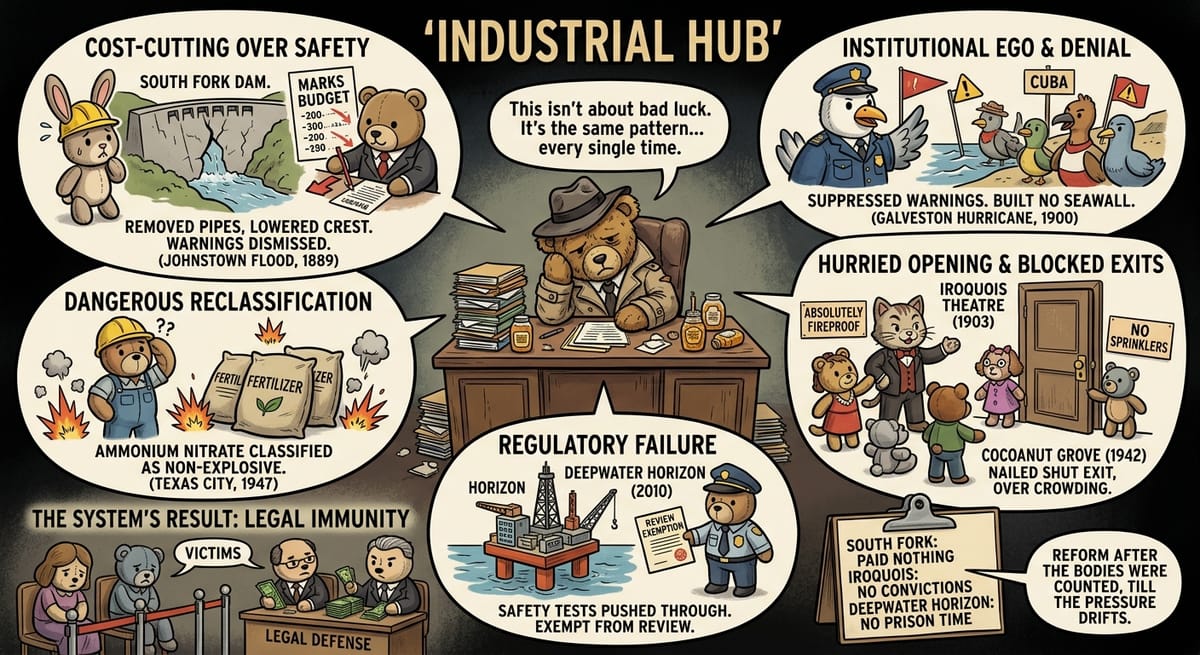
Six American industrial disasters from 1889 to 2010 — the Johnstown Flood Iroquois Theatre Texas City Cocoanut Grove Galveston and Deepwater Horizon — share one pattern: negligence protected by legal immunity.
Industrial Disasters: When Negligence Kills
Every disaster in this series has an official explanation. The South Fork Dam failed due to “extraordinary rainfall.” The Cocoanut Grove fire was caused by a bus boy and a match. The Grandcamp exploded because of an onboard fire. Deepwater Horizon was a “well control incident.” These explanations are technically accurate and almost entirely beside the point.
The pattern across these events is not bad weather or a misread pressure test. It is the same sequence, repeated across a century: someone in a position of responsibility made a decision to save money, ignore a warning, skip an inspection, or reclassify a hazard — and then the people downstream of that decision died.
← Back to Disasters With Dark Causes
In This Series
- The Johnstown Flood: When Rich Men’s Negligence Drowned a Town
- The Galveston Hurricane: 8,000 Dead and a Government That Didn’t Respond
- The Iroquois Theatre Fire: 602 Dead in an Afternoon
- The Cocoanut Grove Fire: The Nightclub Inferno
- The Texas City Disaster: The Explosion That Leveled a Port
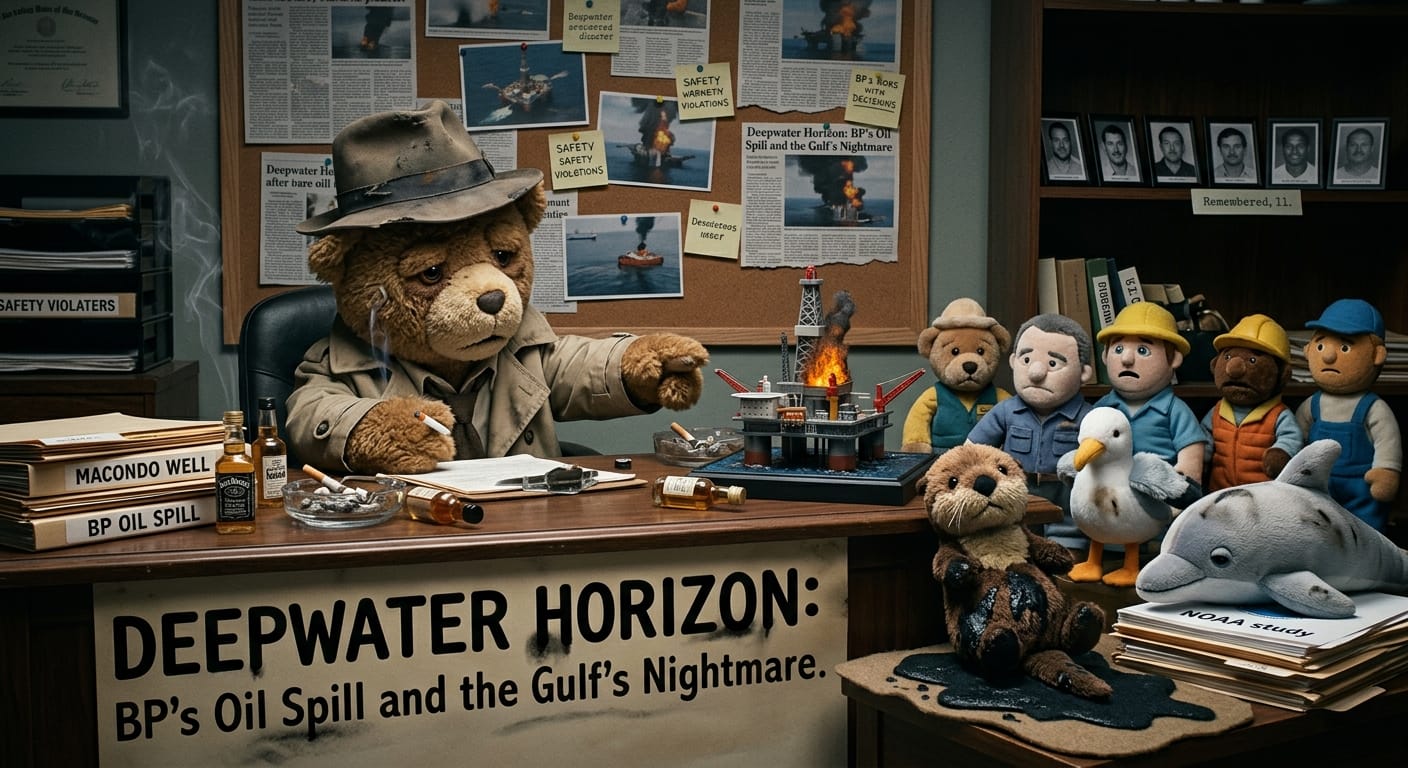
- Deepwater Horizon: BP’s Oil Spill and the Gulf’s Nightmare
The Decision That Preceded Every Death
The Johnstown Flood of May 31, 1889, killed 2,209 people because the South Fork Fishing and Hunting Club’s wealthy members declined to repair a dam they had modified and degraded. The modifications that caused the failure — removal of the discharge pipes, lowering of the dam’s crest, installation of fish screens that blocked the spillway — were all cost-cutting decisions made years before the flood. The warning from businessman Daniel Morrell had been received and dismissed.
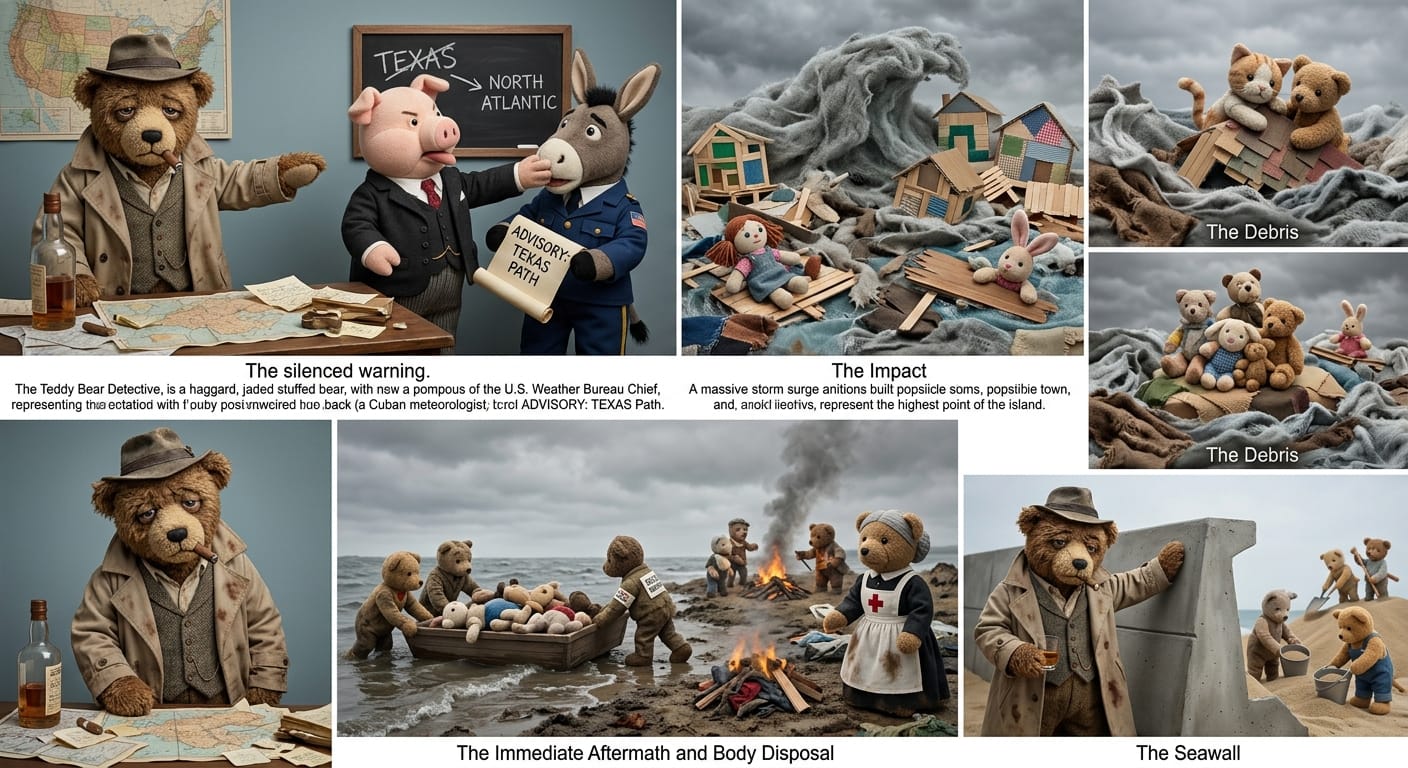
The Galveston Hurricane of September 8, 1900, killed at least 8,000 people partly because the U.S. Weather Bureau’s chief, Willis Moore, had suppressed Cuban meteorologists’ warnings about the storm’s path. Moore’s motive was institutional ego — he didn’t want a foreign weather service undercutting his bureau’s authority. The city had no seawall because its own engineer had published a paper declaring one unnecessary.
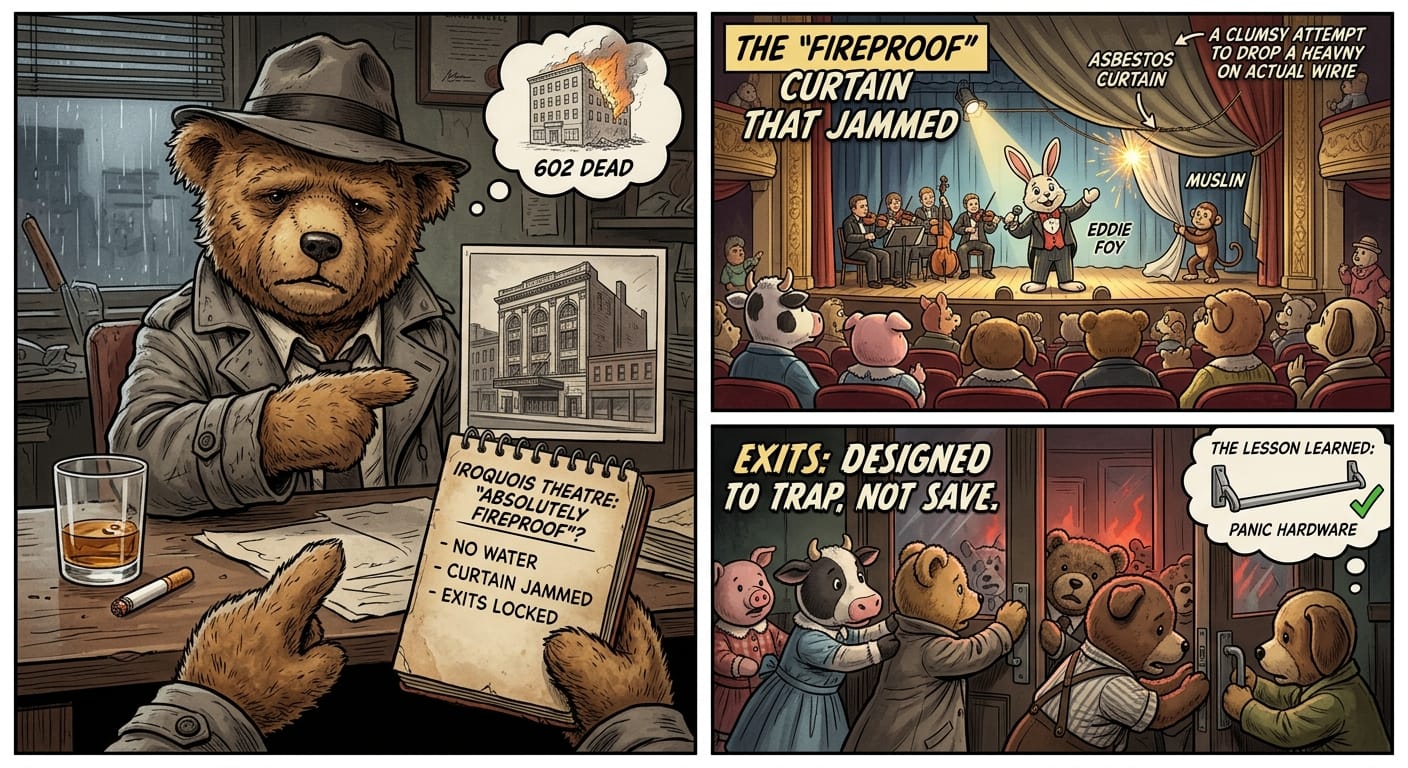
The Iroquois Theatre fire of December 30, 1903, killed 602 people in a building its owners advertised as “absolutely fireproof.” The sprinklers weren’t connected to water. The exits opened inward. The fire curtain jammed. The theatre had never received a completed safety inspection because it rushed to open before construction was finished.
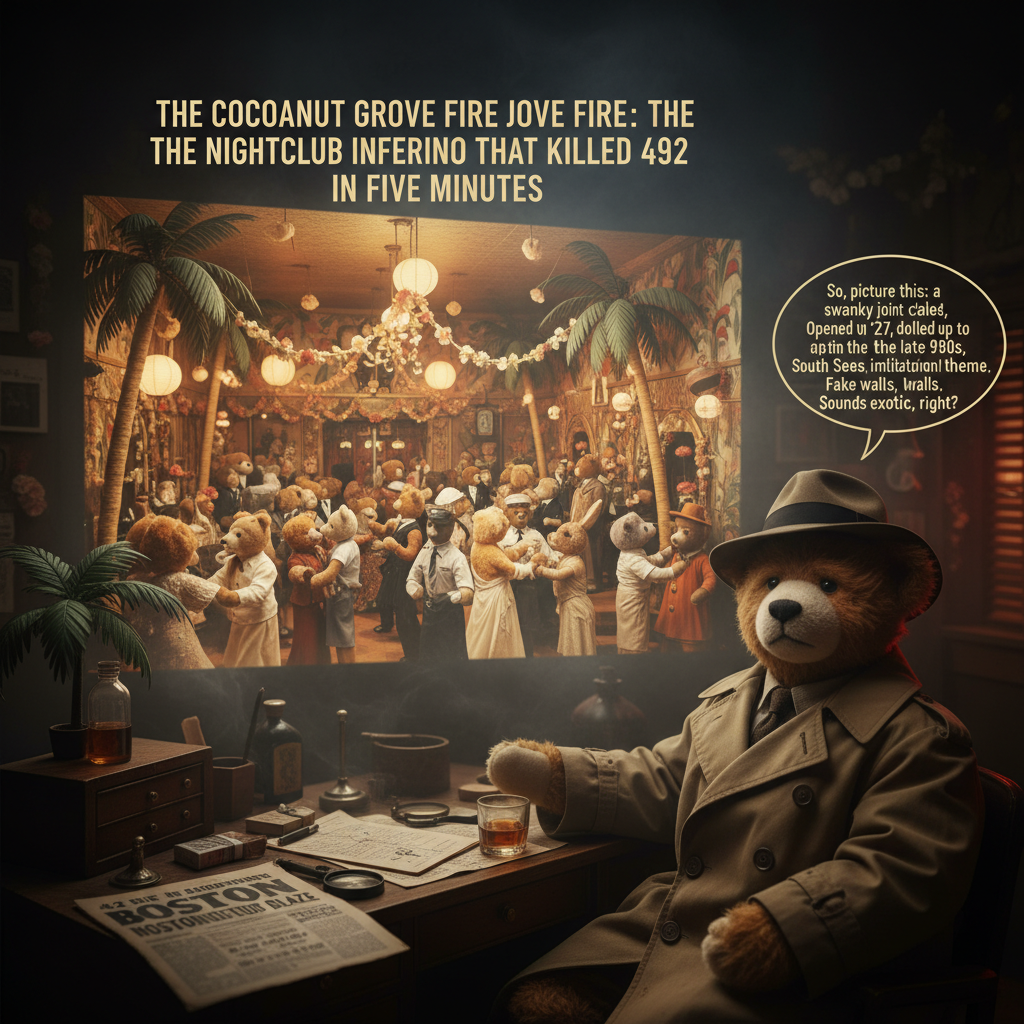
The Cocoanut Grove fire of November 28, 1942, killed 492 people in a nightclub operating at roughly double its licensed capacity, with an exit nailed shut and decorations that burned like paper. The owner had enough political connections to keep inspectors looking the other way for years.
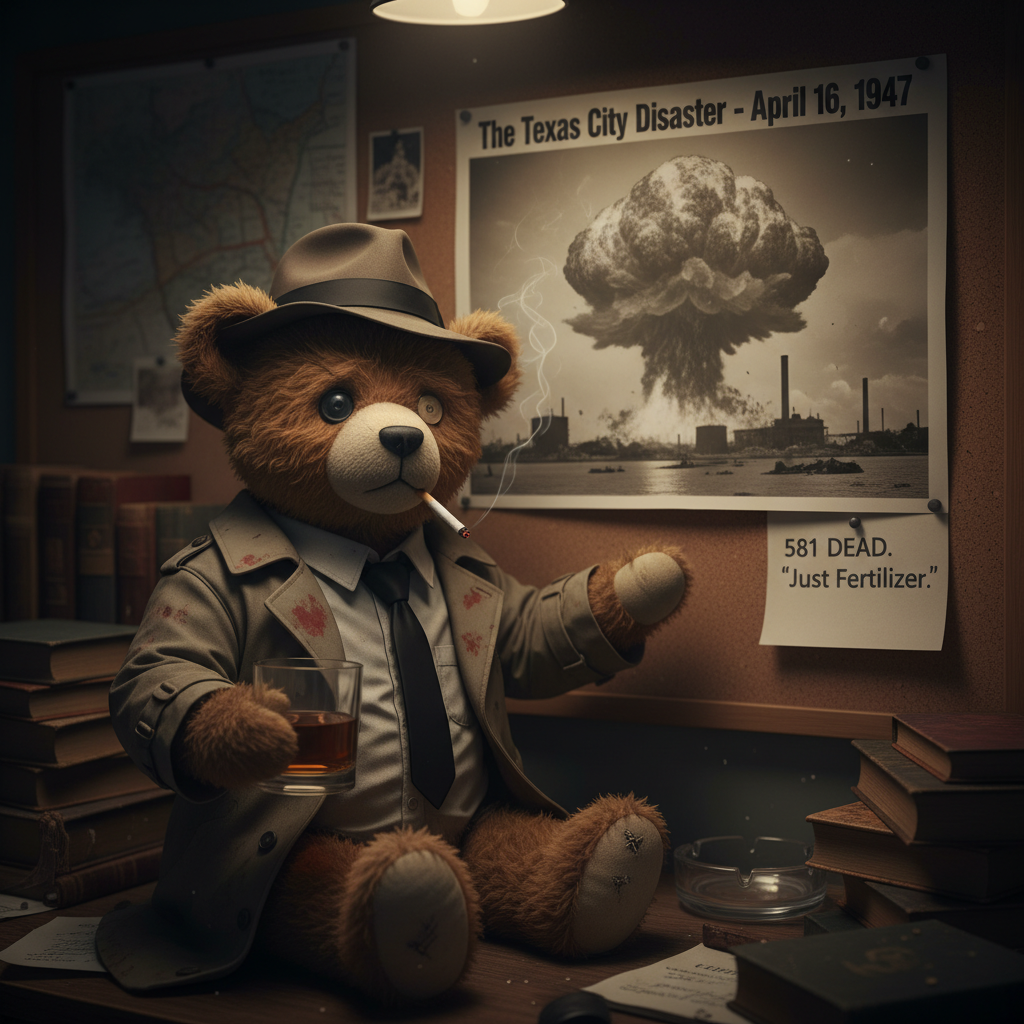
The Texas City disaster of April 16, 1947, killed 581 people because 2,300 tons of ammonium nitrate — a known explosive — had been classified as non-explosive fertilizer for maritime shipping purposes, and the workers loading it were never told what it could do.
Deepwater Horizon on April 20, 2010, killed 11 men and spilled 210 million gallons of oil into the Gulf because a well that was behind schedule was pushed through safety tests that had produced warning signs, by companies operating under a regulator that had exempted the project from environmental review. ^1^
Legal Immunity Was the System Working as Intended
What connects these events across 121 years is not just negligence — it is the near-total failure of legal accountability afterward. The South Fork Club members paid nothing. No one was convicted in the deaths of 602 people at the Iroquois. Barney Welansky of the Cocoanut Grove served four and a half years before being pardoned. The Supreme Court ruled in Dalehite v. United States that the Texas City survivors couldn’t sue the federal government for the regulatory failure that killed their families. BP’s executives faced no prison time despite pleading guilty to 11 counts of felony manslaughter. ^2^
The pattern is structural. Negligence that produces industrial disasters happens in organizations with resources — wealthy clubs, nightclub owners with political connections, oil companies with $16 billion annual profits, cargo shipping operations operating under favorable federal classifications. Those resources translate into legal defense. Deaths that occur at scale, when produced by the actions of wealthy institutions, are systematically harder to prosecute than individual crimes. This is not a coincidence. It is how the legal system has handled industrial negligence for over a century — with occasional fines, occasional short sentences, and consistent failure to hold decision-makers personally accountable at the level the harm they caused would seem to warrant.
Reform Came After the Bodies Were Counted, and Drifted Once the Pressure Subsided
The regulatory reforms that followed each disaster in this series are real. Exit hardware that prevents crushing in a panic, fire codes that require sprinkler systems in public buildings, ammonium nitrate reclassification as a hazardous material, offshore drilling safety reforms — these were all produced by the political pressure that followed mass death. People died and the rules changed.
But the rules changed too late for the 602 at the Iroquois, the 492 at the Cocoanut Grove, the 581 at Texas City, and the 11 on the Deepwater Horizon. Safety regulation in the United States has historically operated as disaster response rather than disaster prevention — written after the bodies have been counted, enforced until the political pressure subsides, and then subject to the same cycle of budget cuts, industry lobbying, and regulatory capture that produced the disaster in the first place.
The six events covered in this series span from 1889 to 2010. The most recent of them produced the largest corporate criminal penalty in U.S. history and no prison time for anyone. The pattern has not ended.
─────────
Sources:
- Hays, Samuel P. Beauty, Health, and Permanence: Environmental Politics in the United States, 1955–1985. Cambridge University Press, 1987.
- Freyer, Tony. Antitrust and Global Capitalism, 1930–2004. Cambridge University Press, 2006.
- Tebeau, Mark. Eating Smoke: Fire in Urban America, 1800–1950. Johns Hopkins University Press, 2003.
The Series