Disasters With Dark Causes in American History
American disasters where the real cause was a human decision — from the Johnstown Flood in 1889 to the Flint water crisis in 2014 — collected in two series covering nine events and 3800 deaths.

Disasters With Dark Causes in American History
Every disaster has a cause. The question this section asks is what kind of cause — because the difference between a natural disaster and a preventable catastrophe is not always obvious from the casualty count. The 2,209 people who drowned in the Johnstown Flood on May 31, 1889, died in a flood. They also died because wealthy men stopped maintaining a dam above their town. The 13 people who died when the I-35W bridge fell into the Mississippi River on August 1, 2007, died in a structural failure. They also died because a design error from 1967 had gone unchecked through 40 years of routine inspections.
The disasters collected here are American events where the cause was not fate. It was a decision — usually made by someone with authority, usually to save money or avoid inconvenience or preserve reputation — that transformed a hazard into a catastrophe.
In This Series
The Two Series
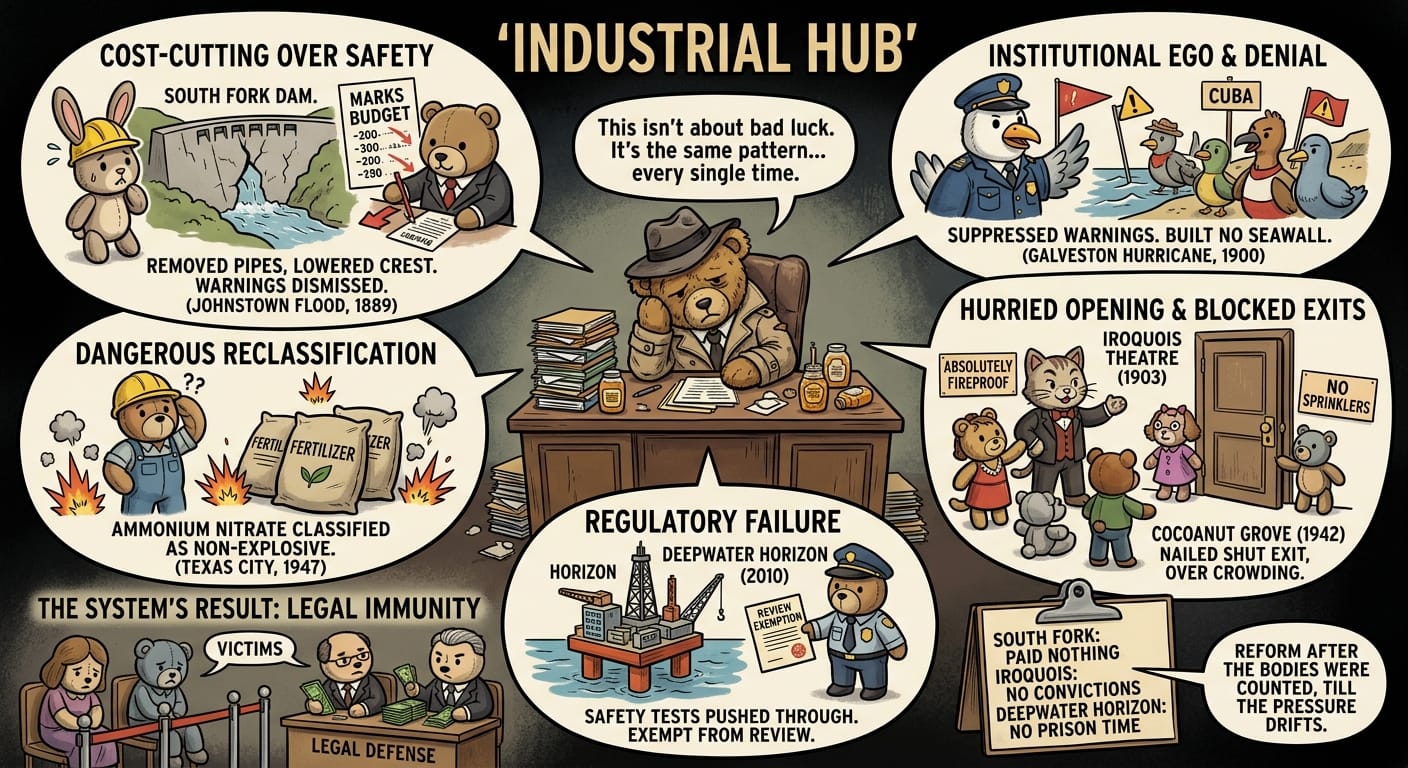
Industrial disasters covers six events from 1889 to 2010, each one involving industrial or commercial operations where negligence killed people at scale: the Johnstown Flood, the Galveston Hurricane of 1900, the Iroquois Theatre fire of 1903, the Cocoanut Grove nightclub fire of 1942, the Texas City ammonium nitrate explosion of 1947, and the Deepwater Horizon blowout of 2010. The total death toll across these six events exceeds 3,800 people. No one involved in decision-making for any of these events served significant prison time.
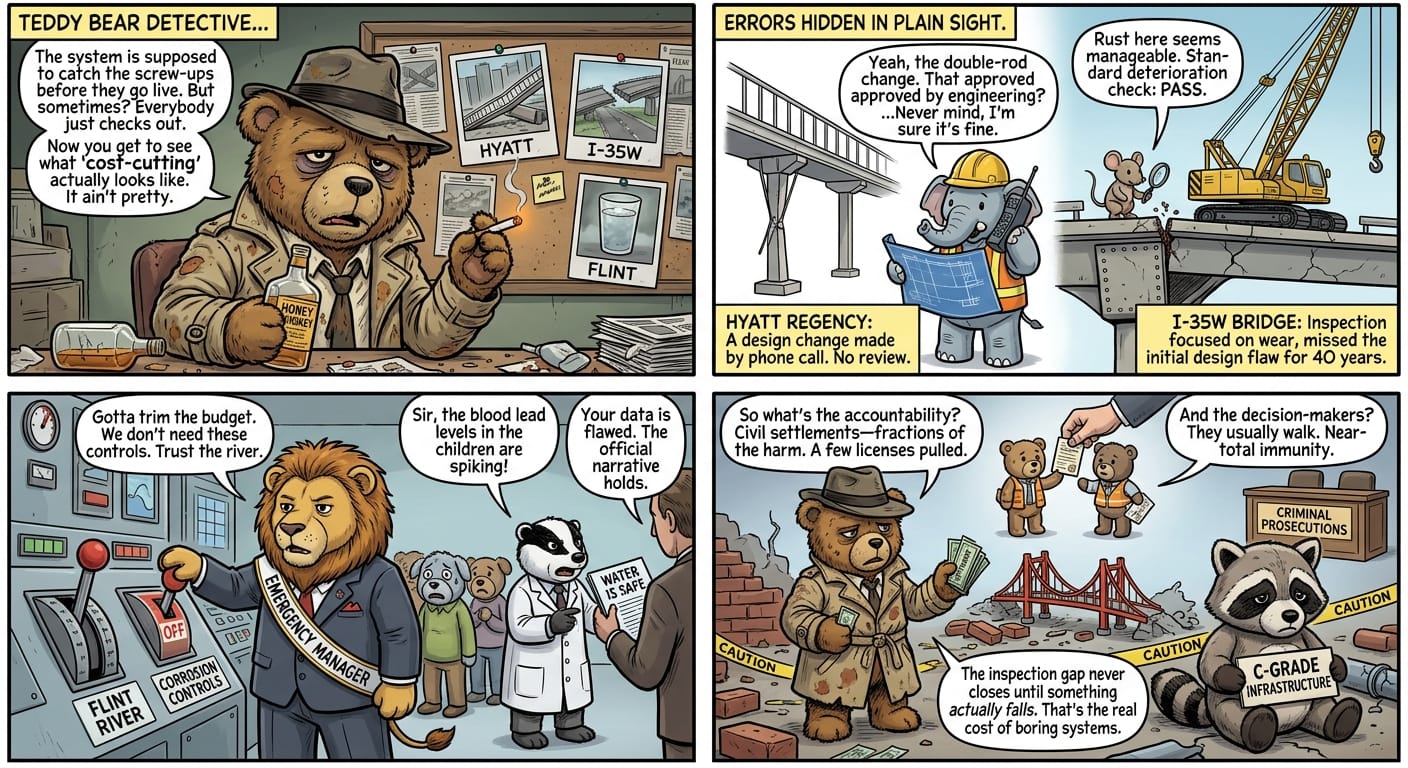
Infrastructure failures covers three events from 1981 to 2014, each involving the failure of physical systems that governments or developers were responsible for maintaining and certifying as safe: the Hyatt Regency walkway collapse in Kansas City (114 dead), the I-35W bridge collapse in Minneapolis (13 dead), and the Flint water crisis, which permanently harmed between 6,000 and 12,000 children with irreversible lead poisoning. ^1^
The events are different in mechanism, scale, and context. The pattern they share is worth examining.
Every Disaster Here Followed the Same Decision Architecture
In every case covered by these two series, the disaster was preceded by a decision that created or maintained the conditions for failure, and an oversight system that failed to stop it.
The South Fork Fishing and Hunting Club removed the discharge pipes from the South Fork Dam and screened the spillway with fish guards. Daniel Morrell warned them the dam was dangerous. They declined his offer to send an engineer. The dam failed 9 years later.
The U.S. Weather Bureau’s chief Willis Moore suppressed Cuban meteorologists’ hurricane tracking data in September 1900 because he didn’t want a foreign weather service undercutting his bureau’s authority. The people of Galveston had no adequate warning before 8,000 of them drowned.
Barney Welansky, the Cocoanut Grove’s owner, operated a nightclub at twice its licensed capacity with a nailed-shut exit and flammable decorations, because his connections at Boston City Hall kept inspectors from pressing the issue. 492 people died in five minutes.
The Michigan Department of Environmental Quality told Flint’s emergency managers that corrosion controls weren’t required when switching water sources. This was wrong. The federal EPA knew it was wrong and did not intervene effectively for 18 months. Between 6,000 and 12,000 Flint children absorbed lead into their developing brains during that period.
In each case, there was a prior warning, a regulatory framework that should have prevented the disaster, and a human decision to ignore or circumvent it. This is not coincidence. It is the architecture of preventable catastrophe. ^2^
The Immunity Pattern Held Across Nine Events and 121 Years
Across nine individual events covered in these two series, the legal aftermath follows a consistent pattern. Civil settlements compensate some victims at some fraction of their actual harm. Regulatory agencies are reorganized or renamed. Inspection standards are revised. And the individuals who made the decisions that created the conditions for disaster face, at most, the loss of a professional license.
No one was convicted in the deaths of 2,209 people at Johnstown. No one was convicted in the deaths of 602 people at the Iroquois Theatre. Barney Welansky of the Cocoanut Grove served less than five years and was pardoned. The Supreme Court ruled in Dalehite v. United States (1953) that Texas City survivors couldn’t sue the federal government for the regulatory classification decision that allowed 2,300 tons of a known explosive to be handled as fertilizer. BP’s executives faced no prison time after pleading guilty to 11 felony manslaughter counts. The criminal cases against Michigan officials for Flint remain unresolved more than a decade later. ^3^
This pattern is not uniform — the Hyatt Regency engineers lost their licenses, which was meaningful — but it is pervasive enough to constitute a norm. Mass death caused by negligence in industrial and infrastructure contexts does not, in American legal history, typically produce criminal accountability for the people who made the decisions that caused it.
These Are Not Historical Curiosities. The Pattern Is Still Running.
The argument sometimes made about historical disasters is that they belong to an earlier, less regulated era — that we have OSHA now, and the EPA, and NTSB investigations, and building codes with panic hardware on outward-opening doors. This is partly true. The Iroquois Theatre fire directly produced the panic bar. The Texas City explosion produced the reclassification of ammonium nitrate as a hazardous material. The Cocoanut Grove fire forced fire codes across the country. Regulation exists because people died.
But Deepwater Horizon was 2010. Flint was 2014. The I-35W bridge was 2007. These are not historical curiosities from an era before oversight. They are recent events that occurred within fully developed regulatory frameworks — and in each case, the regulatory framework failed, either because of industry capture (Deepwater Horizon), inadequate design review processes (I-35W), or deliberate circumvention by the government officials the framework was supposed to hold accountable (Flint). ^4^
The history of industrial and infrastructure disasters in the United States is not a story of steady progress from negligence to safety. It is a cycle: disaster, outrage, reform, regulatory drift, disaster. The reforms are real. The drift is also real. The question each new disaster raises is whether the oversight system has kept pace with the hazard — and the answer, in each case covered here, was no.
The 3,800-plus people who died in the industrial disasters documented in this section were not unlucky. They were downstream of decisions made by people who had reasons to cut corners, ignore warnings, and avoid the cost of safety. Understanding those decisions — who made them, why they were made, and what happened when the consequences became impossible to ignore — is the point of this record.
─────────
Sources:
- McCullough, David. The Johnstown Flood. Simon & Schuster, 1968.
- Perrow, Charles. Normal Accidents: Living with High-Risk Technologies. Basic Books, 1984.
- Freyer, Tony. Antitrust and Global Capitalism, 1930–2004. Cambridge University Press, 2006.
- National Commission on the BP Deepwater Horizon Oil Spill and Offshore Drilling. Deep Water: The Gulf Oil Disaster and the Future of Offshore Drilling. U.S. Government Printing Office, 2011.
In This Section