The Cocoanut Grove Fire: The Nightclub Inferno
492 people died in the Cocoanut Grove nightclub fire on November 28 1942 — in five minutes — because a Boston club owner locked an exit and held double the legal capacity.
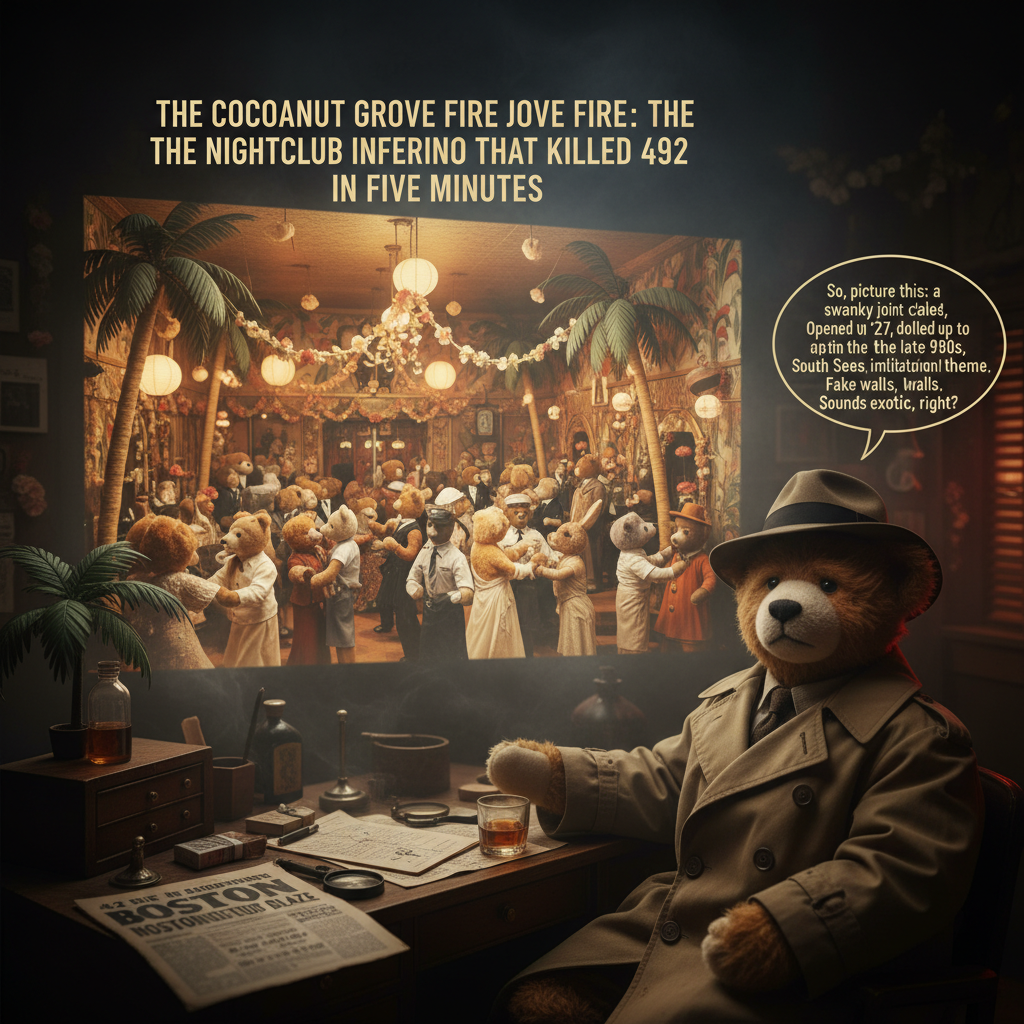
The Cocoanut Grove Fire: The Nightclub Inferno That Killed 492 in Five Minutes
On the night of November 28, 1942, 492 people died in a nightclub fire at the Cocoanut Grove in Boston, Massachusetts. The fire took less than five minutes to move through the main room. The building was licensed for 460 people and held somewhere between 800 and 1,000 that night. The exits were too few, too small, and in one case nailed shut. The decorations burned like kindling. It was the deadliest nightclub fire in American history, and nearly every factor that caused it had been visible for years.
Part of Industrial Disasters — ← Back to series hub
A Nightclub Built on Political Connections and Ignored Inspections
The Cocoanut Grove at 17 Piedmont Street in Boston’s Bay Village neighborhood was a popular spot by any measure — opened in 1927 and renovated extensively in the late 1930s, featuring a main dining room, a lounge, and a basement bar called the Melody Lounge, all decorated with a South Seas tropical theme: fake palm trees, imitation leather and satin walls, cloth and paper decorations designed to evoke an island paradise. The decorations were not fireproofed.
The club was owned by Barney Welansky, a Boston businessman with close ties to Mayor James Michael Curley, which is part of why the Cocoanut Grove had been repeatedly passed by city inspectors despite well-documented overcrowding and inadequate exits. The most recent fire inspection had reportedly taken place while the basement Melody Lounge was still under renovation — meaning the completed space was never formally inspected. ^1^ On November 28, 1942, the club was packed beyond any licensed capacity. Boston College had just beaten Holy Cross that afternoon in a college football game significant enough to draw additional celebrants, and servicemen on weekend leave from nearby military installations filled many of the seats.
How Did the Cocoanut Grove Fire Start and Spread So Fast?
At approximately 10:15 p.m., a bus boy named Stanley Tomaszewski was replacing a lightbulb in the Melody Lounge that a patron had removed — possibly to create more privacy in a booth. He struck a match to see in the dark space and accidentally ignited the artificial palm tree beside him. The fire moved into the fabric ceiling above the bar within seconds.
The decorations — synthetic fabric, paper, treated cloth — burned with extreme speed and produced intense heat and toxic gases, including carbon monoxide and hydrogen cyanide from the burning synthetic materials. Patrons in the Melody Lounge had approximately 90 seconds to reach the single stairway leading up before conditions became unsurvivable. Many did not make it. ^2^ The fire moved from the basement up to the main floor via the stairway and through the ventilation system. In the main room, a revolving door at the primary entrance became jammed with panicked bodies and stopped turning — trapping hundreds of people between the door and the fire behind them. A second exit, a side door on Shawmut Street, had been locked and bolted by management, apparently to prevent patrons from slipping out without paying. Bodies were stacked against it afterward. A third door in the Broadway Lounge addition opened inward, and the crush of people against it prevented it from moving.
492 Dead, Medical History Made in the Wreckage
Bodies were found in piles at every blocked exit. Rescue workers who arrived — the Boston Fire Department received the alarm at 10:23 p.m. — found the main entrance choked with the dead and the dying. Inside, the fire had already swept through the main room. The entire catastrophe, from the first ignition in the Melody Lounge to conditions incompatible with survival in the main room, took roughly five minutes.
Of the 492 who died, many were identified from the contents of their wallets and purses, since fire and smoke had left their clothing and features difficult to distinguish. The youngest confirmed victim was 16-year-old Eleanor Chiampa. Many of the dead were members of the military, there on weekend passes. ^3^
Among the survivors taken to Massachusetts General and Boston City Hospital were some of the most seriously burned patients American medicine had dealt with outside of combat. The response to the Cocoanut Grove produced several genuine medical advances: fluid resuscitation protocols for burn patients, penicillin treatment of wound infection (one of the drug’s first major civilian applications in the United States), and psychiatric protocols for treating acute grief and trauma, developed by Dr. Erich Lindemann at MGH in the weeks after the fire.
Welansky Got Four and a Half Years. His Political Friends Got Nothing.
Barney Welansky, the club’s owner, was the only person convicted in connection with the disaster. He was tried on charges of involuntary manslaughter in 1943, convicted on 19 counts, and sentenced to 12 to 15 years in Massachusetts State Prison. He served four and a half years before Governor Maurice Tobin pardoned him in 1946 on the grounds that Welansky was dying of cancer. He died six weeks after his release. ^4^
The building inspector who had approved the club, the fire department officials who had passed it during inspections, and the city officials whose relationships with Welansky had smoothed the way for a decade of operating violations faced no legal consequences. It’s the same pattern as the Iroquois Theatre in 1903 — owners indicted, charges dropped or sentences minimal, inspectors untouched — and it would run forward to Texas City in 1947 and Deepwater Horizon in 2010.
The Fire Codes That Followed Applied to Buildings Everywhere Except Cocoanut Grove
The Cocoanut Grove fire produced more immediate regulatory change than almost any other fire disaster in American history. Within months, Massachusetts and then states across the country revised their fire codes to require outward-opening doors on all public buildings, ban the use of flammable materials in interior decoration, mandate sprinkler systems in nightclubs and entertainment venues, and limit occupancy strictly. ^5^
The Cocoanut Grove building itself was demolished in 1945. The site at 17 Piedmont Street is now a parking garage. A small plaque marks where 492 people died because a club owner locked an exit, stuffed a room with flammable decorations, let a space hold twice its legal capacity, and had the right friends at City Hall to keep inspectors from looking too closely.
The revolving door that jammed on 800 people jammed because too many people hit it at once — and too many people were in that building because the city of Boston had looked away for years.
─────────
Sources:
- Benzaquin, Paul. Holocaust!: The Shocking Story of the Boston Cocoanut Grove Fire. Henry Holt, 1959.
- National Fire Protection Association. The Cocoanut Grove Nightclub Fire. NFPA Archives, 1943.
- Esposito, John C. Fire in the Grove: The Cocoanut Grove Tragedy and Its Aftermath. Da Capo Press, 2005.
- Commonwealth of Massachusetts. Commonwealth v. Welansky, 316 Mass. 383, 1944.
- Tebeau, Mark. Eating Smoke: Fire in Urban America, 1800–1950. Johns Hopkins University Press, 2003.