Deepwater Horizon: BP's Oil Spill and the Gulf's Nightmare
The Deepwater Horizon explosion on April 20 2010 killed 11 workers and released 210 million gallons of oil into the Gulf — after BP bypassed safety tests on an overdue well to save money.
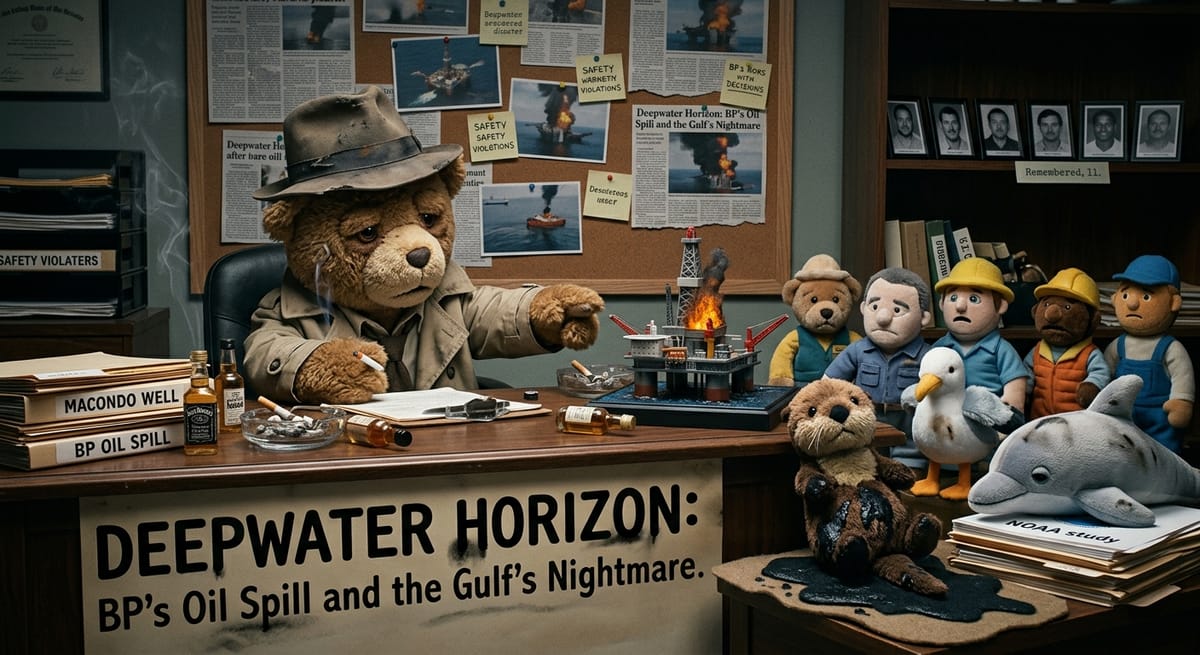
Deepwater Horizon: BP’s Oil Spill and the Gulf’s Nightmare
On April 20, 2010, the Deepwater Horizon oil rig exploded in the Gulf of Mexico, killing 11 workers and injuring 17 others. The blowout that followed went uncontrolled for 87 days, releasing an estimated 210 million gallons of crude oil into the Gulf of Mexico — the largest marine oil spill in history. The 11 men who died were working on a well that a sequence of bad decisions and bypassed safety protocols had turned into a bomb.
Part of Industrial Disasters — ← Back to series hub
BP Kept Pushing a Well That Was Telling Them to Stop
The Macondo well, located 5,000 feet below the Gulf’s surface and drilled to a depth of 18,360 feet below the seafloor, was behind schedule and over budget when the Deepwater Horizon arrived to complete it in early 2010. BP, which held the drilling rights, was under pressure to finish the well and move the rig — at a rental cost of approximately $500,000 per day — to its next assignment. ^1^
The decisions made in the days before the explosion reflected that pressure. On April 9, tests showed that cement at the bottom of the wellbore — the barrier that was supposed to prevent hydrocarbons from migrating up the well — was not properly set. BP proceeded. On April 17, the crew ran a test using seawater instead of drilling mud to determine whether the well’s pressure barriers were intact — a cheaper and faster approach, but one that meant less weight holding down any migrating gas. On April 19, the crew began replacing the drilling mud in the riser pipe with seawater before a final test called a negative pressure test had confirmed the well was properly sealed.
The negative pressure test, conducted on April 20, produced anomalous readings. Investigators from the National Commission on the BP Deepwater Horizon Oil Spill later determined that BP and Transocean employees — who shared oversight of the rig — misread the test results or chose interpretations that allowed them to proceed. At 9:49 p.m. on April 20, a blowout of gas and drilling fluid shot up the riser pipe, ignited on the rig deck, and exploded.
What Does 87 Days of Uncontrolled Blowout Look Like?
BP’s initial response was built around the premise that the well could be contained quickly. The company’s estimates of the flow rate — initially reported as 1,000 barrels per day — were consistently and dramatically low. By the time independent scientists were allowed to measure the actual flow rate using video from the seafloor, the well was releasing somewhere between 35,000 and 60,000 barrels per day. ^2^
BP attempted to control the well through a series of measures that failed in succession. The “top kill” — pumping drilling mud and then heavy materials directly into the blowout preventer — failed in late May. A containment dome lowered over the wellhead became clogged with methane hydrate crystals. The “top hat” containment cap captured some oil but not all of it. Relief wells — the measure that ultimately worked — take months to drill. Throughout the summer of 2010, oil spread across the Gulf at a rate that overwhelmed response capacity. At its maximum, the surface slick covered approximately 2,500 square miles. BP applied approximately 1.84 million gallons of Corexit, a chemical dispersant, to break up the oil — a decision that reduced surface visibility of the spill but whose long-term effects on Gulf marine life became a separate ongoing scientific and regulatory debate. ^3^
The Ecological Damage Lasted Years and Is Still Being Measured
The Deepwater Horizon spill affected approximately 1,300 miles of Gulf coastline from Louisiana to Florida. Marshes along the Louisiana coast — already depleted by decades of subsidence, canal dredging, and prior oil industry activity — absorbed heavy oiling that killed marsh grasses and accelerated erosion in ecosystems that were not stable to begin with.
Bottlenose dolphin populations in heavily oiled areas showed increased rates of lung disease, liver damage, reproductive failure, and unusual mortality events in the years following the spill. A NOAA study published in 2014 found that dolphins in the Barataria Bay area, which received some of the heaviest oiling, were dying at four times the normal rate and showing signs of disease consistent with oil exposure, including pneumonia at a rate four times higher than dolphin populations in reference areas. ^4^ Commercial fishing in the Gulf was halted across 37 percent of federal Gulf waters at the spill’s peak, affecting the livelihoods of approximately 33,000 commercial fishermen. Some fishing areas remained closed into 2011.
$65 Billion in Costs, No One Went to Prison
In 2012, BP agreed to pay $4.5 billion in criminal penalties — the largest criminal fine in U.S. history at the time — and pleaded guilty to 14 criminal counts, including 11 counts of felony manslaughter for the 11 workers killed in the explosion. Three BP employees faced criminal charges; none served time in prison. In 2016, BP agreed to pay $20.8 billion to the federal government and five Gulf states in a civil settlement, bringing the company’s total legal costs to approximately $65 billion. ^5^
BP’s profit in 2009, the year before the explosion, was $16.6 billion. Transocean, which owned the Deepwater Horizon rig, paid $1.4 billion in criminal and civil penalties. Halliburton, which had performed the faulty cement job on the Macondo well, paid $1.1 billion. The Minerals Management Service — the federal agency responsible for regulating offshore drilling, criticized for years for its cozy relationship with the industry it was supposed to oversee — was reorganized and renamed the Bureau of Safety and Environmental Enforcement after the disaster. The agency had granted the Deepwater Horizon drilling operation a “categorical exclusion” from environmental review requirements, exempting it from a more thorough assessment of blowout risks.
The Gulf Floor Stayed Contaminated. The Men Who Made the Decisions Did Not.
The seafloor around the Macondo wellhead remains contaminated. Research published in the years following the spill documented oil compounds in Gulf seafloor sediments across an approximately 1,250 square mile area. Deep sea coral communities, which grow at rates of millimeters per year and can live for centuries, showed damage consistent with oil and dispersant exposure at sites miles from the wellhead.
Jason Anderson was 35 years old. Shane Roshto was 22. They died because a well that was behind schedule was pushed through safety tests that showed it was not ready, by companies that faced no regulatory check serious enough to slow them down. The immunity pattern here is the same as Texas City in 1947 — massive corporate penalties, no prison time — and the same as Johnstown in 1889, where the people who degraded the dam paid nothing at all. The Flint water crisis in 2014 runs on the same logic: known hazard, government-level failure, accountability that never reached the decision-makers. The 210 million gallons that followed the Deepwater Horizon explosion fouled the Gulf for years and continue to affect it in ways that are still being measured.
─────────
Sources:
- National Commission on the BP Deepwater Horizon Oil Spill and Offshore Drilling. Deep Water: The Gulf Oil Disaster and the Future of Offshore Drilling. U.S. Government Printing Office, 2011.
- U.S. Geological Survey Flow Rate Technical Group. Assessment of Flow Rate Estimates for the Deepwater Horizon/Macondo Well. USGS, 2011.
- Joye, Samantha B. “The Gulf of Mexico Ecosystem, Six Years After the Macondo Oil Well Blowout.” Deep-Sea Research II, 2015.
- Smith, Carrie R., et al. “Severe Lung Disease in Bottlenose Dolphins (Tursiops truncatus): Prevalence, Characteristics and Association with Deepwater Horizon Oil Exposure.” PLOS ONE, 2014.
- U.S. Department of Justice. United States v. BP Exploration & Production Inc. DOJ Archives, 2012–2016.