The Iroquois Theatre Fire: 602 Dead in an Afternoon
602 people died in the Iroquois Theatre fire on December 30 1903 — in a building advertised as fireproof with exits that wouldn't open and sprinklers not connected to water.
The Iroquois Theatre Fire: 602 Dead in an Afternoon
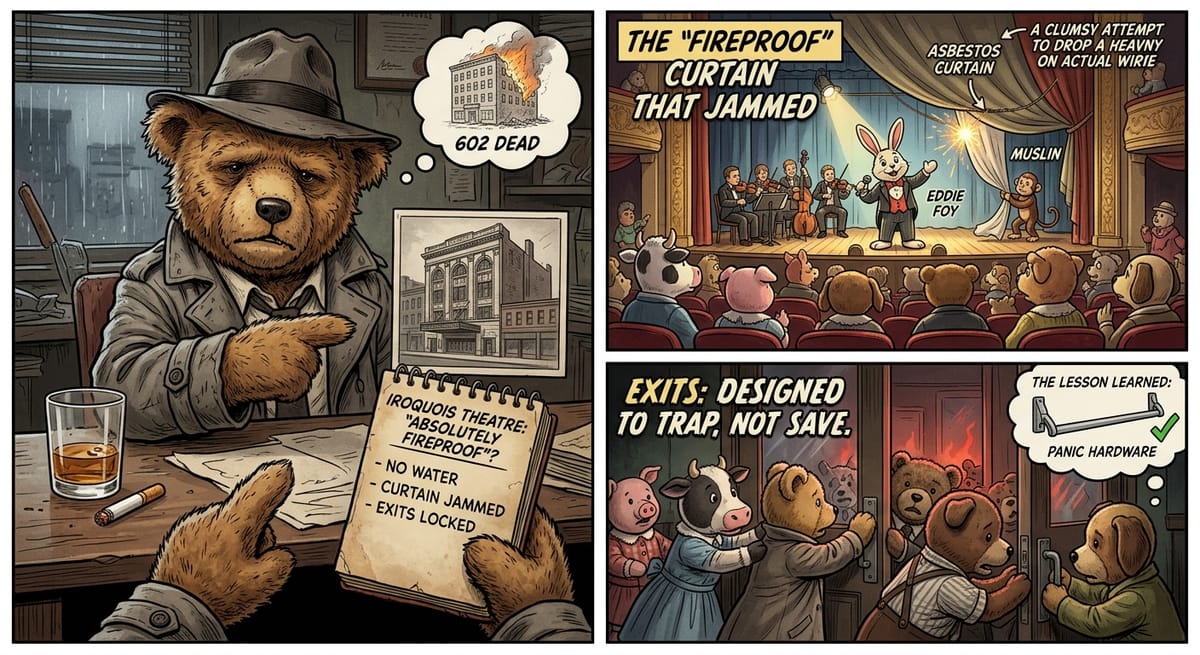
The Iroquois Theatre in Chicago opened on November 23, 1903, with advertisements calling it “absolutely fireproof.” Thirty-seven days later, 602 people died inside it during a matinee performance. The exits were blocked, the sprinklers weren’t connected to water, the fire curtain jammed, and the theatre had never received a proper safety inspection. It remains the deadliest single-building fire in American history — and every failure that caused it was known and correctable before the doors opened.
Part of Industrial Disasters — ← Back to series hub
The “Fireproof” Theatre That Skipped Its Own Inspection
The Iroquois was genuinely impressive by the standards of 1903 — built at a cost of $1 million by the Chicago investment firm of Harry J. Powers, featuring ornate marble interiors, a 1,700-seat main floor, and elaborate stage machinery. The promotional materials emphasized its modern safety features: asbestos fire curtain, fireproof construction, twenty-seven exits.
What the advertisements did not mention was that the theatre had rushed to open before construction was fully complete. Several of those twenty-seven exits had not yet been fitted with hardware — patrons accustomed to European theatre exit mechanisms, which required pulling a handle, could not find latches that weren’t there yet. The ventilation system above the stage had not been properly installed. The sprinkler system had no water connected to it. And the city of Chicago had not yet completed a formal fire safety inspection of the building. ^1^ None of this stopped the theatre from opening, selling tickets, and filling to capacity.
How Did 602 People Die at the Iroquois Theatre?
The matinee performance of Mr. Bluebeard on December 30, 1903, attracted a crowd of approximately 1,900 people — roughly 200 more than the theatre was licensed to hold, predominantly women and children on school holiday. A spark from a malfunctioning stage light ignited a thin muslin drape hanging in the wings midway through the second act. The fire spread upward into the elaborate rigging above the stage with extraordinary speed. Backstage workers attempted to drop the asbestos fire curtain that was supposed to seal off the stage from the auditorium. The curtain jammed — it had caught on a guide wire — and stopped about eight feet above the stage floor. This created a gap through which a fireball of superheated gas, released when a stagehand opened a rear door to escape, shot out into the auditorium. ^2^
The fireball killed hundreds of people almost instantly, burning across the main floor and upper galleries in seconds. The lights went out. Roughly 1,900 people in a dark, smoke-filled theatre rushed toward exits simultaneously.
The Exits Were Designed to Trap People
Many of the theatre’s exits opened inward — a design choice that ensured the crush of bodies pressed against the doors in a panic made them impossible to open. The European “bascule” latches on some exits, unfamiliar to American audiences, left people pressing and pulling at doors that would not move while fire moved through the space behind them. Bodies were found six and seven deep in exit doorways.
On the upper gallery level, audience members who could not get down the main stairways tried to reach a fire escape on the alley side of the building. They found a locked iron gate and jumped. The drop to the alley below was fatal for many. Rescue workers who arrived from an adjacent building used boards and ladders as improvised bridges to reach survivors still alive on the gallery ledge. Eddie Foy, the headliner comedian performing when the fire broke out, stayed on stage and called for calm, urging the orchestra to continue playing and the audience not to rush the exits. By most accounts his efforts slowed the panic for only a short time. He was one of the performers who escaped through a rear stage exit. The audience behind him was trapped. ^3^
602 Dead, No One Convicted
The final death toll was 602 — 212 people died inside the theatre during or immediately after the fire, and an additional 390 died of injuries over the following days and weeks. The dead were overwhelmingly female and young: a holiday crowd of mothers with children, school girls on break, families. The Illinois coroner’s records list victims as young as five years old.
Chicago Mayor Carter Harrison Jr. ordered the theatre closed immediately. Within days, city inspectors who examined the Iroquois found violations so numerous that one inspector reportedly said it was easier to list what was not in violation. The sprinkler system had no active water connection. Exit signs were missing. The fire curtain’s jamming mechanism had been observed during installation and never corrected. ^4^
The theatre’s owners — Harry Powers and his partners — were indicted on charges of manslaughter. Benjamin Marshall, the architect, was also charged. Will J. Davis, the manager, faced charges. All of the charges were eventually dropped. No one was convicted. The theatre owners settled civil lawsuits quietly, the amounts undisclosed.
The Safety Standard Every Building Now Follows Came From This Fire
The Iroquois fire triggered fire safety legislation across the United States and in several European countries. Chicago revised its building codes within months, requiring that all theatre exits open outward with panic hardware — the “crash bar” mechanism now found on virtually every public building exit door in the country. This became the standard specifically because of what happened at the Iroquois. ^5^
The National Fire Protection Association, founded in 1896, expanded its work on theatre safety codes in direct response to the disaster. New York, Boston, and dozens of other cities revised their inspection requirements. The Iroquois Theatre itself was rebuilt, renamed the Colonial Theatre, then the Oriental Theatre, and operated under various names until it was demolished in 1997.
The 602 people who died on December 30, 1903, died in a theatre its owners called fireproof, with exits that could not be opened, sprinklers not connected to water, and a fire curtain that jammed. Every one of those failures had been possible to prevent. The same immunity pattern that protected the South Fork Club after Johnstown protected the Iroquois owners here — and it would protect Barney Welansky after Cocoanut Grove forty years later.
─────────
Sources:
- Brandt, Nat. Chicago Death Trap: The Iroquois Theatre Fire of 1903. Southern Illinois University Press, 2003.
- National Fire Protection Association. NFPA Historical Records: Iroquois Theatre. NFPA Archives, 1904.
- Foy, Eddie, and Harlow, Alvin F. Clowning Through Life. E. P. Dutton, 1928.
- Musham, H. A. The Great Chicago Theatre Disaster. Illinois State Historical Society, 1905.
- Tebeau, Mark. Eating Smoke: Fire in Urban America, 1800–1950. Johns Hopkins University Press, 2003.