Mining Camp Violence: The Lawless Towns That Built America
Gold rush mining camps ran homicide rates nearly double modern cities — and Chinese miners were killed with legal impunity while white miners built San Francisco's financial district.
Mining Camp Violence: The Lawless Towns That Built America
Mining camp violence in the American West was not random disorder — it was a racial economy enforced by guns before the formal legal system arrived to encode what the guns had already decided. In the six months after gold was discovered at Sutter’s Mill on January 24, 1848, approximately 80,000 people flooded into California from the eastern United States, Mexico, Chile, Australia, and China. By 1852, the gold rush population had reached 250,000. The infrastructure for governing this population — courts, law enforcement, property registration, contract enforcement — arrived years later, if at all. What filled the gap was informal violence, ethnic cleansing, extralegal execution, and the systematic exclusion of non-white miners from the richest claims.
The mining camp is a foundational American institution that built fortunes, shaped cities, and killed thousands of people whose deaths were neither investigated nor remembered.
How the Math of Murder Worked in the Camps
Mining camps formed wherever a strike occurred — Sutter’s Mill, Deadwood, Tombstone, Leadville, Virginia City — and they shared structural features that produced predictable pathologies. The population was overwhelmingly male, heavily armed, and far from existing legal institutions. Alcohol was available from the first week. The stakes were high: a single day’s claim on a productive placer deposit could yield hundreds of dollars in gold; a claim in the wrong spot yielded nothing. The combination created conditions for violence at a rate historians have struggled to document precisely because record-keeping was, charitably, inconsistent.
Historian Roger D. McGrath’s study of two California mining camps — Bodie and Aurora — estimated a homicide rate of approximately 116 per 100,000 residents in Bodie during its active mining period in the late 1870s and early 1880s. For reference, the highest homicide rate of any large American city in 2023 was approximately 60 per 100,000. The mining camp rate was not uniformly distributed across the population: it fell almost exclusively on adult men involved in disputes over claims, gambling, and women. Unarmed men, women, and what the period called “respectable” citizens experienced relatively low rates of violence. The camps killed the combatants they produced.^1^
The Claim System as a Generator of Lethal Conflict
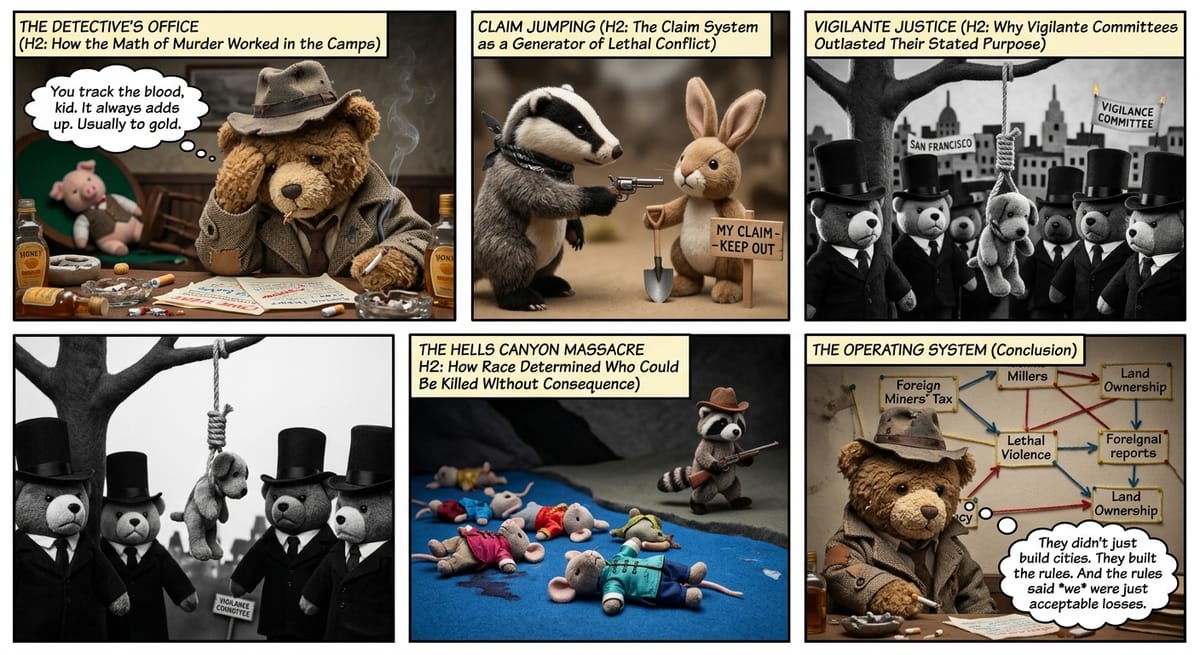
The property rights system in mining camps was created extrajudicially. Miners’ meetings — informal assemblies of whoever showed up — established claim sizes, procedures for registering claims, and rules about what constituted abandonment. These rules had no legal standing but were enforced by social pressure and, where that failed, by gunfire. Claim jumping — occupying a registered claim while the registrant was absent — was a constant problem and a consistent source of lethal conflict.
In Deadwood, Dakota Territory, during the 1876 gold rush, the entire territory was legally part of the Great Sioux Reservation under the 1868 Fort Laramie Treaty. Every miner in Deadwood was trespassing on treaty land. The U.S. government declined to enforce the treaty — the Black Hills gold rush was too economically significant — but the legal ambiguity meant that no legitimate court could recognize mining claims. Deadwood operated entirely on the extralegal system its inhabitants created, which included a brief period of vigilante justice in 1876 that resulted in several hangings.^2^
Why Vigilante Committees Outlasted Their Stated Purpose
San Francisco’s Committee of Vigilance, organized in 1851 and reconstituted in 1856, was the most organized expression of mining-era vigilante justice and the most consequential for subsequent American legal culture. The 1851 committee hanged four men, whipped one, and deported 28 others from the city. The 1856 committee hanged four more and deported approximately 30 opponents, including a county judge and a U.S. Marshal.
The second committee’s targets in 1856 were primarily Irish Catholic immigrants associated with the Democratic political machine, and historian Kevin Mullen has argued persuasively that the Vigilance Committee’s violence was as much ethnic and political as it was about crime control. The men they hanged — James Casey and Charles Cora — had committed killings, but the committee’s operations went well beyond responding to specific crimes into broad political control of the city.^3^
Similar committees formed in Montana in 1863–1864, Virginia City and Nevada City, targeting what they called the Plummer Gang — a criminal network allegedly led by Sheriff Henry Plummer. The Montana vigilantes hanged 21 men between December 1863 and February 1864, including Plummer himself on January 10, 1864. The targets’ guilt varied enormously; historian Frederick Allen’s 2004 study concluded that Plummer himself may have been innocent of the specific crimes attributed to him, though he was certainly not honest. The vigilantes worked from lists assembled without legal process, and the criteria for appearing on the list included being a stranger, having a criminal record anywhere, or having enemies among the vigilante leadership.^4^
How Race Determined Who Could Be Killed Without Consequence
The violence in mining camps was not equally distributed across ethnic groups, and the unequal distribution was not accidental. California’s Foreign Miners’ Tax of 1850 — which required non-citizen, non-native-born miners to pay $20 per month for the right to mine — was explicitly designed to drive Mexican, Chilean, and Chinese miners out of the richest placers. Enforcement was often violent: in Sonora, California in July 1850, a mob of 3,000 American miners expelled Mexican miners from the region by force, killing several.
The Chinese mining population, which grew substantially through the 1850s and 1860s as gold rush miners were supplemented by railroad laborers and agricultural workers, faced systematic violence and legal exclusion. Chinese miners were prohibited from testifying in court against white defendants under California law until 1872, which meant that violence against Chinese miners was effectively unprosecutable regardless of the evidence. Between 1849 and 1900, an estimated 150 Chinese miners were killed in anti-Chinese violence in California mining districts, with additional deaths in Idaho, Wyoming, and Oregon — most of these killings resulted in no criminal charges.^5^
The Hells Canyon Massacre of 1887, in which a group of horse thieves killed between 10 and 34 Chinese gold miners on the Snake River in eastern Oregon, resulted in one grand jury investigation that identified six suspects by name. No one was ever convicted. The bodies of the Chinese miners were found in the river weeks later, partially buried in sand bars.
What the Camps Actually Built
The mining camps were economically productive beyond the gold they extracted. They built cities — San Francisco’s financial district grew directly from gold rush commerce. They built infrastructure — roads, telegraphs, and eventually railroads ran toward wherever the mines were. They established patterns of western land settlement and resource extraction that shaped federal policy for a century. The extralegal property systems they invented informed subsequent legal frameworks for mining rights.
They also established, in the absence of legal institutions, which populations were killable. The informal violence that governed claim disputes and personal conflicts operated within racial hierarchies that were then codified into law — the Foreign Miners’ Tax, the California testimony exclusion, federal and state laws restricting Chinese immigration and property ownership. The violence of the camps wasn’t random disorder. It was the operating system of a racial economy, running on its own logic before the formal legal system arrived to encode what the guns had already decided.
The range wars that followed operated by the same logic at a larger scale, with hired armies substituting for mob violence and land associations substituting for miners’ meetings.
─────────
Sources:
- McGrath, Roger D. Gunfighters, Highwaymen, and Vigilantes: Violence on the Frontier. University of California Press, 1984.
- Parker, Watson. Gold in the Black Hills. University of Oklahoma Press, 1966.
- Mullen, Kevin J. Let Justice Be Done: Crime and Politics in Early San Francisco. University of Nevada Press, 1989.
- Allen, Frederick. A Decent, Orderly Lynching: The Montana Vigilantes. University of Oklahoma Press, 2004.
- Chan, Sucheng. This Bittersweet Soil: The Chinese in California Agriculture, 1860–1910. University of California Press, 1986.
Part of Frontier Violence — ← Back to series hub