Freedom Rider Attacks: When Buses Became Battlegrounds
On Mother's Day 1961 a Freedom Rider bus was firebombed outside Anniston Alabama while police watched. The federal government asked the riders to stop.
Freedom Rider Attacks: When Buses Became Battlegrounds
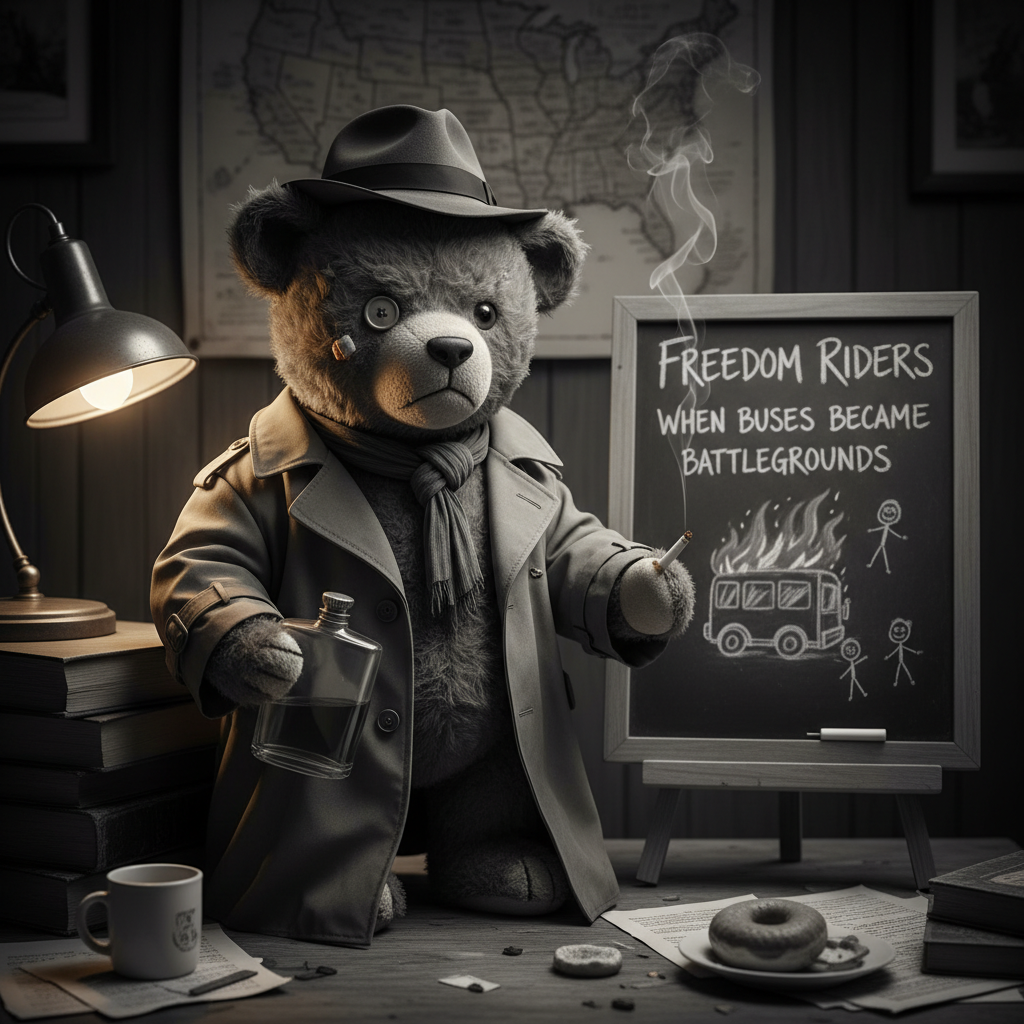
On May 14, 1961 — Mother’s Day — a Greyhound bus carrying thirteen Freedom Riders was firebombed outside Anniston, Alabama, after a mob slashed its tires, forced it to stop, and held the doors shut to trap the riders inside. The riders escaped the burning bus and were beaten as they came off. That same day, a second Trailways bus arriving in Anniston was boarded by white men who beat the riders systematically for several minutes while law enforcement watched, then continued to Birmingham where riders were attacked again — Bull Connor having given the Klan fifteen minutes to operate before police would respond.^1^
Part of Blood of the Civil Rights Movement — ← Back to series hub
What the Freedom Rides Were Testing
The Freedom Rides were organized by CORE — the Congress of Racial Equality — to test the enforcement of two Supreme Court decisions: Boynton v. Virginia (1960), which extended the prohibition on segregation in interstate travel to include bus terminals and waiting rooms, and Morgan v. Virginia (1946), which had banned segregation on interstate buses. Despite these rulings, Southern bus companies, terminals, and waiting rooms remained segregated, and the federal government was not enforcing the law.^2^
The original thirteen Freedom Riders — seven Black, six white — departed Washington, D.C., on two buses on May 4, 1961, intending to reach New Orleans by May 17. They encountered violence in South Carolina and more in Anniston. The initial CORE group, battered and some hospitalized, could not continue. A new group of riders, organized largely by the Nashville Student Movement and including Diane Nash, John Lewis, and James Lawson, picked up the rides.
John Lewis at Montgomery Was Beaten with a Crate
John Lewis had been on the original Greyhound bus and had been beaten in Rock Hill, South Carolina, on May 9. He joined a subsequent group entering Montgomery, Alabama, on May 20, 1961. At the Montgomery Greyhound terminal, a mob of several hundred white people was waiting. Jim Zwerg, a white rider from Wisconsin, was beaten first. Lewis was attacked with a crate and left bleeding. Life magazine photographer Don Urbrock was beaten with his own camera.^3^
Lewis sustained a head injury requiring stitches. He went on to be beaten again on the Edmund Pettus Bridge in Selma four years later, and to serve for more than thirty years in Congress. The brutality at Montgomery was not aberrant — it was the enforcement mechanism for a segregation system that the Supreme Court had already ruled illegal.
The Federal Government’s Response Was to Ask the Riders to Stop
Attorney General Robert Kennedy’s response to the Freedom Rides was to try to stop them. Kennedy called for a “cooling off” period, asked CORE to halt the rides, and expressed concern about embarrassment to the United States during Cold War diplomacy. Diane Nash, speaking for the Nashville students, told Kennedy that the riders could not stop because they had been told all their lives to wait. They did not stop.^4^
Kennedy ultimately dispatched federal marshals to protect the riders in Montgomery — though the marshals arrived after the mob had already attacked. When riders were jailed in Mississippi for using white waiting rooms in apparent compliance with the Supreme Court’s ruling, Kennedy’s office negotiated to have them taken to Parchman Farm state penitentiary rather than pushing for their release. More than 300 people were jailed there over the summer of 1961. The federal government’s response to systematic law enforcement failure and organized mob violence was negotiation and delay, not enforcement.
What the Riders Paid
Hank Thomas was 19 years old on the Anniston bus, a student at Howard University who got off the burning bus and was beaten by the mob, then beaten again in Mississippi and jailed at Parchman. William Barbee was attacked in Montgomery on May 20 and left partially paralyzed; he recovered but remained disabled for years. Genevieve Hughes was a white woman attacked by the mob in Birmingham who described being left on the floor of the terminal after being hit, with no police response.
None of the attackers at Anniston, Birmingham, or Montgomery were prosecuted at the time. Decades later, some investigations were reopened. In 2012, Freedom Rider Jerome Ardmore filed a complaint with the Alabama attorney general’s office about the Anniston attack. No prosecutions resulted.^5^
The Interstate Commerce Commission, under pressure from the Kennedy administration, issued regulations banning segregation in interstate travel facilities in September 1961. The regulations were finally enforced. The Freedom Riders had succeeded — at the cost of being burned out of a bus, beaten repeatedly in three states, and jailed by the hundreds for attempting to use public transportation in the way federal courts said they were entitled to use it.
The coordinated mob violence in Anniston and Birmingham was not spontaneous — it was organized by the same Klan network that had operated in Alabama for decades and that had bombed the 16th Street Baptist Church two years later. The pattern of law enforcement facilitation — Connor’s fifteen-minute window, state troopers who didn’t intervene — reflects the same structure documented in Bloody Sunday at the Edmund Pettus Bridge.
─────────
Sources:
- Arsenault, Raymond. Freedom Riders: 1961 and the Struggle for Racial Justice. Oxford University Press, 2006.
- Lewis, John, and Michael D’Orso. Walking with the Wind: A Memoir of the Movement. Simon & Schuster, 1998.
- Farmer, James. Lay Bare the Heart: An Autobiography of the Civil Rights Movement. Arbor House, 1985.
- Branch, Taylor. Parting the Waters: America in the King Years, 1954–63. Simon & Schuster, 1988.
- Peck, James. Freedom Ride. Simon & Schuster, 1962.