Selma and Bloody Sunday: The Bridge That Changed America
On March 7 1965 state troopers beat 600 voting rights marchers at the Edmund Pettus Bridge in Selma Alabama. The footage broadcast on TV forced the Voting Rights Act.
Selma and Bloody Sunday: The Bridge That Changed America
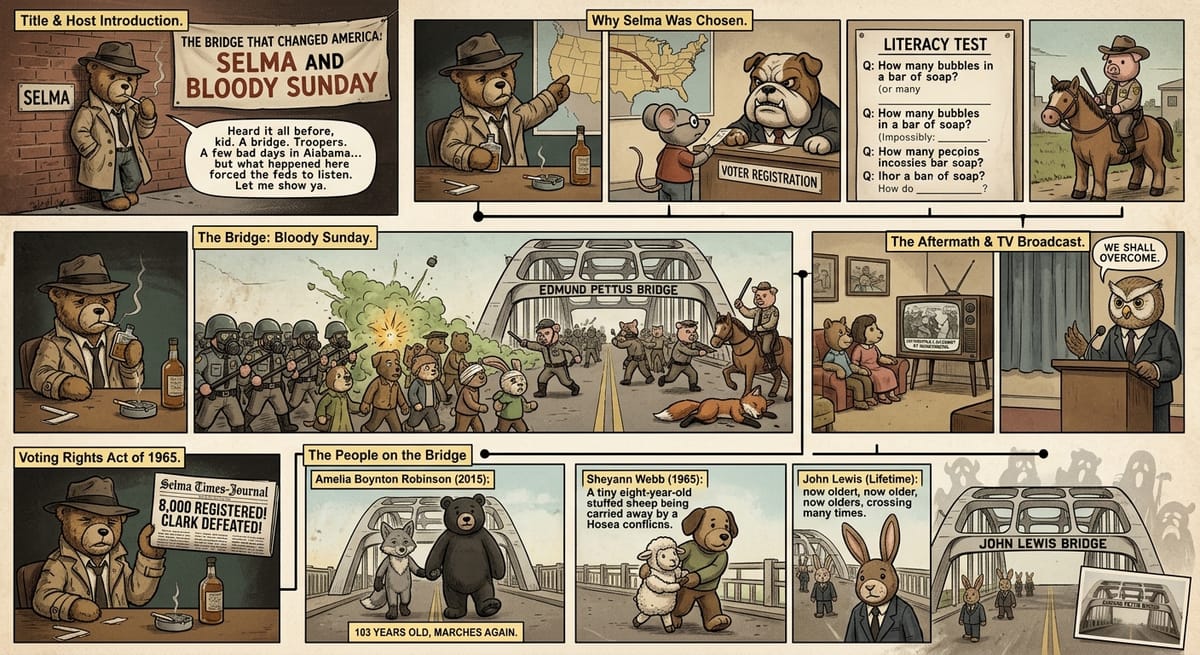
On March 7, 1965, approximately 600 people began marching from Selma, Alabama, toward Montgomery to demand voting rights. At the Edmund Pettus Bridge — named for a Confederate general and Ku Klux Klan leader — they were met by Alabama state troopers and a mounted posse of Dallas County sheriff’s deputies. When the marchers knelt to pray, Major John Cloud ordered the advance. What happened next was filmed, photographed, and broadcast on national television, interrupting a prime-time screening of Judgment at Nuremberg: American state troopers attacking peaceful marchers on a public bridge. It forced the Voting Rights Act of 1965.
Part of Blood of the Civil Rights Movement — ← Back to series hub
Why Selma Was Chosen for a Voting Rights Campaign
Selma and Dallas County, Alabama, were chosen by the SCLC and the Student Nonviolent Coordinating Committee because the disparity between the Black population and Black voter registration was stark and documentable. Dallas County was approximately 57 percent Black in 1965. Of approximately 15,000 Black residents of voting age, fewer than 400 were registered to vote. White citizens made up roughly 99 percent of the voter rolls.^1^
The registration process was designed to prevent registration. Black applicants were required to pass a literacy test administered at the discretion of routinely hostile registrars who asked impossible questions and rejected applicants for minor errors or no stated reason. Registration was only possible on two days a month. Applicants who showed up in organized groups were turned away. Farmworkers risked being fired and evicted from plantation housing if their employers found out they had tried to register.
Sheriff Jim Clark and his posse — a mounted force of volunteer white men organized as a supplementary law enforcement body — enforced these arrangements through documented routine violence. Annie Lee Cooper, 53 years old, was arrested in January 1965 after she punched Clark in the jaw when he grabbed her during a voting rights demonstration. She had been trying to register to vote.^2^
The State Troopers Charged into the Marchers
At about 4 p.m. on March 7, the state troopers charged. Footage shows people going down and the troopers continuing to swing. The posse on horseback rode into the crowd. Tear gas was deployed. Amelia Boynton Robinson, 53, was beaten unconscious and left in the road; the photograph of her on the ground, apparently dead, circulated worldwide. She had survived.
John Lewis sustained a fractured skull from a club blow to the head. After being released from Good Samaritan Hospital, still bandaged, he went directly to speak at Brown Chapel AME Church where the survivors had gathered. His speech was broadcast on ABC, which had cut away from its airing of Judgment at Nuremberg to show footage from Selma. Seventeen marchers were hospitalized; dozens more were treated at local churches and clinics.^3^
The Political Aftermath: Eight Days to a Joint Session of Congress
President Johnson spoke to a joint session of Congress on March 15, 1965 — eight days after Bloody Sunday — called the Selma marchers heroes, and used the words of the civil rights movement: “We shall overcome.”
The Voting Rights Act of 1965 was signed into law on August 6, 1965. It banned literacy tests and other discriminatory registration devices, provided for federal examiners to oversee registration in covered jurisdictions, and established the preclearance requirement — states and localities with histories of discrimination had to receive federal approval before changing voting laws.^4^ In Dallas County, Alabama, by the end of 1965, more than 8,000 Black residents had been registered to vote. Jim Clark was defeated for re-election in 1966.
The People Who Were on the Bridge
Amelia Boynton Robinson had been the first Black woman to run for Congress in Alabama in 1964 — before Bloody Sunday — and went on to become a founder of the annual voting rights pilgrimage to Selma. She was 103 years old when she marched across the Edmund Pettus Bridge holding President Obama’s hand on the 50th anniversary in 2015. She died that August.
Sheyann Webb was eight years old on Bloody Sunday, had been attending SCLC meetings at Brown Chapel since January, and was at the bridge when the troopers charged. Hosea Williams grabbed her and carried her out. She later wrote a memoir, Selma, Lord, Selma.
John Lewis walked across the Edmund Pettus Bridge dozens of times in his lifetime, including on the 50th anniversary, six months before his death on July 17, 2020. Congress voted to rename the bridge for him. As of this writing, the Edmund Pettus Bridge still bears its original name.^5^
The systematic exclusion of Black voters in Selma was not an aberration — it was continuous with the Black Codes and convict leasing system that had controlled Black political participation since Reconstruction. The same machinery of voter suppression documented in the 1960s has been revived through legal means since the Supreme Court gutted the Voting Rights Act in 2013. Understanding the full scope of racial terror requires seeing Selma not as a turning point that resolved the problem but as one documented episode in an ongoing system.
─────────
Sources:
- Garrow, David J. Protest at Selma: Martin Luther King, Jr., and the Voting Rights Act of 1965. Yale University Press, 1978.
- Fager, Charles E. Selma, 1965: The March That Changed the South. Beacon Press, 1985.
- Lewis, John, and Michael D’Orso. Walking with the Wind: A Memoir of the Movement. Simon & Schuster, 1998.
- Branch, Taylor. At Canaan’s Edge: America in the King Years, 1965–68. Simon & Schuster, 2006.
- Webb, Sheyann, and Rachel West Nelson. Selma, Lord, Selma. University of Alabama Press, 1980.