The 16th Street Baptist Church Bombing: Four Girls on a Sunday Morning
On September 15 1963 KKK members bombed a Birmingham church killing four girls — Addie Mae Collins Cynthia Wesley Carole Robertson and Carol Denise McNair.
The 16th Street Baptist Church Bombing: Four Girls on a Sunday Morning
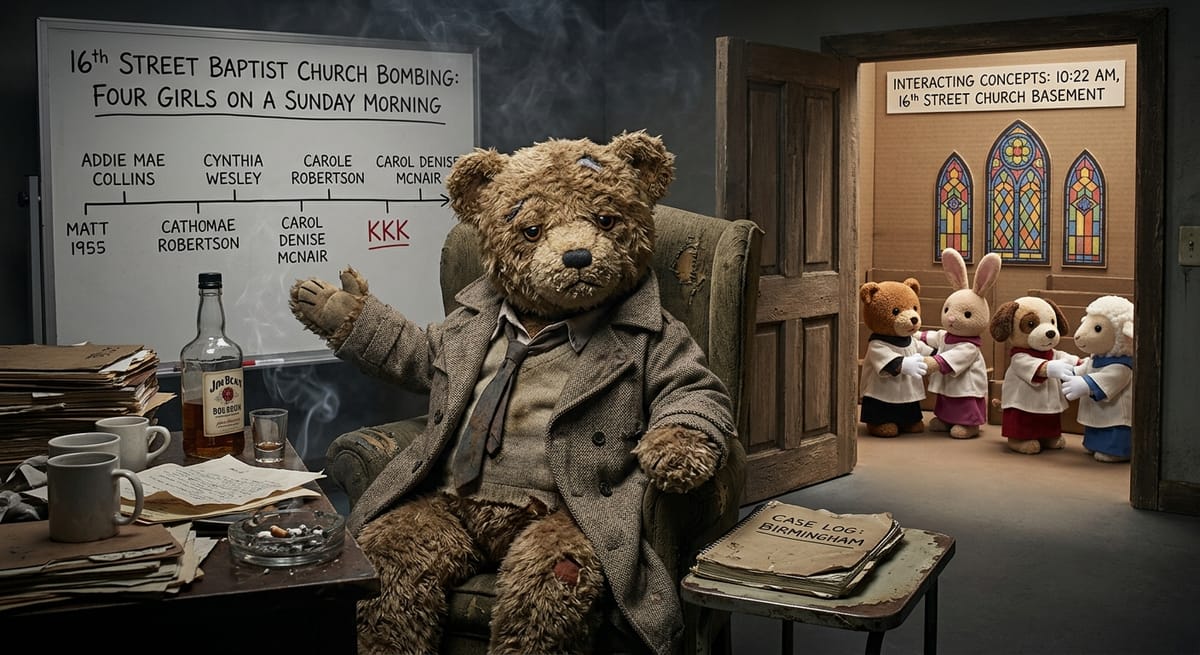
On September 15, 1963, at 10:22 a.m., a bomb planted by members of the Ku Klux Klan exploded beneath the steps of the 16th Street Baptist Church in Birmingham, Alabama, killing four girls — Addie Mae Collins, Cynthia Wesley, and Carole Robertson, all 14, and Carol Denise McNair, 11 — who had been changing into choir robes for the 11 a.m. Youth Sunday service. Twenty-two other people were injured. The men who killed them were identified by the FBI within weeks. It took thirty-nine years to convict them all.
Part of Blood of the Civil Rights Movement — ← Back to series hub
Why Birmingham’s 16th Street Church Was a Target
The 16th Street Baptist Church, built in 1911, was the largest Black church in Birmingham and the central organizing hub for the civil rights movement there. Fred Shuttlesworth had used it as a base for the Alabama Christian Movement for Human Rights since the late 1950s. In the spring of 1963, Martin Luther King Jr. and the Southern Christian Leadership Conference had made Birmingham the focal point of Project C — “C” for confrontation — a campaign of marches, sit-ins, and economic boycotts aimed at forcing the desegregation of the city’s commercial district.^1^
Birmingham’s Public Safety Commissioner, Bull Connor, responded to the spring demonstrations with fire hoses and police dogs. The images — children slammed into walls by water pressure, police dogs biting at teenagers — circulated around the world and generated the political pressure that led to the Civil Rights Act. The bombing in September was the Klan’s answer to that victory.
Birmingham had been so thoroughly targeted by Klan bombers — at least 50 bombing attacks between 1945 and 1963, hitting Black homeowners who moved into contested neighborhoods, civil rights leaders’ homes, and Black churches — that Black residents had given the area the sardonic nickname “Dynamite Hill.” No one had been prosecuted for any of it.^3^
The Four Girls the Bomb Killed
Addie Mae Collins was quiet and serious, her family said. She was in the basement of the church with her younger sister Sarah, who survived.
Cynthia Wesley had been adopted by Claude and Gertrude Wesley; her father was the principal of a local Black high school and she had been an honor student.
Carole Robertson was the daughter of Alvin and Alpha Robertson; she had been a Girl Scout. Her grandmother identified her body.
Carol Denise McNair was eleven — the youngest of the four. Her father, Chris McNair, was a photographer who later became a state legislator. In the weeks before the bombing, Carol had seen a white girl perform at a recital and told her parents she wanted to play piano like that. Her parents had signed her up for lessons.^2^
The Bomb and the FBI’s Decision Not to Prosecute
The bomb — a minimum of fifteen sticks of dynamite — had been planted under the church steps the night before by Robert Chambliss, a KKK member known as “Dynamite Bob.” FBI agents in Birmingham’s field office identified Chambliss, Thomas Blanton Jr., Bobby Frank Cherry, and Herman Frank Cash as the likely perpetrators within weeks of the bombing. FBI Director J. Edgar Hoover — who had spent years surveilling and harassing civil rights leaders including King through COINTELPRO — refused to allow prosecution, reportedly because he believed the evidence was insufficient and because pursuing the case would expose FBI informants. The Birmingham Police Department’s own investigation went nowhere.^4^
Thirty-Nine Years to Convict the Men Who Did This
Robert Chambliss was finally convicted of murder on November 18, 1977 — fourteen years after the bombing — after Alabama Attorney General Bill Baxley reopened the case and built a new prosecution. Chambliss was 73 years old. He was sentenced to life in prison and died there in 1985.
Thomas Blanton Jr. was convicted of four counts of murder in 2001, thirty-eight years after the bombing, and sentenced to life in prison. Bobby Frank Cherry was convicted in 2002, thirty-nine years after the bombing, and sentenced to life in prison. Herman Frank Cash died in 1994 without being charged.^4^
What the Bombing Accomplished — and What It Didn’t Change for Sarah Collins Rudolph
Sarah Collins Rudolph was fourteen years old on September 15, 1963. She was in the church basement with her sister Addie Mae when the bomb went off. She survived but lost sight in her right eye and carried shrapnel in her body for years. She testified at the Blanton and Cherry trials decades later, describing what she saw before the explosion.
In 2013, fifty years after the bombing, Alabama Governor Robert Bentley awarded Sarah Collins Rudolph a certificate of merit. She has said publicly that she has never received compensation for her injuries or for the death of her sister, and that she has never received an apology from the city of Birmingham or the state of Alabama.^5^
The deaths of four children at a Sunday church service generated international condemnation and, alongside the March on Washington and the murders of other civil rights workers throughout 1963, built the political pressure that produced the Civil Rights Act of 1964. The political impact was real. The girls were still dead. The men who killed them remained free for decades. The FBI had evidence that could have put them in prison in 1963, and the director of the FBI suppressed it.
The church bombing fits the documented pattern of organized racial violence targeting Black institutions that runs from Reconstruction through the present. The Klan’s first era established the template: violence aimed at Black political and civic life, carried out with the confidence that accountability would not follow.
─────────
Sources:
- McWhorter, Diane. Carry Me Home: Birmingham, Alabama — The Climactic Battle of the Civil Rights Revolution. Simon & Schuster, 2001.
- Belin, Cynthia Levinson and Sanford. The Clock Without a Face (for context on the girls’ stories — see primary sources below).
- Colvin, Claudette (as documented in): Hoose, Phillip. Claudette Colvin: Twice Toward Justice. Farrar Straus Giroux, 2009.
- Gado, Mark. Death of Innocence: The 16th Street Baptist Church Bombing. Crime Library, 2006.
- Bass, Jonathan S. Blessed Are the Peacemakers: Martin Luther King Jr., Eight White Religious Leaders, and the “Letter from Birmingham Jail.” LSU Press, 2001.