The First Ku Klux Klan: Terrorism in White Hoods
Founded in 1865 by six Confederate officers the first KKK became America's largest domestic terror organization killing thousands of Black people and their white allies before federal prosecutions collapsed it by 1872.
The First Ku Klux Klan: Terrorism in White Hoods
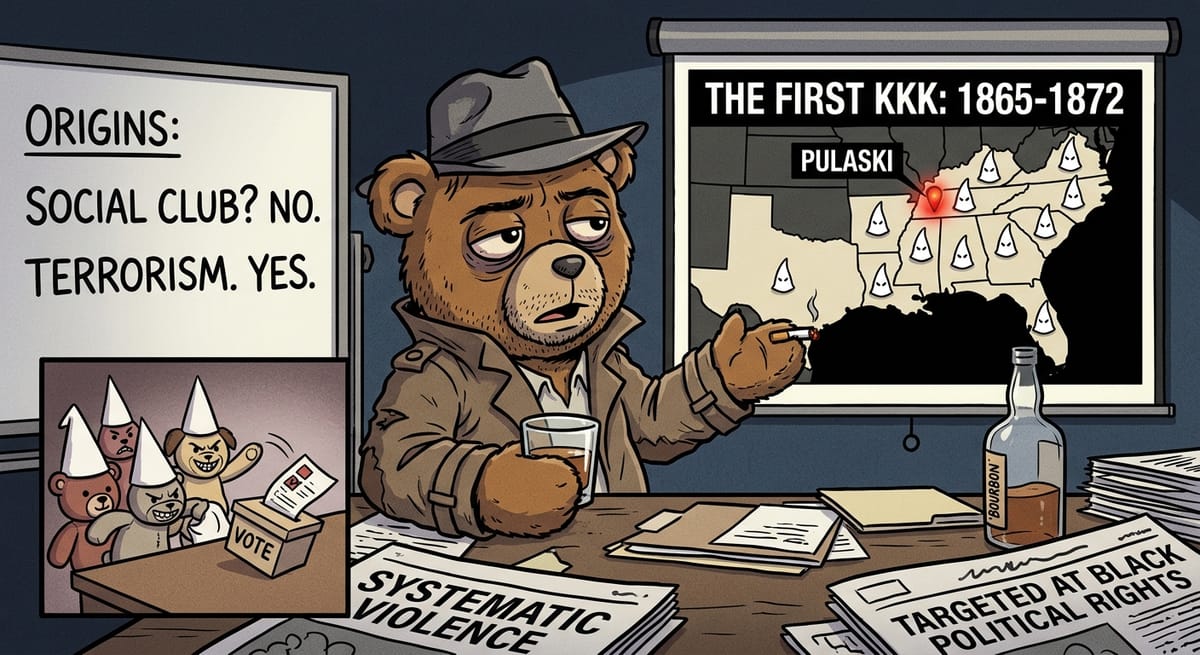
The Ku Klux Klan was founded in December 1865 in Pulaski, Tennessee, by six former Confederate officers. Within five years it had become the largest domestic terrorist organization in American history — a systematic campaign of murder, rape, arson, and intimidation across the former Confederate states, aimed with precision at Black people who exercised political rights and the white Republicans who supported them.
Part of From Reconstruction to Jim Crow — ← Back to series hub
The “Social Club” Origin Story Is Confederate Revisionism
The founding mythology — that a group of bored veterans started a social club, adopted robes and ridiculous titles as a joke, and only later drifted into violence — is Confederate revisionism with a thin veneer of plausibility. The early Klan did have the trappings of a fraternal organization: elaborate hierarchies with names like Grand Wizard, Grand Dragon, and Grand Cyclops; rituals and passwords; a taste for theatrical absurdity. But within a year of its founding, it had organized a systematic campaign of murder, rape, arson, and intimidation across the former Confederate states, aimed with precision at Black people who exercised political rights and the white Republicans who supported them.^1^
The structure was decentralized by design. Individual dens — called “klaverns” — operated with substantial independence, which made it difficult for federal authorities to prosecute the organization as a whole. The Grand Wizard was Nathan Bedford Forrest, the Confederate general whose troops massacred Black Union soldiers at Fort Pillow, Tennessee, in April 1864. Forrest gave the Klan a commander with military credibility and a national profile. He would later claim he had ordered it disbanded in 1869 when violence spiraled out of his control — a claim historians treat with skepticism.^2^
The Klan’s Violence Was Tactical, Not Random
Between 1865 and 1871, Klan members and affiliated white supremacist groups across the South killed an estimated several thousand Black people and their white allies, though the documented count runs into the hundreds. The murders were tactical. They targeted specific people: Black men who had registered to vote, Black men who had run for or held office, Black men who had purchased land, teachers in freedmen’s schools, and Republican organizers both Black and white.
In Lincoln County, Mississippi, in 1871, Klan riders murdered Jack Dupree, a Black Union League leader, in front of his wife, who had just given birth. They split open his abdomen while she watched. The message was not random. Dupree had been organizing Black voters, and someone wanted him stopped.
In York County, South Carolina, Klan members committed eleven documented murders in the first six months of 1871 and beat, whipped, or otherwise assaulted hundreds more. The Congressional report on Klan activities in South Carolina, published in 1872, ran to thirteen volumes and documented thousands of individual incidents.^3^
In Alabama, Georgia, and Tennessee, Klan riders burned freedmen’s schoolhouses — more than forty in the first three years of Reconstruction in Georgia alone. The targets were not random. Education was political. Literacy enabled voting, economic independence, and legal self-defense, all of which the Klan’s backers wanted to prevent.
How Did Congress Finally Stop the First Klan?
By 1870, Congress had seen enough. The Ku Klux Klan Act of 1871 — also called the Civil Rights Act of 1871 — authorized the president to suspend habeas corpus in areas where Klan terrorism had made it impossible to enforce the law through ordinary courts. President Ulysses Grant used that authority in nine counties in South Carolina in October 1871, suspending habeas corpus and deploying federal troops and marshals to make mass arrests.
More than 600 men were arrested in South Carolina alone. Federal prosecutors, working with testimony from survivors and witnesses — many of them Black — won convictions and sent Klan leaders to federal prison.^4^ The prosecutions, led by U.S. Attorney General Amos Akerman, were effective enough that the first Klan largely collapsed between 1871 and 1872.
Harriet Simril, a Black woman in York County, South Carolina, testified before Congress in 1871 about a night raid by Klan members who beat her husband and then assaulted her. Her testimony, given under her own name, is preserved in the Congressional record. She was not the only one. Hundreds of Black witnesses testified, at considerable personal risk, because the federal government had finally created a structure where their testimony could matter.
The Klan Worked Because It Had Institutional Support
The Klan’s effectiveness rested on several factors that had nothing to do with the hoods. First, local law enforcement either participated directly or refused to interfere. Sheriffs, deputies, and constables across the South were overwhelmingly white and often Klan members themselves, which meant that victims had no local recourse. Second, the courts were similarly compromised — all-white juries, even in cases with overwhelming evidence, would not convict white men for crimes against Black people. Third, the Klan had community sanction: it operated with the tacit or explicit support of the white planter class and local Democratic Party apparatus.^5^
This was not a rogue criminal organization operating against the wishes of white Southern society. It was white Southern society’s enforcement arm, wearing theatrical costumes.
Breaking the Klan’s Structure Did Not Break the Violence
The federal crackdown of 1871–1872 broke the first Klan as an organized structure. It did not end the violence. Rifle clubs, Red Shirts, and other paramilitary groups took up where the Klan left off, operating more openly and with even less concern for concealment because, by the mid-1870s, federal will to enforce Reconstruction was eroding. When the last federal troops left the South in 1877, organized racial terror continued under different names and continued to achieve the same results.
The first Klan demonstrated something that would shape American racial terror for the next century: you did not need a functioning conspiracy to sustain white supremacist violence. You needed community tolerance, complicit law enforcement, and the credible threat that killing Black people for exercising legal rights would cost the killers nothing. The Klan proved all three were available.
The Black Codes operated in parallel as the legislative arm of the same project. Lynching in America became the Klan’s successor tactic — decentralized, deniable, and equally protected by local institutions. Ida B. Wells spent decades building the evidentiary record of what that protection cost. The Red Summer of 1919 showed the same pattern playing out in the urban North fifty years later.
─────────
Sources:
- Foner, Eric. Reconstruction: America’s Unfinished Revolution, 1863–1877. Harper & Row, 1988.
- Horn, Stanley F. Invisible Empire: The Story of the Ku Klux Klan, 1866–1871. Patterson Smith, 1969.
- United States Congress. Report of the Joint Select Committee to Inquire into the Condition of Affairs in the Late Insurrectionary States. Government Printing Office, 1872.
- Akerman, Amos T. Papers and correspondence, 1871–1872. Library of Congress Manuscript Division.
- Trelease, Allen W. White Terror: The Ku Klux Klan Conspiracy and Southern Reconstruction. Louisiana State University Press, 1971.