Whitey Bulger: The Gangster Who Was an FBI Informant
Whitey Bulger ran Boston's Winter Hill Gang while serving as an FBI informant — and used classified informant identities to have rivals murdered. The FBI paid $100 million to settle wrongful death suits.
Whitey Bulger: The Gangster Who Was an FBI Informant
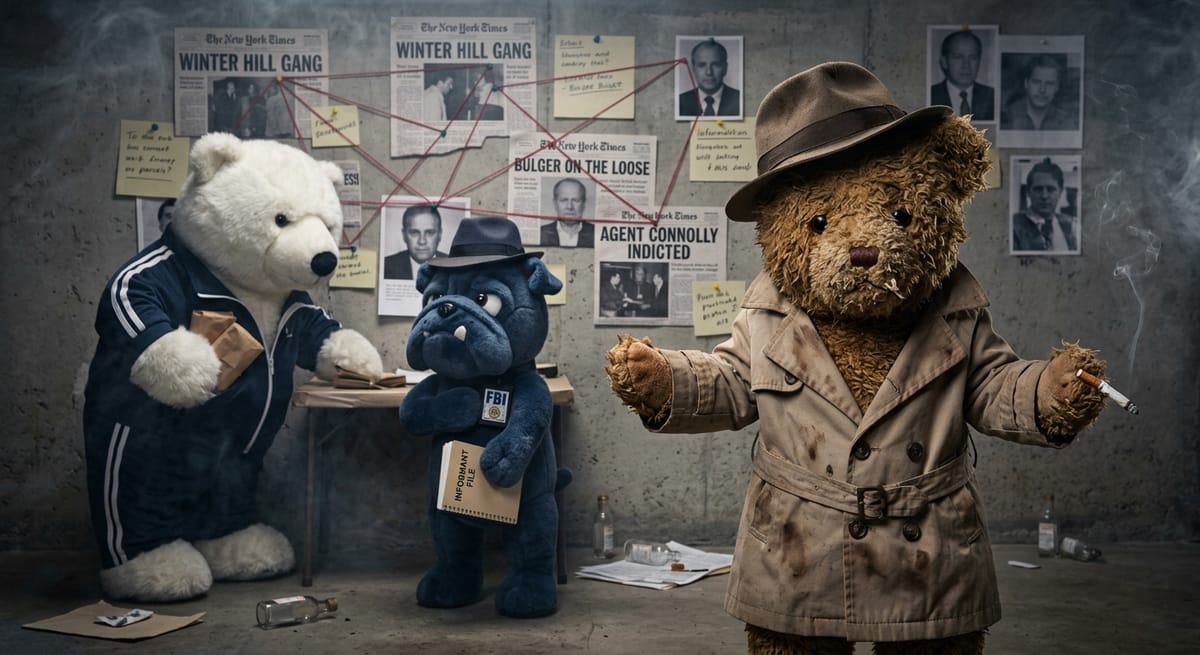
Whitey Bulger ran the Winter Hill Gang in South Boston while simultaneously serving as a registered FBI informant — and used that informant relationship to have competing informants murdered. James “Whitey” Bulger ran the Winter Hill Gang from the mid-1970s until his 1994 flight from federal indictment, murdered at least eleven people personally according to the testimony of his associates, and spent sixteen of those years on the FBI’s books as an informant.^1^ The relationship between Bulger and FBI Special Agent John Connolly — who grew up in South Boston in the same housing project as Bulger’s brother William, who became president of the Massachusetts State Senate — is one of the most thoroughly documented examples of law enforcement corruption in American history. It ended with Connolly convicted of murder and Bulger convicted of eleven murders, and with substantial evidence that FBI leadership in Boston and Washington had known about Bulger’s crimes for years and prioritized his usefulness as an informant over the lives of his victims.
Part of Regional Organized Crime — ← Back to series hub
Bulger’s Criminal Career Before the FBI Relationship
James Joseph Bulger Jr. was born on September 3, 1929, in Dorchester, Massachusetts, and grew up in the Old Harbor Housing Project in South Boston. He was arrested multiple times as a teenager and young adult, committed his first bank robbery at age twenty-six, and was sentenced to twenty years at Atlanta Federal Penitentiary in 1956. He volunteered for LSD experiments at Atlanta — the CIA-funded MKUltra program — which may or may not have influenced his subsequent behavior, though attempts to use the experiments as a mitigating factor in his later trials were unsuccessful. He was released from federal prison in 1965 and eventually established himself in South Boston’s criminal world, rising through the Winter Hill Gang under Howie Winter. When Winter was imprisoned in 1979, Bulger took over the organization as de facto boss — by that point already an FBI informant for four years.^1^
How the FBI Relationship Actually Worked
FBI Agent John Connolly recruited Bulger as an informant in 1975, framing the relationship as a counter to the Patriarca family — the New England branch of the Italian-American Mafia — which the FBI was actively targeting. What Bulger received in exchange included advance warning of grand jury subpoenas for Winter Hill Gang associates, the identities of FBI informants embedded in or near his organization, and effective immunity from investigation for a period spanning most of the late 1970s and 1980s, as FBI agents in the Boston field office declined to pursue cases against Winter Hill that would have jeopardized their relationship with their most productive informant against the Patriarcas.^1^
The informant identities were the most immediately lethal provision. At least four individuals — Brian Halloran, John Callahan, John McIntyre, and Debra Davis — were murdered by Bulger after Connolly or other FBI agents provided their names. Halloran was killed in May 1982 after Connolly allegedly warned Bulger that Halloran had approached the FBI about a murder case. McIntyre was murdered in 1984 after his identity as an informant was passed to Bulger through channels that included FBI contact.^1^
The specific mechanism by which FBI information reached Bulger was documented through the testimony of Stephen “the Rifleman” Flemmi, Bulger’s primary partner in the Winter Hill Gang, who became a government cooperating witness in the 1990s. Flemmi’s testimony was extensive, detailed, and corroborated by documentary evidence including FBI files that showed Connolly’s relationship with Bulger and the information flows between them.
What the Winter Hill Gang Actually Controlled
The Winter Hill Gang’s criminal territory centered on South Boston, Somerville, and Charlestown, with extension into the broader Boston metropolitan area. Revenue came from drug dealing, which Bulger managed despite his public reputation as a South Boston patriarch who supposedly opposed drugs in his neighborhood; loan sharking and gambling bookmaking operations throughout the city; and tribute collection from independent criminal operators, which amounted to taxing anyone who wanted to run gambling or drugs in Winter Hill territory.
The drug revenue was significant and grew through the 1980s as cocaine distribution expanded in the Boston market. Bulger and Flemmi controlled the South Boston cocaine and marijuana trade while publicly presenting themselves as neighborhood defenders who kept drugs out of the community — a mythology that the neighborhood partly believed and that local politicians, including Bulger’s brother William, benefited from cultivating.^1^ By the late 1980s, Bulger’s organization was also extorting legitimate businesses: the South Boston liquor store licensing process, the vending machine business, and specific construction contractors in the area were all subject to Bulger’s demands. The combined revenue from all sources was estimated by prosecutors at multiple millions of dollars per year throughout the 1980s.
How Sixteen Years on the Most Wanted List Ended
The Winter Hill Gang began to unravel after Flemmi and Bulger’s bookmaking operation was indicted in 1995. In January 1995, a federal indictment charging Bulger with racketeering was sealed. Connolly allegedly warned Bulger that the indictment was coming, giving him time to flee. Bulger went on the FBI’s Ten Most Wanted list in 1999. He and his long-term companion Catherine Greig lived under assumed identities — Carol and Charles Gasko — in Santa Monica, California for sixteen years, funded by cash he had accumulated. He was captured on June 22, 2011, at age eighty-one, after an FBI tip line ad specifically targeting women who might know Greig produced a lead from a former neighbor. He was living in a rent-controlled apartment in Santa Monica, surrounded by over $800,000 in cash and thirty weapons.^1^
Bulger was tried in the District of Massachusetts beginning in June 2013. Multiple former associates including Flemmi and Kevin Weeks testified, documenting thirty-three murders attributed to the Winter Hill Gang and eleven personally committed by Bulger. He was convicted on August 12, 2013, on thirty-one of thirty-two counts, including eleven murders, and sentenced to two consecutive life terms plus five years. John Connolly was convicted in 2002 of racketeering and obstruction charges, sentenced to ten years, then convicted in a separate Florida prosecution in 2008 of second-degree murder for the 1982 killing of John Callahan — an unprecedented conviction of an FBI agent for murder committed in the course of protecting a criminal informant, resulting in a forty-year sentence.^1^
Bulger was transferred to USP Hazelton in West Virginia in October 2018. On October 30, 2018, he was found dead in his wheelchair, beaten to death with a padlock in a sock. He was eighty-nine. Three members of the Patriarca family were implicated in the killing.
The FBI’s Institutional Failure Was Larger Than One Agent
The Bulger case’s most significant element isn’t the murders or even the individual corruption — it’s the documented evidence that FBI leadership in both Boston and Washington were informed of the relationship’s problems and chose not to terminate it. Internal FBI memos from the late 1970s and 1980s documented concerns about Connolly’s relationship with Bulger. Multiple supervisors raised objections that were addressed bureaucratically rather than substantively. The relationship continued because it was producing indictments against the Patriarca family, which the FBI genuinely valued, and the cost — in the lives of people Bulger killed with FBI-provided information — was either not fully understood or was treated as acceptable.^1^
The Department of Justice settled civil wrongful death lawsuits brought by the families of four of Bulger’s victims in 2007, paying approximately $100 million in damages — an implicit acknowledgment that the FBI’s conduct had contributed to the deaths. No further criminal prosecutions of FBI personnel beyond Connolly followed.
The Bulger case is the clearest available example of what happens when law enforcement’s desire for informant intelligence overrides its obligation to public safety. Connolly’s corruption was individual. The institutional failure that allowed it to persist for sixteen years was systemic. The Irish mobs article covers the broader context of Irish-American organized crime in Boston and New York; this case is the point where that criminal history intersects most directly with institutional law enforcement failure.
─────────
Sources:
- Cullen, Kevin. Whitey Bulger: America’s Most Wanted Gangster and the Manhunt That Brought Him to Justice. Norton, 2013.
- Lehr, Dick, and Gerard O’Neill. Black Mass: The Irish Mob, the FBI, and a Devil’s Deal. PublicAffairs, 2000.
- Weeks, Kevin, and Phyllis Karas. Brutal: The Untold Story of My Life Inside Whitey Bulger’s Irish Mob. William Morrow, 2006.
- Mudd, Roger. The Commission on Law Enforcement and the Administration of Justice: The Challenge of Crime in a Free Society. U.S. Government Printing Office, 1967.