Irish Mobs: The Westies Winter Hill and Blood on the Docks
The Westies controlled Hell's Kitchen through dismemberment and fear. Winter Hill ran Boston for three decades under FBI protection. Irish-American organized crime dominated its territories without the national structure the Italian families had.
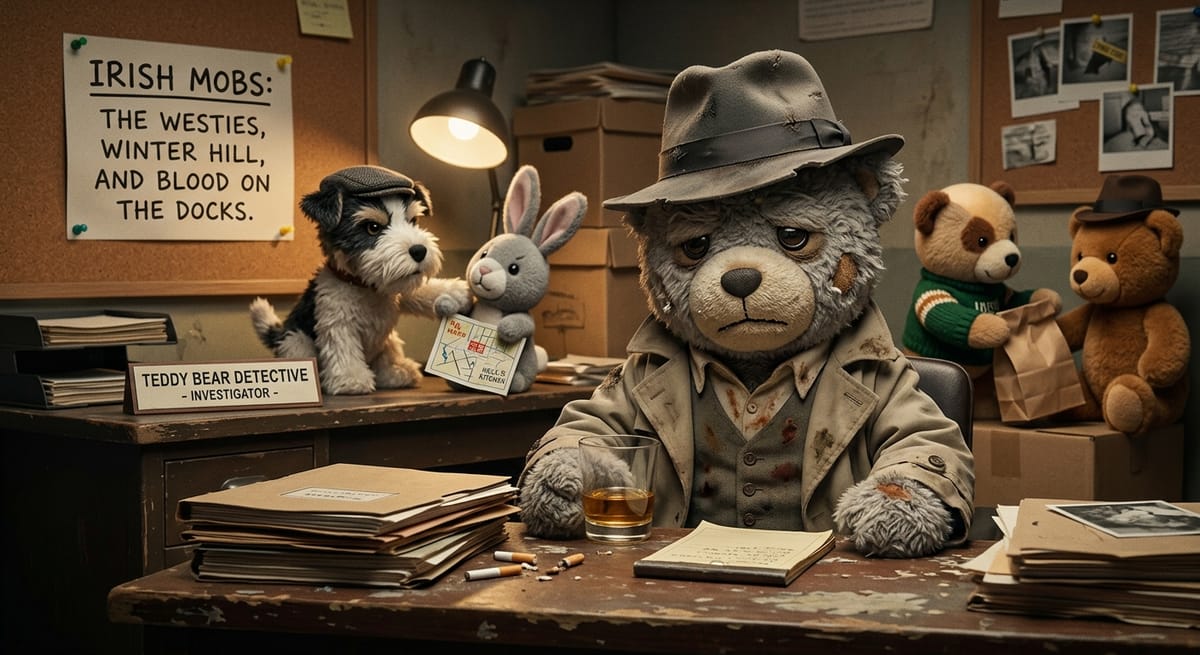
Irish Mobs: The Westies, Winter Hill, and Blood on the Docks
Irish-American organized crime in the twentieth century operated in the shadow of the Italian-American Mafia’s cultural dominance, but in specific cities and specific industries, it was the dominant criminal force. The Westies controlled Hell’s Kitchen in Manhattan with a ferocity that made the Italian families reluctant to challenge them directly. The Winter Hill Gang ran South Boston’s criminal economy for three decades. The waterfront union rackets that bled New York’s dockworkers for a generation were largely Irish-American enterprises.^1^ These were not minor footnotes to the organized crime story. They were the story in their territories.
Part of Other Organized Crime — ← Back to series hub
The Westies Operated Too Violently to Build What They Could Have Destroyed
The Westies took their name from their geography — the West Side of Manhattan, specifically the area north of Penn Station and south of 57th Street, known as Hell’s Kitchen. The neighborhood had been a working-class Irish enclave since the mid-nineteenth century and had produced street gangs continuously since then. What distinguished the Westies from their predecessors was the organizational structure — loose, decentralized, genuinely psychopathic in a way that the Italian-American families, with their emphasis on discipline and hierarchy, found both useful and terrifying.
Jimmy Coonan, who led the Westies from the early 1970s through his 1988 RICO conviction, and Mickey Featherstone, his chief enforcer, ran a crew that murdered for money, for personal disputes, and apparently sometimes for the pleasure of it. The FBI and New York police investigators documented that the Westies were in the practice of dismembering bodies after killings to prevent identification and complicate investigation — a practice that produced grim crime scene evidence and generated fear in their territory that no rival wished to test.^1^
The Westies entered into a formal arrangement with the Gambino family in the early 1980s, agreeing to perform contract murders for the Gambinos in exchange for a share of Gambino construction rackets in Manhattan. The arrangement was financially beneficial and operationally logical: the Gambinos needed contract killers with no traceable connection to their organization, and the Westies needed the legitimate economic protection that Gambino family relationships provided. Between 1982 and 1988, the arrangement produced several murders performed by Westies on Gambino contracts.^1^
The RICO prosecution of 1988 produced convictions of Coonan and Featherstone on murder, racketeering, and extortion charges. Featherstone became a government cooperating witness before trial, testifying against Coonan and other former associates. Coonan was convicted and sentenced to seventy-five years. The organization collapsed almost immediately after the convictions; without leadership and with the primary figures cooperating against each other, the Westies as a functioning criminal enterprise effectively ceased to exist by 1990.
Winter Hill Was More Durable Because It Had a Better Protector
The Winter Hill Gang, based in the Somerville neighborhood of Boston’s inner suburbs, was the dominant Irish-American criminal organization in New England from the late 1960s through Whitey Bulger’s flight in 1994. The organization predated Bulger and had its own distinct character.
The gang emerged from the Irish gang wars of the 1960s, a series of conflicts between competing Irish-American criminal factions in Boston and Somerville that produced over sixty murders between 1965 and 1975. The Winter Hill faction, led by Howie Winter from a garage in Somerville, eventually prevailed largely by outlasting the other factions and absorbing their members. By the mid-1970s, Winter Hill effectively controlled Irish-American organized crime in Greater Boston, with revenue from bookmaking, loan sharking, and extortion extending throughout the city.
The relationship between Winter Hill and the Patriarca family — the Italian-American mob that controlled New England organized crime officially — was one of subordination in theory and independence in practice. Winter Hill paid tribute to the Patriarcas and participated in Commission-sanctioned activities, but the gang’s actual operations in South Boston, Somerville, and Charlestown were essentially autonomous, with the Patriarcas having neither the presence nor the inclination to challenge it directly.^1^
The Waterfront Was Where Irish Organized Crime Had Its Longest Run
The waterfront organized crime that dominated New York Harbor for most of the twentieth century was not exclusively Irish, but Irish-American union officials and criminal figures were central to it for decades. The shape-up system — in which dockworkers competed daily for work assignments, with hiring bosses controlling who worked and extracting kickbacks — was the mechanism through which organized crime extracted money from the waterfront labor force.
The International Longshoremen’s Association locals in the New York harbor were controlled through a combination of Irish-American and Italian-American figures, with different locals reflecting different ethnic presences on specific piers. The Brooklyn piers were largely Italian-controlled through Gambino and Genovese family associates. The West Side Manhattan piers were more mixed, with Irish-American figures including those associated with the Westies holding positions in specific locals.
The 1953 Waterfront Crime Commission investigation — triggered by the Budd Schulberg articles in the New York Sun and the 1954 Elia Kazan film On the Waterfront, which was based on those articles — documented the shape-up system, the kickbacks, and the murders of union activists who challenged the arrangement in specific enough detail to produce state and federal reform legislation. The shape-up was abolished in New York in 1954, though the corruption persisted in modified forms for decades.^1^
Why Irish Organized Crime Didn’t Build a National Structure
The decline of Irish-American organized crime as a distinct force followed a path similar to the Italian-American families: RICO prosecutions, loss of territorial control, the impossibility of maintaining criminal enterprises in the face of sustained federal investigation. The Westies collapsed in 1988. Winter Hill fell apart after Bulger’s 1994 flight and Flemmi’s 1995 arrest. The waterfront rackets survived longer but contracted as containerization changed the economics of the docking business and removed the labor-intensive shape-up structure that had made them profitable.
What remained were smaller criminal operations in individual neighborhoods — loan sharks and bookmakers serving their traditional customers — without the territorial coherence or institutional depth that had characterized the organizations at their peak. The Irish-American neighborhood presence that had sustained the criminal structures contracted as the neighborhoods themselves changed. Hell’s Kitchen gentrified. South Boston diversified. The neighborhoods that had been the organizational base for decades became real estate.
The Irish organizations’ fundamental limitation was the same one that made them powerful: they were built around specific neighborhoods and specific people, without the national coordination structure that the Italian-American Commission provided. When the neighborhood changed or the leadership fell, there was nothing underneath to sustain the enterprise.
─────────
Sources:
- English, T.J. The Westies: Inside New York’s Irish Mob. St. Martin’s Press, 1990.
- Lehr, Dick, and Gerard O’Neill. Black Mass: The Irish Mob, the FBI, and a Devil’s Deal. PublicAffairs, 2000.
- Allen, Oliver E. The Tiger: The Rise and Fall of Tammany Hall. Addison-Wesley, 1993.
- Bell, Daniel. The End of Ideology: On the Exhaustion of Political Ideas in the Fifties. Free Press, 1960.