The War on Drugs: America's Longest Failed Experiment
Nixon declared the War on Drugs in 1971. Fifty years later drug use is higher the supply is more dangerous and the U.S. has incarcerated more people per capita than any country on earth.
The War on Drugs: America’s Longest Failed Experiment
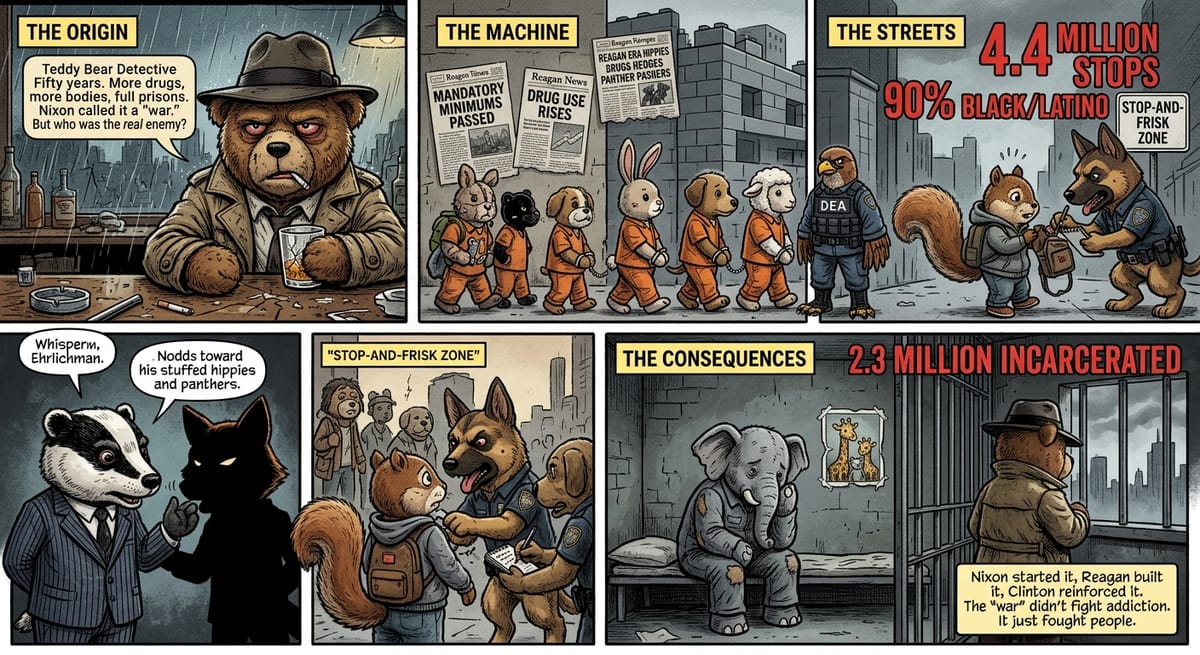
Richard Nixon declared the War on Drugs in 1971. More than fifty years later, drug use rates in the United States are higher than they were then, the drug supply is more diverse and more dangerous, and the country has incarcerated more people per capita than any nation on earth.^1^ The war did not achieve its stated objectives. What it did achieve — a prison population that reached 2.3 million by 2008, a racial caste system enforced through drug arrests, the militarization of domestic policing — was never a stated objective but was, in several respects, a predictable outcome of the tools that were chosen.
← Back to the Drug Trade section hub
In This Series
- Nixon’s War on Drugs: The Strategy Behind the Slogan — The DEA, the scheduling system, and what Ehrlichman actually admitted
- Mandatory Minimums: The Laws That Filled the Prisons — How the trigger system transferred power from judges to prosecutors
- Three Strikes Laws: Life Sentences for Petty Crime — California’s Proposition 184 and the life sentences it produced for pizza theft
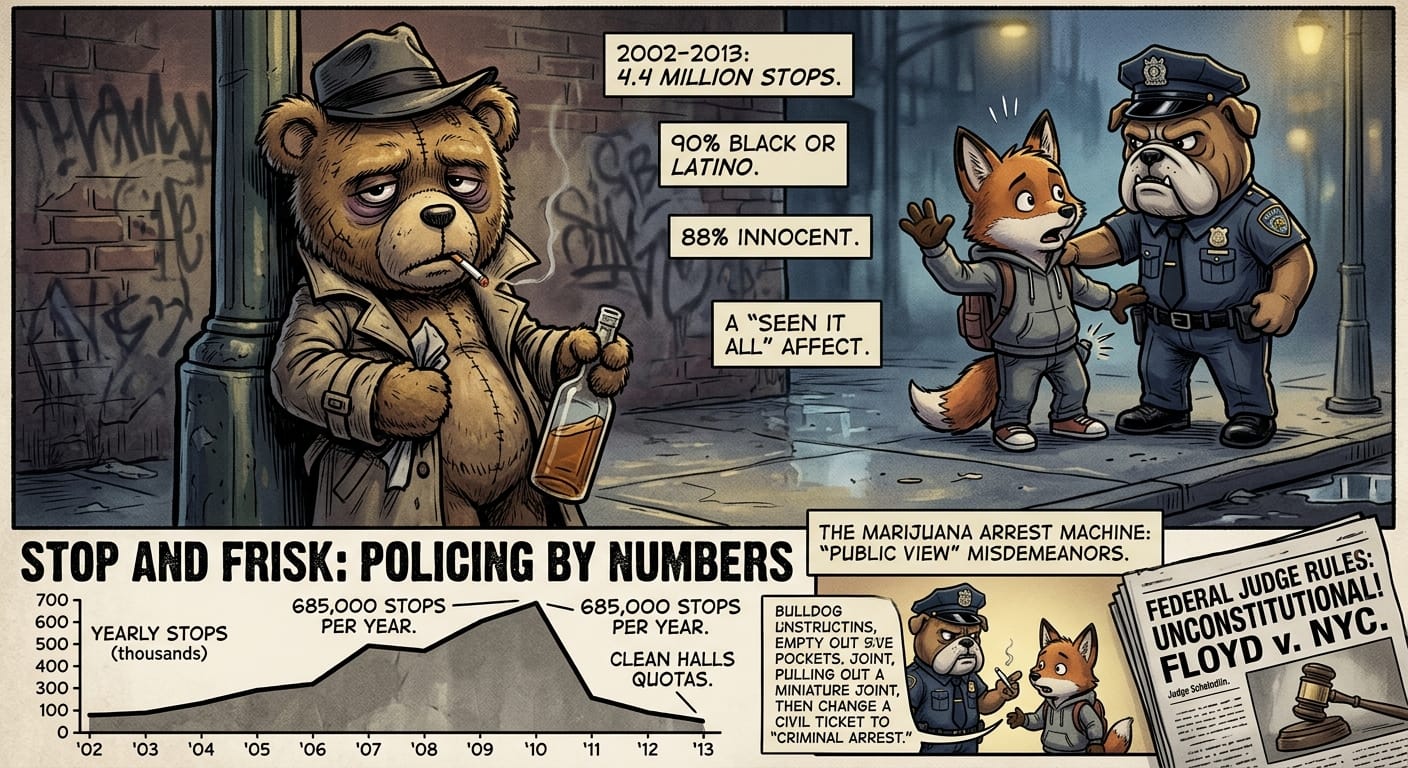
- Stop and Frisk: Policing by Numbers — 4.4 million stops, 90 percent Black and Latino, 88 percent found innocent
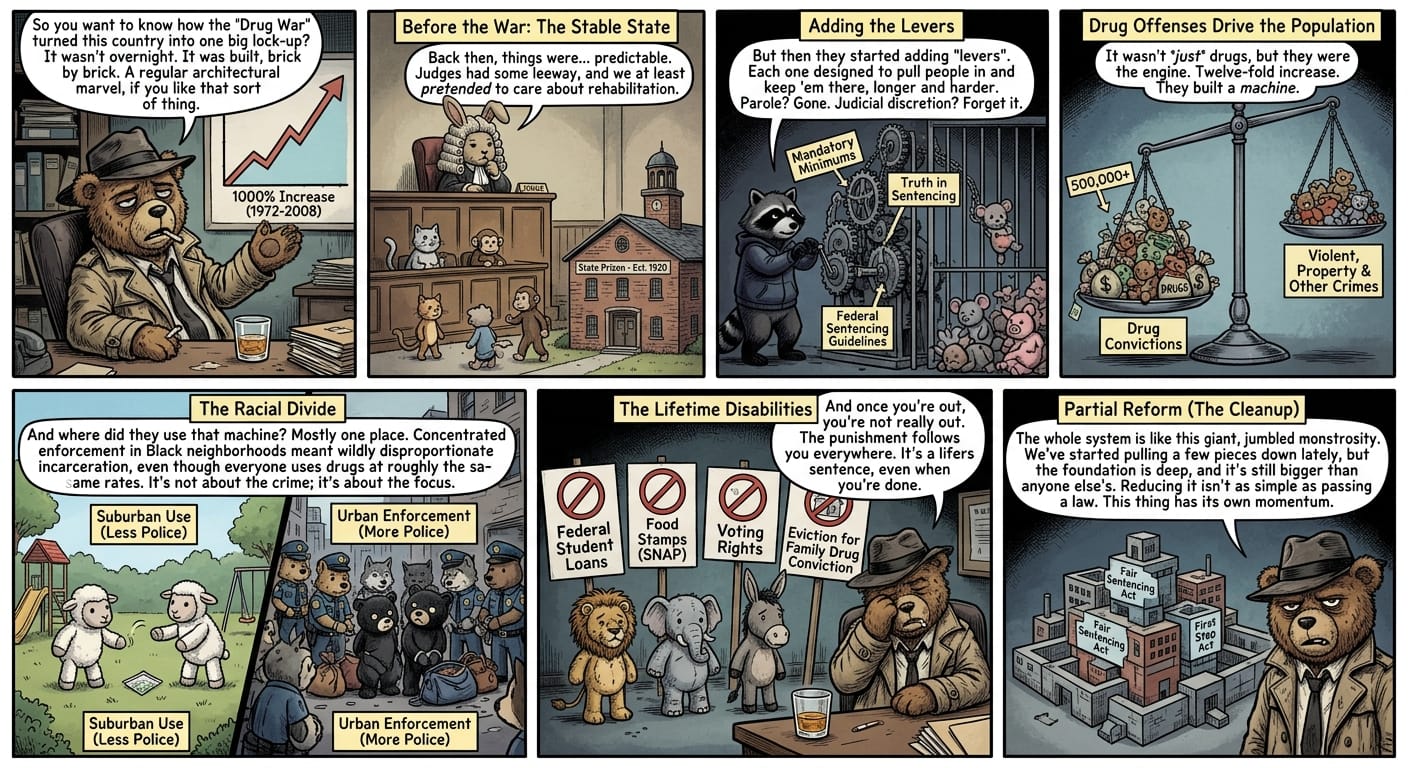
- Mass Incarceration: How the Drug War Built the Prison System — From 200,000 to 2.3 million, and what the collateral consequences cost
- Modern Drug Reform: Decriminalization and What Comes Next — Oregon’s Measure 110, the fentanyl disruption, and what has actually changed
The Policy Machine Nixon Built and Reagan Scaled
The six pieces in this series trace the War on Drugs through its structural components: origin, sentencing, policing, incarceration, and the partial reform that has followed. Read together, they describe a policy machine that was designed for different purposes than the ones it claimed and that produced its actual outcomes consistently, regardless of which party was in power.
Nixon built the framework: the DEA, the scheduling system, the rhetorical infrastructure that classified drug use as a criminal rather than medical problem. John Ehrlichman, his domestic policy chief, later said explicitly that the targeting of Black and antiwar communities was the political purpose underneath the public health language. The institution Nixon created — the Drug Enforcement Administration — began in 1973 with 1,470 agents and $75 million. By 2020 it employed more than 9,000 people in 86 countries.^2^
Reagan scaled the machine. The Anti-Drug Abuse Acts of 1986 and 1988 created mandatory minimums, established the 100-to-1 crack-to-powder sentencing disparity, and provided the legislative machinery for mass drug prosecutions. The federal drug budget quadrupled during his presidency. When he left office, the federal prison population had increased 65 percent.
The 1994 Crime Bill — signed by Bill Clinton, with strong support from Democrats who had watched the party lose on crime politics for a generation — added $9.7 billion for prison construction, created truth-in-sentencing requirements, and passed three-strikes provisions that produced life sentences for non-violent drug offenders in states that adopted the model.
What Mandatory Minimums and Three Strikes Built
Mandatory minimums did not reduce drug use. Every serious study of the relationship between sentence length and drug trafficking behavior has found that potential sentence length is not a significant deterrent for people entering the drug trade. What mandatory minimums did was transfer discretion from judges to prosecutors, enable the racial targeting of crack enforcement to produce dramatically disproportionate sentences for Black defendants, and fill prisons with low-level drug offenders while their supervisors cooperated their way to reduced sentences.
Three-strikes laws did not rehabilitate anyone or reduce recidivism. They produced life sentences for stealing pizza slices and 25-year-to-life terms for petty theft committed by people with prior records. They cost California billions of dollars. They were applied at rates 13 times higher against Black defendants than white defendants in Los Angeles County. California voters repealed the most extreme version in 2012 with 69 percent support.
Stop-and-frisk in New York produced 4.4 million stops between 2002 and 2013, 90 percent of them of Black and Latino New Yorkers, 88 percent of whom were found to have done nothing wrong. After Floyd v. City of New York ended the program, the violent crime rate did not increase. The program had not been keeping crime down. It had been conducting mass surveillance of Black and Latino communities under the language of public safety.
The People Who Served the Time
Mass incarceration — the product toward which all of these policies pointed — is often discussed in aggregate statistics: 2.3 million incarcerated at peak, six times the white incarceration rate for Black Americans, twelve-fold increase in drug offense imprisonments between 1980 and 2008.^3^ The aggregate is important. So are the names behind it. The people who lost decades of their lives to mandatory minimum sentences for drug offenses that would not have triggered equivalent sentences in any comparable democracy were human beings whose absence from their families and communities produced consequences that statistics do not capture: children raised without fathers, parents who aged in prison, neighborhoods that lost entire cohorts of young men to incarceration and returned them with felony records that foreclosed employment, housing, and civic participation.
Drug reform — modern decriminalization, the Fair Sentencing Act, the First Step Act, marijuana legalization — has produced partial and uneven improvement. The U.S. incarceration rate remains more than double its 1980 level. The structural conditions that made certain communities vulnerable to both drug markets and aggressive enforcement have not been changed by sentencing reform. The War on Drugs has partially demobilized. Its consequences are still being lived.
─────────
Sources:
- Alexander, Michelle. The New Jim Crow: Mass Incarceration in the Age of Colorblindness. The New Press, 2010.
- Baum, Dan. Smoke and Mirrors: The War on Drugs and the Politics of Failure. Little, Brown, 1996.
- The Sentencing Project. Trends in U.S. Corrections. The Sentencing Project, 2023.
The Series