Stop and Frisk: Policing by Numbers
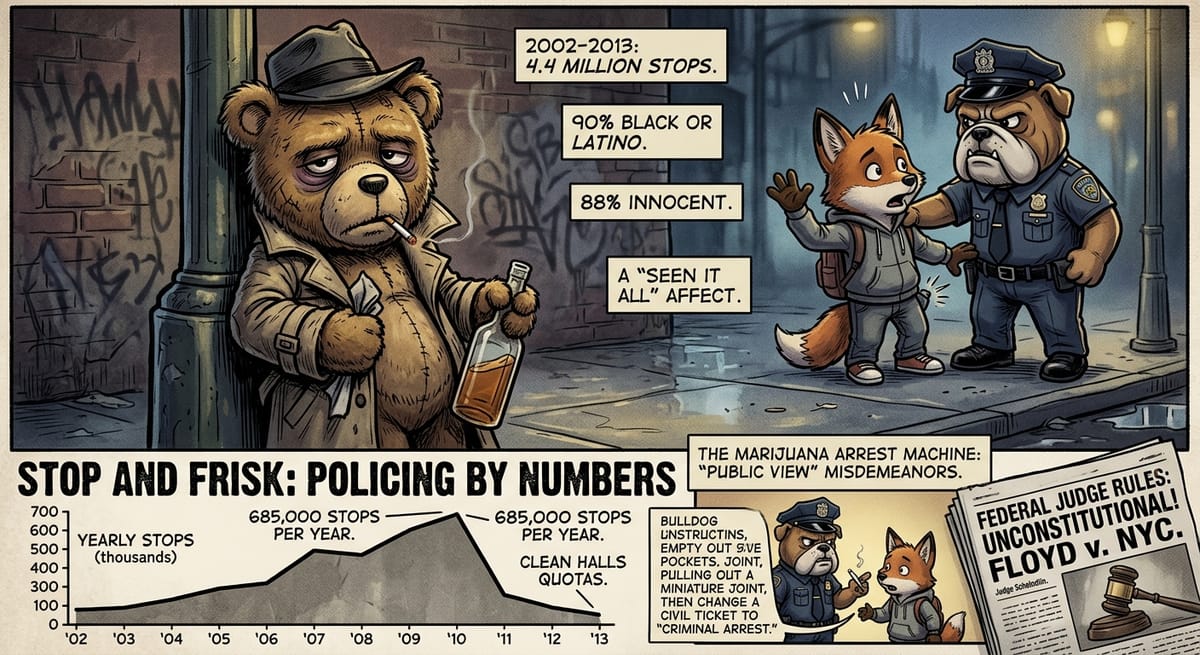
The NYPD conducted 4.4 million stop-and-frisk encounters between 2002 and 2013. Ninety percent targeted Black and Latino New Yorkers. Eighty-eight percent were found to have done nothing wrong.
Stop and Frisk: Policing by Numbers
Between 2002 and 2013, the New York City Police Department conducted approximately 4.4 million stop-and-frisk encounters — detaining people on the street, questioning them, and patting them down for weapons or contraband. Roughly 90 percent of those stopped were Black or Latino. Roughly 88 percent were found to have done nothing wrong.^1^ The program was the most visible and statistically documented manifestation of what the drug war looked like on the street: mass contact between police and civilians, applied with profound racial concentration, justified by the language of crime prevention.
Part of The War on Drugs — ← Back to series hub
What Legal Authority Made Stop and Frisk Possible
Stop and frisk rests on Terry v. Ohio, a 1968 Supreme Court decision that established the “reasonable suspicion” standard for police stops — a standard lower than the probable cause required for arrest. Under Terry, an officer who has reasonable suspicion that a person is about to commit, is committing, or has committed a crime may stop and briefly detain that person. If the officer also has reasonable suspicion that the person is armed and dangerous, the officer may conduct a limited pat-down for weapons.
New York’s application of this doctrine under Mayor Michael Bloomberg and Police Commissioner Raymond Kelly was codified in a department-wide program called Clean Halls and the broader stop-question-and-frisk program. NYPD officers were given productivity benchmarks — informal quotas, despite official denials — for stops, summonses, and arrests, a practice documented in recordings made by NYPD officer Adrian Schoolcraft, who secretly recorded roll call meetings in which supervisors pressured officers to meet numerical targets.
How Bloomberg Built It to 685,000 Stops Per Year
Bloomberg took office in January 2002. In that year, the NYPD recorded 97,296 stops. By 2011, the number had climbed to 685,724 — more than seven times the 2002 figure. The program’s internal justification was that it deterred gun carrying and reduced violent crime. Its critics pointed out that guns were recovered in less than 0.2 percent of stops in most years, and that violent crime was declining across comparable American cities that were not running stop-and-frisk programs at anything close to New York’s scale.^2^
The racial data was consistent and striking. In 2011, Black and Latino New Yorkers accounted for approximately 85 percent of stops, though they represented approximately 55 percent of the city’s population. White New Yorkers accounted for approximately 10 percent of stops while representing approximately 44 percent of the city’s population. The NYPD’s own internal analyses, introduced as evidence in litigation, showed that controlling for crime rates in specific precincts did not fully explain the racial disparity in stop rates.
How Stop and Frisk Became a Drug Arrest Machine
Stop and frisk was formally a crime prevention and gun interdiction tool, but its relationship to the drug war was direct. A significant share of the arrests and summonses generated by the program were for low-level marijuana possession — a misdemeanor in New York, technically requiring that the marijuana be “in public view” to be charged criminally rather than as a civil offense.
NYPD officers developed a practice of asking stopped individuals whether they had anything on them, then instructing them to empty their pockets when they said yes. When marijuana was removed from a pocket and held in the hand — now “in public view” — the charge shifted from a non-criminal civil infraction to a criminal misdemeanor arrest. The New York Civil Liberties Union documented this practice extensively, and it produced tens of thousands of marijuana misdemeanor arrests annually in the 2000s, the majority among Black and Latino young men in the Bronx and Brooklyn.^3^
In 2011, New York City arrested approximately 50,700 people for low-level marijuana possession, according to ACLU analysis — more marijuana arrests than any city in the world. Those arrests attached a criminal record that, for young men who were otherwise eligible for financial aid, housing assistance, and public employment, imposed the full suite of collateral consequences that follow any misdemeanor or felony drug conviction.
What Floyd v. City of New York Actually Found
The NYPD’s stop-and-frisk program was challenged in Floyd v. City of New York, a class-action lawsuit filed by the Center for Constitutional Rights in 2008. The plaintiffs argued that the program violated the Fourth Amendment’s prohibition on unreasonable search and seizure and the Fourteenth Amendment’s equal protection guarantee.
Federal Judge Shira Scheindlin ruled in August 2013 that the NYPD had violated the constitutional rights of the plaintiffs and ordered a federal monitor to oversee reforms. Her 195-page opinion reviewed years of stop data and concluded that “the City has adopted a policy of indirect racial profiling by targeting racially defined groups for stops based on local crime suspect data.”^4^ She found that officers had conducted stops without the reasonable suspicion legally required and that the Bloomberg administration had been deliberately indifferent to the constitutional violations.
Bloomberg’s administration appealed and sought to have Scheindlin removed from the case. Bill de Blasio, who ran for mayor in 2013 partly on a promise to end unconstitutional stop-and-frisk, dropped the appeal upon taking office in January 2014. Stops fell from 685,724 in 2011 to 22,939 in 2015 — a 97 percent reduction — without the violent crime wave that program defenders had predicted.
The Pattern Wasn’t Limited to New York
Stop-and-frisk as a policing strategy was not unique to New York. Similar programs, sometimes called “predictive policing” or “hot spot enforcement” or simply aggressive order-maintenance, operated in Chicago, Los Angeles, Baltimore, and other cities throughout the 2000s. Chicago’s version, documented in a 2015 ACLU study, produced 250,000 stops in a six-month period in 2014, with Black residents accounting for 72 percent of stops in a city that is approximately 32 percent Black.^5^
The pattern across cities was consistent: aggressive street-level policing concentrated in Black and Latino neighborhoods, justified by crime data that reflected where police were looking as much as where crime was occurring, producing drug arrests and minor offense charges without reducing violent crime at measurable rates. Stop-and-frisk in New York declined sharply after Floyd and the change of administration. Violent crime continued to decline after the program’s contraction — demonstrating, empirically, that the relationship between mass stop programs and crime rates was not what proponents claimed. What the program actually achieved was something different from deterrence: a condition in specific neighborhoods where young Black and Latino men were subject to repeated, humiliating police contact, carrying the constant possibility of arrest, in a way that had no analogue in other parts of the city. The drug war’s street-level expression was, in that sense, continuous with mass incarceration — different tool, same target, same result.
─────────
Sources:
- New York Civil Liberties Union. Stop and Frisk: The Human Impact. NYCLU, 2013.
- Center for Constitutional Rights. Stop and Frisk: The Story of an Ongoing Policy of Racial Profiling. CCR, 2012.
- Scheindlin, Shira. Opinion in Floyd v. City of New York, No. 08-CV-1034. United States District Court, Southern District of New York, August 12, 2013.
- ACLU of Illinois. Stop and Frisk in Chicago. ACLU of Illinois, 2015.
- Fagan, Jeffrey. “Terry’s Original Sin.” University of Chicago Legal Forum, 2016.