Nixon's War on Drugs: The Strategy Behind the Slogan
Nixon's own domestic policy chief admitted the War on Drugs was designed to target Black communities and antiwar activists — not protect public health. What Ehrlichman said and what Nixon actually built.
Nixon’s War on Drugs: The Strategy Behind the Slogan
The War on Drugs Nixon declared in 1971 was built on a political lie dressed in public health language. Richard Nixon called drug abuse “public enemy number one” on June 17, 1971, and the phrase entered the American lexicon. But Nixon’s own domestic policy chief later admitted that the war on drugs was designed to target Black communities and antiwar activists — not to protect public health.^1^ The institution Nixon built to fight that war now employs more than 9,000 people in 86 countries.
Part of The War on Drugs — ← Back to series hub
What Ehrlichman Actually Admitted
In 1994, journalist Dan Baum interviewed John Ehrlichman — Nixon’s domestic policy advisor, later imprisoned for Watergate — who was dying of cancer. What Ehrlichman said, as Baum reported it in a 2016 Harper’s Magazine article, was this:
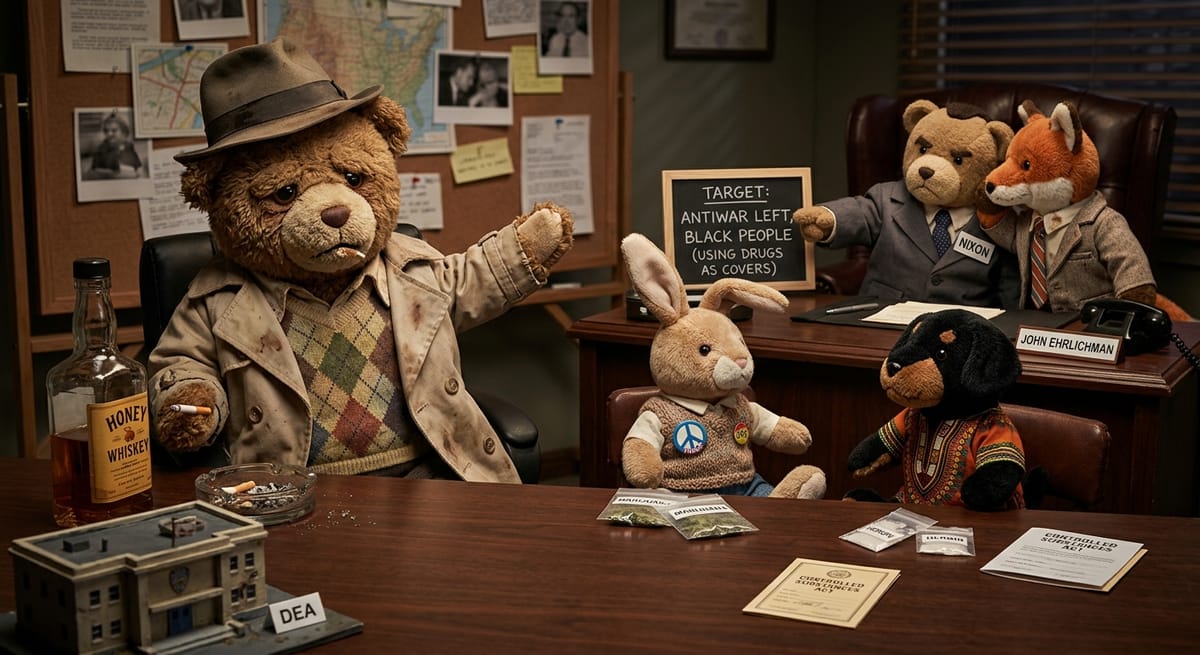
“The Nixon campaign in 1968, and the Nixon White House after that, had two enemies: the antiwar left and Black people. You understand what I’m saying? We knew we couldn’t make it illegal to be either against the war or Black, but by getting the public to associate the hippies with marijuana and Blacks with heroin, and then criminalizing both heavily, we could disrupt those communities. We could arrest their leaders, raid their homes, break up their meetings, and vilify them night after night on the evening news. Did we know we were lying about the drugs? Of course we did.”
Ehrlichman denied making this statement before his death. Baum has maintained the account is accurate. Whether the exact quotation is verbatim or reconstructed from notes, it is consistent with a substantial body of documented evidence about the political motivations behind Nixon’s drug policy, and it tracks what the Nixon administration actually did.^1^
Why 1971 Was the Right Moment for a Cynical Drug War
Nixon entered office in January 1969 having campaigned heavily on “law and order” — a phrase that his own campaign team understood was coded racial politics in the aftermath of the urban rebellions of 1967 and 1968 and the political mobilization of the Black Power movement. The anti-Vietnam War movement was simultaneously creating a political problem on the left: returning veterans, college campuses, and a growing counterculture were generating protest that the administration needed tools to disrupt.
Drugs served both purposes. By 1971, marijuana was associated in public perception primarily with the counterculture and the antiwar movement. Heroin was associated primarily with Black urban communities, in part because of high rates of addiction among Vietnam veterans returning to cities and in part because heroin had been a significant problem in urban Black communities since the 1950s. The Nixon administration’s decision to classify both as Schedule I substances — the most restrictive federal classification, reserved for drugs with “no accepted medical use” — and to create the federal infrastructure to prosecute them was not pharmacologically driven. It was political.
How the DEA Became a Permanent Institution
Nixon’s most lasting institutional contribution to the drug war was the creation of the Drug Enforcement Administration in July 1973. Before the DEA, federal drug enforcement was fragmented across multiple agencies — the Bureau of Narcotics and Dangerous Drugs, the Office of Drug Abuse Law Enforcement, the Office of National Narcotics Intelligence, and customs and Treasury enforcement units. Nixon consolidated them into a single agency with a unified mission and a direct line to the White House.
The DEA began operations with 1,470 special agents and a budget of approximately $75 million. By 2020, it employed more than 9,000 people — including roughly 4,600 special agents — and had a budget of approximately $3.1 billion. It operates in 86 countries.^2^ The agency Nixon created to fight a war that was, by his own team’s account, partly political has become one of the largest and most globally active law enforcement bureaucracies in the world.
What Did Nixon Actually Think About Heroin Addiction?
There was a genuine drug crisis woven into Nixon’s political calculations. Heroin addiction among American soldiers in Vietnam was a real and serious problem by 1970 and 1971. Congressional testimony and military reports estimated that between 10 and 15 percent of enlisted men in Vietnam were using heroin by 1971, with addiction rates particularly high in certain units.^3^
Nixon’s response to veteran heroin addiction was actually one of the more genuinely public health-oriented parts of his drug policy. He funded treatment programs and pushed for methadone maintenance as a harm reduction tool for veterans — a position that was, at the time, more progressive than his conservative base preferred. The distinction between how Nixon treated veteran heroin addiction — as a health problem requiring treatment — and how his administration treated urban heroin addiction — as a criminal problem requiring enforcement — was not lost on observers at the time and says something legible about whose suffering generated sympathy.
The Controlled Substances Act Locked In the Framework
The Controlled Substances Act, signed into law on October 27, 1970, created the federal drug scheduling system that remains operative today. It established five schedules based on a combination of medical utility and abuse potential. Schedule I — the highest restriction — covers drugs deemed to have no accepted medical use and high abuse potential, including heroin, LSD, and marijuana. Schedule II covers drugs with accepted medical uses but high abuse potential, including cocaine, methamphetamine, and opioids like oxycodone.
The placement of marijuana in Schedule I was explicitly contested within the administration. Nixon had appointed the Shafer Commission to evaluate marijuana’s appropriate legal status. In March 1972, the Shafer Commission released its report recommending that marijuana be decriminalized for personal use. Nixon rejected the recommendation publicly and privately. Oval Office tapes from 1971 and 1972, released decades later, document Nixon’s contempt for the commission’s work and his insistence that marijuana remain a criminal matter regardless of the evidence.^4^
Nixon’s Template Outlasted His Presidency
Nixon’s War on Drugs established the template that every subsequent administration would either extend or partially modify but never fundamentally reject. That template includes: federal scheduling as the mechanism for classifying drugs; criminal prosecution rather than public health treatment as the primary policy response; DEA enforcement as the operational infrastructure; and the rhetorical framing of drug use as a moral and criminal problem rather than a medical one. Nixon also established the precedent of using drug enforcement as a political instrument — targeting communities and movements that threatened the existing power structure under the neutral-sounding language of law enforcement.
The War on Drugs Nixon declared in 1971 did not reduce drug use in America. Drug use rates have fluctuated over the past fifty years in response to generational patterns, economic conditions, pharmaceutical industry behavior, and cultural shifts — none of which correlate reliably with the intensity of federal drug enforcement. What the war did was build the infrastructure — the DEA, the scheduling system, the criminal justice pipeline — that every subsequent drug crisis ran through. Nixon is not responsible for everything that happened in that pipeline after he left. He built the pipe. Reagan would scale it with mandatory minimums and a budget that quadrupled over eight years. The mass incarceration that followed was the predictable result.
─────────
Sources:
- Baum, Dan. “Legalize It All.” Harper’s Magazine, April 2016.
- Baum, Dan. Smoke and Mirrors: The War on Drugs and the Politics of Failure. Little, Brown, 1996.
- Musto, David. The American Disease: Origins of Narcotic Control. Oxford University Press, 1987.
- Massing, Michael. The Fix. Simon & Schuster, 1998.
- Schlosser, Eric. Reefer Madness: Sex, Drugs, and Cheap Labor in the American Black Market. Houghton Mifflin, 2003.