The Triangle Shirtwaist Fire: 146 Dead Because the Doors Were Locked
On March 25, 1911, 146 workers died in 18 minutes at the Triangle Shirtwaist factory because the exit doors were locked. The owners were tried and acquitted.
The Triangle Shirtwaist Fire: 146 Dead Because the Doors Were Locked
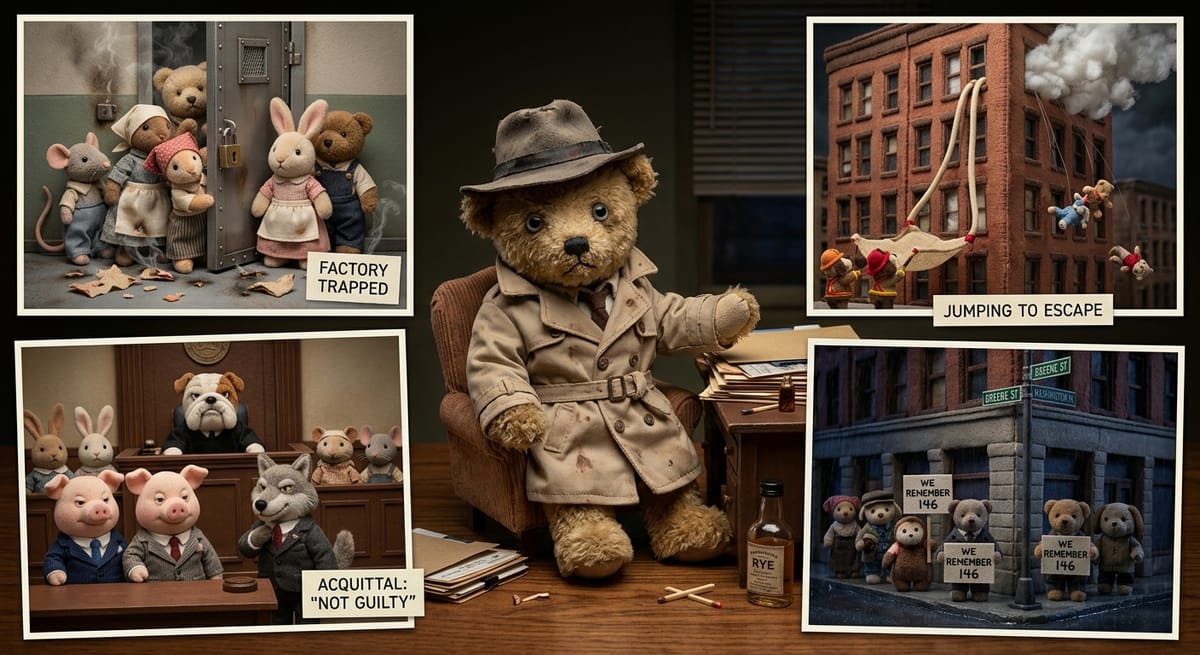
The Triangle Shirtwaist Fire is the clearest case of employer negligence killing workers at industrial scale. On Saturday, March 25, 1911, a fire broke out on the eighth floor of the Asch Building in Greenwich Village. The factory owners had locked the exit doors to prevent workers from taking unauthorized breaks or stealing fabric. Within eighteen minutes, 146 workers were dead — most of them young immigrant women who had jumped from ninth-floor windows rather than burn. The owners were acquitted. They collected more from their insurance company than they lost.
Who Worked Inside the Triangle Factory
The Triangle Waist Company occupied the top three floors of the ten-story Asch Building at the corner of Greene Street and Washington Place. It was owned by Isaac Harris and Max Blanck, two Russian Jewish immigrants who had built one of the largest shirtwaist manufacturing operations in New York City. Their factory employed approximately 500 workers, most of them Italian and Jewish immigrant women between the ages of 14 and 23.
The shirtwaist industry had been at the center of New York’s labor movement for several years. In the winter of 1909–1910, more than 20,000 garment workers — the overwhelming majority of them young women — had gone on strike in what became known as the “Uprising of the 20,000.” Triangle workers had participated. Harris and Blanck had settled with the union, agreeing to certain wage improvements but refusing to recognize the International Ladies’ Garment Workers’ Union.
The conditions in the Asch Building that Saturday afternoon were typical of the industry. The cutting tables were covered in scrap fabric and tissue patterns. Bins beneath the tables held months of accumulated trimmings. Wooden floors, wooden furniture, and thin cotton fabric everywhere — and one fire escape, which was not wide enough for the workers using it. It collapsed under the weight of the fleeing women.^1^
Why 146 People Died While the Building Was Still Standing
The fire started near a cutting table on the eighth floor, probably from a discarded cigarette or match. It spread almost instantly, fed by the fabric scraps. Workers on the eighth floor managed to escape in large numbers — they were able to use the stairs before the fire cut them off, or climb to the roof with help from New York University students on the floor above. On the ninth floor, where approximately 250 workers had been sewing, the situation was different.
The stairwell doors opened inward and were locked from the outside. Workers who reached the doors found them immovable. The fire escape, when they found it, was a narrow ladder mounted on the exterior of the building that twisted under heat and gave way, dropping survivors onto the concrete of the courtyard below.^2^
The fire department arrived quickly. Their ladders reached only to the sixth floor. Onlookers on the street below watched workers jump from the ninth-floor windows — some in pairs, holding hands. The bodies landed on the pavement and in front of the fire trucks. The life nets the department stretched could not hold a person falling from nine stories.
The fire was extinguished within thirty minutes. The dead included 123 women and 23 men. The youngest was 14-year-old Kate Leone. The oldest was Providenza Panno, 43.^3^
What Did the Acquittal of Harris and Blanck Actually Mean?
Harris and Blanck were indicted on charges of first- and second-degree manslaughter. The prosecution’s case rested on proving that the two men knew the doors on the ninth floor were kept locked during working hours. A former Triangle worker named Kate Alterman testified to exactly that — she had been locked out of the stairwell by a locked door during the fire, survived by finding an open elevator, and described the practice clearly.
The defense produced witnesses who contradicted her testimony and argued that the door in question might have been locked accidentally or by someone other than the owners. The jury, after deliberating for nearly two hours, acquitted both men. The verdict prompted protests across the city.^4^
Harris and Blanck later settled civil suits brought by the families of the dead for $75 per victim — a sum the factory owners collected in full from their insurance company, which paid out approximately $60,000 more than their losses.
The Fire’s Aftermath Rewrote New York’s Labor Laws
The Triangle fire killed 146 workers in eighteen minutes because of unsafe conditions that were standard in the industry and that government inspectors had done nothing to change. The political aftermath was shaped almost entirely by two men: State Assemblyman Al Smith and State Senator Robert F. Wagner, who used the Factory Investigating Commission created in the fire’s aftermath to document working conditions across New York’s industrial sector.
Over the following four years, the commission’s work produced 36 new laws covering factory safety, fire prevention, working hours for women and children, sanitation standards, and a host of other workplace conditions. Frances Perkins — a young social reformer who watched women jump from the Triangle building from the street below — later became Franklin Roosevelt’s Secretary of Labor and the architect of much of the New Deal’s labor legislation.^5^
The bodies of seven of the victims were never identified. They were buried in the Evergreens Cemetery in Brooklyn in a public funeral attended by 80,000 people. Every year, on March 25, workers’ organizations gather at the Asch Building — now owned by New York University and renamed the Brown Building — and read the names of the 146 dead aloud.
The owners locked the doors because they didn’t trust their workers. The Triangle fire belongs alongside Ludlow and Lattimer as evidence that employer indifference to workers’ lives was not an accident — it was a cost calculation. The broader context for all of these events is in the Labor Wars series hub.
─────────
Part of America’s Labor Wars — ← Back to series hub
Sources:
- Von Drehle, David. Triangle: The Fire That Changed America. Atlantic Monthly Press, 2003.
- Stein, Leon. The Triangle Fire. Cornell University Press, 1962.
- Kheel Center for Labor-Management Documentation and Archives. Triangle Shirtwaist Factory Fire. Cornell University ILR School, 2011.
- McEvoy, Arthur F. “The Triangle Shirtwaist Factory Fire of 1911: Social Change, Industrial Accidents, and the Evolution of Common-Sense Causality.” Law & Social Inquiry 20, no. 2 (1995).
- Downey, Kirstin. The Woman Behind the New Deal: The Life of Frances Perkins, FDR’s Secretary of Labor and His Moral Conscience. Nan A. Talese/Doubleday, 2009.