The Lattimer Massacre: Immigrant Miners Shot Down by Deputies
In 1897, Pennsylvania deputies shot unarmed immigrant miners near Lattimer. Nineteen died, mostly shot in the back. All 73 charged deputies were acquitted.
The Lattimer Massacre: Immigrant Miners Shot Down by Deputies
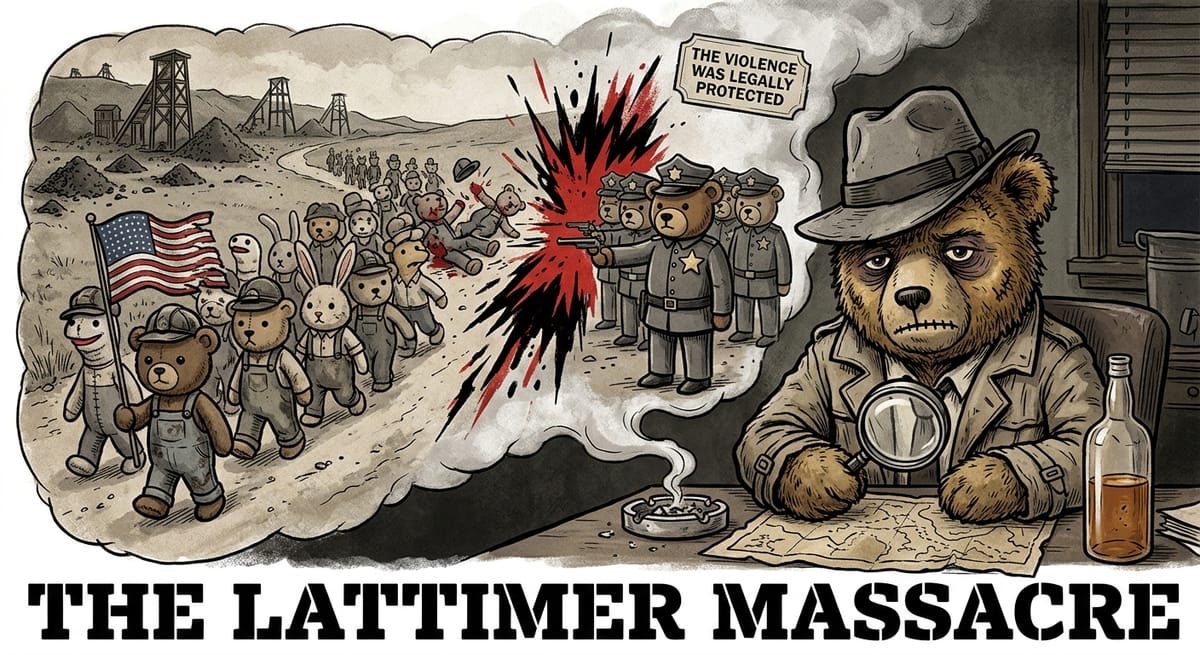
The Lattimer Massacre of 1897 demonstrates that the violence used against labor organizers was not incidental to American industrial capitalism — it was legally protected. On September 10, 1897, a column of unarmed immigrant miners marching on a public road in Luzerne County, Pennsylvania, was met by Sheriff James Martin and roughly 150 deputies. When the shooting stopped, 19 miners were dead and 36 more were wounded — nearly all shot in the back. Every deputy was acquitted. Not a single family of the dead received compensation.
The Anthracite Fields Were Built on Immigrant Labor Nobody Organized
The hard-coal region of northeastern Pennsylvania was, by the 1890s, one of the most heavily immigrant industrial workplaces in the United States. Polish, Slovak, Lithuanian, Hungarian, Italian, and Ukrainian miners had poured into the region over the preceding two decades, drawn by the same coal companies that had exhausted the native-born labor supply. By 1897, Slavic immigrants made up roughly 40 percent of the anthracite workforce.
These new immigrants occupied the lowest rungs of the mine’s labor hierarchy: they were the “greenhorn” workers who did the most dangerous underground labor — loading coal, timbering, handling blasting — and received the lowest pay. The older Welsh, Irish, and English miners who dominated the higher-skilled positions, and who had organized the Miners’ and Mine Laborers’ Protective Association years earlier, made little effort to include the newcomers.
In August 1897, a wave of spontaneous strikes broke out across the anthracite fields, driven largely by these newer immigrant workers. The strikes were loosely organized and moved from mine to mine as marching columns of workers traveled the roads between collieries, calling out workers at each stop. The United Mine Workers of America had almost no presence in the region at the time.^1^
Who Were the Men Marching Toward Lattimer?
On the morning of September 10, 1897, roughly 400 miners — mostly Polish and Slovak workers from the Harwood and Cranberry areas — assembled and began marching toward Lattimer, about two miles away. They were unarmed. They carried an American flag.
Sheriff Martin intercepted them on the road before they reached the mine, reading a proclamation ordering them to disperse. The marchers refused, asserting their right to use a public road. Some accounts describe the crowd as taunting the deputies. No account credibly describes them as threatening violence — they had no weapons.
The shooting started from the deputies’ side. The exact sequence is disputed, but within seconds, deputies were firing into the column from multiple directions. Many of the men killed were shot in the back while running. Michael Cheslak, a Polish miner from Harwood, was shot three times in the back at close range. Martin Sheftic, a Slovak miner, died of a wound to the spine. The youngest victim was a 19-year-old named John Eagler.^2^
Why Did Every Deputy Walk Free?
Sheriff Martin and 73 of his deputies were charged with murder. The trial was held in Wilkes-Barre in February and March of 1898. The defense argued that the deputies had acted in self-defense and were justified in using lethal force to disperse an illegal assembly. The prosecution countered that the miners had a legal right to march on a public road and that the shooting was unprovoked.
The jury deliberated for less than three hours and acquitted all defendants. Not a single deputy was convicted.^3^
The verdict was not surprising. The jury was composed of native-born Americans with no connection to the immigrant mining communities. The defendants were agents of local government. The dead were Polish and Slovak workers whose names the local press frequently misspelled.
Lattimer’s Legacy Was Not Justice — It Was Radicalization
The Lattimer Massacre had an effect its perpetrators did not intend. It radicalized immigrant miners across the anthracite region in a way that years of organizing had failed to do. The United Mine Workers moved aggressively into the area in 1897 and 1898, finding a workforce ready to organize. The 1900 anthracite strike and the far larger 1902 anthracite strike — which lasted 163 days and brought President Theodore Roosevelt directly into mediation — both drew from the organizational base built in the aftermath of Lattimer.^4^
The 1902 strike ended with a federal commission awarding miners a 10 percent wage increase and a nine-hour day, though not formal union recognition. It was the first major labor dispute in which the federal government mediated rather than simply suppressing the workers. The miners who had been shot at Lattimer five years earlier made that outcome possible by surviving — and by remembering.
The site of the massacre in Lattimer Mines, Pennsylvania, is marked by a small granite monument erected in 1972 by Polish and Slovak fraternal organizations. For 75 years, the event had no public marker. The names of the dead are listed on the stone: Michal Cheslock, Jan Slobodnik, Jan Terri, and sixteen others — names that American newspapers could barely be bothered to spell correctly in 1897.
The acquittal pattern at Lattimer mirrors what happened at Homestead and what would happen again at Ludlow: when employers or their agents killed workers, the legal system found reasons not to convict. The full series context is at the Labor Wars hub.
─────────
Part of America’s Labor Wars — ← Back to series hub
Sources:
- Novak, Michael. The Guns of Lattimer. Basic Books, 1978.
- Dublin, Thomas, and Walter Licht. The Face of Decline: The Pennsylvania Anthracite Region in the Twentieth Century. Cornell University Press, 2005.
- Pinkowski, Edward. Lattimer Massacre. Sunshine Press, 1950.
- Miller, Donald L., and Richard E. Sharpless. The Kingdom of Coal: Work, Enterprise, and Ethnic Communities in the Mine Fields. University of Pennsylvania Press, 1985.